1. a common diatomic gas sample weighing 1.561 g fills a balloon to 1.35 L at...
1. a common diatomic gas sample weighing 1.561 g fills a balloon to 1.35 L at STP. compute the molar mass of the gas and identify it
2. how many electrons in an atom can have quantum numbers :
a. n=2
b. n=3 and ms=+1/2
c. n=1 and l=1
Homework Answers
1.
Assuming the gas obey's ideal gas law
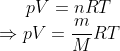
Where m = mass = 1.561 g
M = molar mass of the gas
p = standard pressure = 1 bar
T = standard temperature = 273.15 K
V = Volume = 1.35 L
R = gas constant = 
Hence, solving the ideal gas equation we get

The closest diatomic molecule with similar molar mass is
 with molar mass of 28 g/mol.
Hence, the gas must be nitrogen.
2.
a. for n=2
The allowed values of l are 0 and 1.
The corresponding orbitals are 2s and three degenerate 2p orbitals.
Hence, total number of electrons that can have n=2
is 
Alternatively, for any shell n, the number of electrons it can
hold is given by .
.
Hence, for n=2 
b. for n=3 and m_s = +1/2
Lets calculate the number of electrons with n=3 first.

Now, exactly half of those electrons will have spin up (m_s = +1/2) and other half will have spin down(m_s = -1/2).
Hence, the required number of electrons with quantum numbers n=3 and m_s = +1/2 is

c. n=1 and l =1
Note that for n=1, the allowed values of l is from 0 to n-1. i.e only possible value of l = 0.
Hence, no electron can have n=1 and l=1.
Hence, 0 electrons can have n=1 and l=1.
Add Answer to:
1. a common diatomic gas sample weighing 1.561 g fills a balloon
to 1.35 L at...
Step 1: A 10.83 g sample of a diatomic gas has a volume of 10.10 L...
Step 1: A 10.83 g sample of a diatomic gas has a volume of 10.10 L at STP. What is the molar mass of this gas? Step 2 :Identify this gas
A sample of gas fills a 475.0 L balloon at STP. If the balloon is allowed...
 A sample of gas fills a 475.0 L balloon at STP. If the balloon is allowed to warm to 42°C as it floats up and the pressure changes to 357 torr what is the new volume of the balloon? Show your work for full credit. oufransware
A sample of gas fills a 475.0 L balloon at STP. If the balloon is allowed...
 A sample of gas fills a 475.0 L balloon at STP. If the balloon is allowed to warm to 42°C as it floats up and the pressure changes to 357 torr what is the new volume of the balloon? Show your work for full credit. Youtranswar here
A sample of gas fills a 475.0 L balloon at STP. If the balloon is allowed...
 A sample of gas fills a 475.0 L balloon at STP. If the balloon is allowed to warm to 42°C as it floats up and the pressure changes to 357 torr what is the new volume of the balloon? Show your work for full credit. Enter your answer here
A 2.73 g sample of a diatomic gas in a 1.50 L container has a pressure...
A 2.73 g sample of a diatomic gas in a 1.50 L container has a pressure of 2.50 atm at 535 K. Determine the identity of the gas. (Some slight rounding may be required.) Molar mass in g/mol: H = 1.01, N = 14.01, Cl = 35.45, O = 16.00, F = 19.00
< Question 6 of 9 > A 1.35 g sample of an unknown gas at 81...
 < Question 6 of 9 > A 1.35 g sample of an unknown gas at 81 °C and 1.00 atm is stored in a 2.05 L flask. What is the density of the gas? density: g/L What is the molar mass of the gas? molar mass: g/mol
A 1.35 g sample of an unknown gas at 29 °C and 1.10 atm is stored...
 A 1.35 g sample of an unknown gas at 29 °C and 1.10 atm is stored in a 1.95 L flask. What is the density of the gas? density: What is the molar mass of the gas? g/mol molar mass:
9. The density of a diatomic gas is 1.634 g/L at 1.50 atm and 40.0°C. Calculate the molar mass of the gas, and use the...
 9. The density of a diatomic gas is 1.634 g/L at 1.50 atm and 40.0°C. Calculate the molar mass of the gas, and use the periodic table to identify the gas (10 pts)
A gas mixture is made by combining 5.2 g each of Ar, Ne, and an unknown...
 A gas mixture is made by combining 5.2 g each of Ar, Ne, and an unknown diatomic gas. At STP, the mixture occupies a volume of 12.85 L. What is the molar mass of the unknown gas? molar mass: g/mol Identify the unknown gas. Oo, Och, OF, OH, ON,
Question 10 of 22 A 4.05 g sample of an unknown gas at 35 °C and...
 Question 10 of 22 A 4.05 g sample of an unknown gas at 35 °C and 1.05 atm is stored in a 2.15 L flask. What is the density of the gas? density: 1.88372 g/L What is the molar mass of the gas? molar mass: g/mol Incorrect Question 14 of 22 A gas mixture is made by combining 6.7 g each of Ar, Ne, and an unknown diatomic gas. At STP, the mixture occupies a volume of 15.14 L. What...
 A sample of gas fills a 475.0 L balloon at STP. If the balloon is allowed to warm to 42°C as it floats up and the pressure changes to 357 torr what is the new volume of the balloon? Show your work for full credit. oufransware
 A sample of gas fills a 475.0 L balloon at STP. If the balloon is allowed to warm to 42°C as it floats up and the pressure changes to 357 torr what is the new volume of the balloon? Show your work for full credit. Youtranswar here
 A sample of gas fills a 475.0 L balloon at STP. If the balloon is allowed to warm to 42°C as it floats up and the pressure changes to 357 torr what is the new volume of the balloon? Show your work for full credit. Enter your answer here
 < Question 6 of 9 > A 1.35 g sample of an unknown gas at 81 °C and 1.00 atm is stored in a 2.05 L flask. What is the density of the gas? density: g/L What is the molar mass of the gas? molar mass: g/mol
 A 1.35 g sample of an unknown gas at 29 °C and 1.10 atm is stored in a 1.95 L flask. What is the density of the gas? density: What is the molar mass of the gas? g/mol molar mass:
 9. The density of a diatomic gas is 1.634 g/L at 1.50 atm and 40.0°C. Calculate the molar mass of the gas, and use the periodic table to identify the gas (10 pts)
 A gas mixture is made by combining 5.2 g each of Ar, Ne, and an unknown diatomic gas. At STP, the mixture occupies a volume of 12.85 L. What is the molar mass of the unknown gas? molar mass: g/mol Identify the unknown gas. Oo, Och, OF, OH, ON,
 Question 10 of 22 A 4.05 g sample of an unknown gas at 35 °C and 1.05 atm is stored in a 2.15 L flask. What is the density of the gas? density: 1.88372 g/L What is the molar mass of the gas? molar mass: g/mol Incorrect Question 14 of 22 A gas mixture is made by combining 6.7 g each of Ar, Ne, and an unknown diatomic gas. At STP, the mixture occupies a volume of 15.14 L. What...
Most questions answered within 3 hours.
-
Where is the error in this code sequence?
String s1 = "Hello";
String s2 = "ello";...
asked 11 months ago -
Financial data for Joel de Paris, Inc., for last year
follow:
Joel de Paris, Inc.
Balance...
asked 11 months ago -
Consider this reaction:
Al2(SO4)3 (aq)+ BaCl3
(aq) Al2Cl6 (aq)- +
3BaSO4(s) . What is the...
asked 11 months ago -
Suppose that Savneet is considering increasing her
recent random sample from 20 car rentals to 40...
asked 11 months ago -
Trucks arrive at an unloading terminal at an average rate of 120
per hour.
Trucks arrive...
asked 11 months ago -
Why are methanol and ethanol completely soluble in water while
octanol is not very little soluble....
asked 11 months ago -
A facilities manager at a university reads in a research report
that the mean amount of...
asked 11 months ago -
When the CuSO4 is rehydrated by adding water to the anhydrous
compound, is this an endothermic...
asked 11 months ago -
A ray of sunlight is passing from diamond into crown glass; the
angle of incidence is...
asked 11 months ago -
A block of mass 0.249 kg is placed on top of a light, vertical
spring of...
asked 11 months ago -
how do the kidneys compensate in the presences of acidosis
a) trigger hyperventilate
b) reserve acid...
asked 11 months ago -
Question 501 pts
The rental rate of capital to the firm increases. Which of the
following...
asked 11 months ago