A car is travelling at a flat circular track of radius 25 m and tries to...
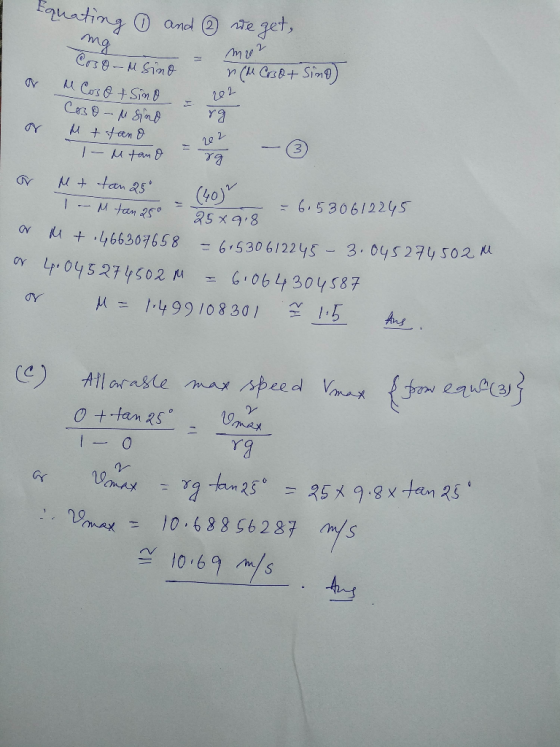
A car is travelling at a flat circular track of radius 25 m and tries to go around at 40 m/sec. a) What should the coefficient of static friction be so the car won’t skid? b) Assume the same car is now travelling at a banked circular track at angle 25o , r=25 m and with same speed. What’s the value of the coefficient of static friction in order for the car not to slide down? c) What would the allowable max speed vmax be if now we assume zero friction at the banked curve?
Homework Answers
In this case necessary centripetal force of the car will be
provided by force of friction acting towards
center 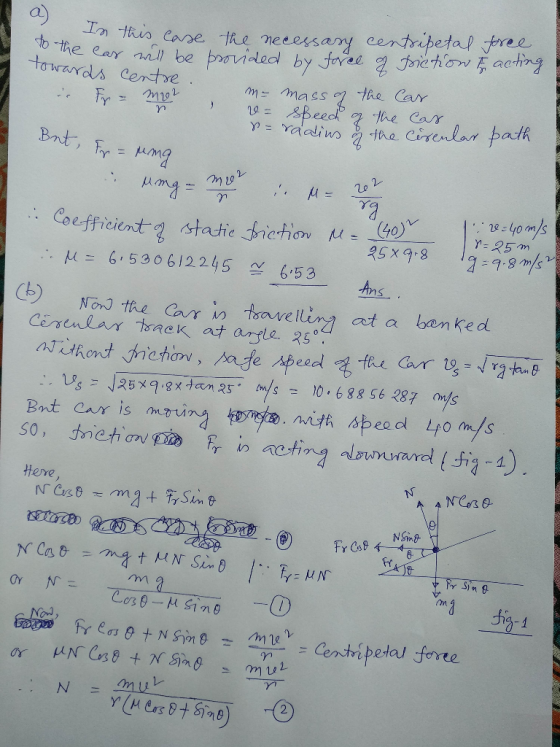
Add Answer to:
A car is travelling at a flat circular track of radius 25 m and
tries to...
A car drives around a flat 119 m radius circular track at 20 m/s. Assume that...
A car drives around a flat 119 m radius circular track at 20 m/s. Assume that this speed is the maximum speed that the car can have without out "skidding out" of the curve.The car moves into the next curve. The radius of this new curve is twice as great as the previous. Assume the coefficient of static friction has not changed. Calculate the car's maximum speed in this curve. m/s
A car travels around flat, un-banked, circular track with a maximum speed of 20 m/s. If...
A car travels around flat, un-banked, circular track with a maximum speed of 20 m/s. If the coefficient of friction between the car tires and the track is 1.0, and the normal force between the car and the track is due to the weight of the car (no aerodynamic effects), what is the radius of the track?
A car on a flat circular track with a radius of 1.00km completes a circuit every...
A car on a flat circular track with a radius of 1.00km completes a circuit every 100.0s. (a) What is the speed of the car in mph? (b) What is the centripetal acceleration of the car in m/s2? (c) On a rainy day, the car is traveling around the track with faster and faster speed. At 72.4 mph the car loses control and slides off the track. What is the coefficient of static friction?
10) A car is travelling around a circular level road with friction (traffic circle). The radius...
10) A car is travelling around a circular level road with friction (traffic circle). The radius of the circle is 4 meters and at a speed of 6.5 m/s the car just starts to skid off the road. What is the coefficient of static friction?
10) A car is travelling around a circular level road with friction (traffic circle). The radius...
10) A car is travelling around a circular level road with friction (traffic circle). The radius of the circle is 3 meters and at a speed of 4.1 m/s the car just starts to skid off the road. What is the coefficient of static friction?
You try drive a car with mass 470kg at 40km/h around a circular track of radius...
You try drive a car with mass 470kg at 40km/h around a circular track of radius 30m. A) What is the centripetal force on required to hold the car in this circular B) The track is banked at an angle of 12 degrees. What size is the friction force preventing the car sliding up the slope? C) If there is a coefficient of maximum static friction of 0.01, can you make the turn or will your car skid?
3. A car is driving at a speed of 20 m/sec on a circular horizontal flat...
 3. A car is driving at a speed of 20 m/sec on a circular horizontal flat (unbanked) road of radius 200 m. (a) What minimum coefficient of static friction will permit the car to follow the circular path without skidding? (b) If the road had a radius of 32 m, what is the maximum speed of the car without skidding? (c) If the road was banked (not flat), could the car go faster? Explain your answer Possibly (but not necessarily)...
An 800. kg racecar travels on a flat circular track of radius 250 m. Assuming the...
An 800. kg racecar travels on a flat circular track of radius 250 m. Assuming the car moves with a constant speed of 45.0 m/s, find (a) its angular speed, (b) the magnitude and direction of its acceleration, and (c) the minimum static coefficient of friction, between the tires and the road, that keeps the car from slipping.
a car is travelling on with speed v=72 km/h around a banked cure of diameter d=...
a car is travelling on with speed v=72 km/h around a banked cure of diameter d= 190 m calculate the following: a. the centripetal acceleration of the car. b.the banked angle to keep the car from sliding assume no friction. c.assume the curve is leveled horizontally , determine the coefficient of static friction to keep the car from sliding d.Calculate the centeripetal force at the given spedd on a car of mass, m=1000 kg and a truck of mass m=12500...
To test the performance of its tires, a car travels along a perfectly flat (no banking)...
To test the performance of its tires, a car travels along a perfectly flat (no banking) circular track of radius 101 m. The car increases its speed at uniform rate of 3.56 m/s^2 until the tires start to skid. If the tires start to skid when the car reaches a speed of 16.9 m/s what is the coefficient of static friction between the tires and the road?
 3. A car is driving at a speed of 20 m/sec on a circular horizontal flat (unbanked) road of radius 200 m. (a) What minimum coefficient of static friction will permit the car to follow the circular path without skidding? (b) If the road had a radius of 32 m, what is the maximum speed of the car without skidding? (c) If the road was banked (not flat), could the car go faster? Explain your answer Possibly (but not necessarily)...
Most questions answered within 3 hours.
-
Where is the error in this code sequence?
String s1 = "Hello";
String s2 = "ello";...
asked 11 months ago -
Financial data for Joel de Paris, Inc., for last year
follow:
Joel de Paris, Inc.
Balance...
asked 11 months ago -
Consider this reaction:
Al2(SO4)3 (aq)+ BaCl3
(aq) Al2Cl6 (aq)- +
3BaSO4(s) . What is the...
asked 11 months ago -
Suppose that Savneet is considering increasing her
recent random sample from 20 car rentals to 40...
asked 11 months ago -
Trucks arrive at an unloading terminal at an average rate of 120
per hour.
Trucks arrive...
asked 11 months ago -
Why are methanol and ethanol completely soluble in water while
octanol is not very little soluble....
asked 11 months ago -
A facilities manager at a university reads in a research report
that the mean amount of...
asked 11 months ago -
When the CuSO4 is rehydrated by adding water to the anhydrous
compound, is this an endothermic...
asked 11 months ago -
A ray of sunlight is passing from diamond into crown glass; the
angle of incidence is...
asked 11 months ago -
A block of mass 0.249 kg is placed on top of a light, vertical
spring of...
asked 11 months ago -
how do the kidneys compensate in the presences of acidosis
a) trigger hyperventilate
b) reserve acid...
asked 11 months ago -
Question 501 pts
The rental rate of capital to the firm increases. Which of the
following...
asked 11 months ago