If n is an integer greater than 0, n factorial (n!) is the product: n* (n-1)...
If n is an integer greater than 0, n factorial (n!) is the product: n* (n-1) * (n-2) * ( n-3)… * By convention, 0! = 1. You must write a program that allows a user to enter an integer between 1 and 7. Your program must then compute the factorial of the number entered by the user. Your solution MUST actually perform a computation (i.e., you may not simply print “5040” to the screen as a literal value if the input is 7). design a flowchart and pseudocode for the following question.
Homework Answers
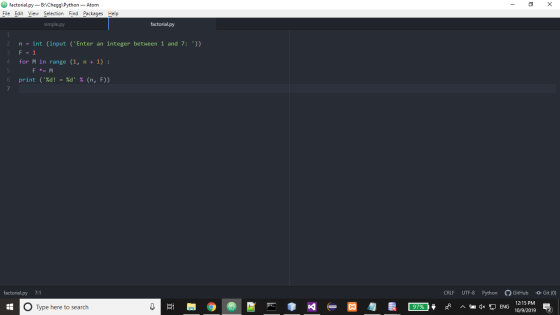
Code
n = int (input ('Enter an integer between 1 and 7: '))
F = 1
for M in range (1, n + 1) :
F *= M
print ('%d! = %d' % (n, F))
output
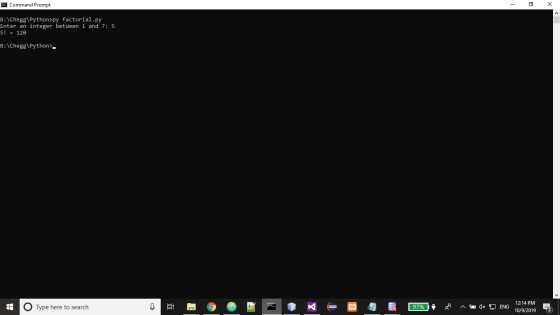
code snaps
flowChart

Pseudocode for Factorial of a number :
Step 1: Declare M and F as integer variable.
Step 2: Initialize F=1 M=1.
Step 2: Enter the value of N.
Step 3: Check whether N Between 1 and 7.
Step 4: If yes then, F=F*N
Step 5: Increament the value of M by 1 .
Step 6: Repeat step 4 and 5 until N==M.
Step 7: Now print the value of F.
If you have any query regarding the code please ask me in the
comment i am here for help you. Please do not direct thumbs down
just ask if you have any query. And if you like my work then please
appreciates with up vote. Thank You.
Add Answer to:
If n is an integer greater than 0, n factorial (n!) is the
product: n* (n-1)...
DONE IN PYTHON The factorial of a non-negative integer n, denoted by n!, is the product...
DONE IN PYTHON The factorial of a non-negative integer n, denoted by n!, is the product of all positive integers less than or equal to n. For example, 5 ! = 5 × 4 × 3 × 2 × 1 = 120. The value of 0! is 1. Write a program, with comments, to do the following: 20 points Ask the user to enter a positive integer n. between 1 and 20 ; You may assume the user will enter...
Calculating the Factorial of a Number - PSEUDOCODE In mathematics, the notation n! represents the factorial...
Calculating the Factorial of a Number - PSEUDOCODE In mathematics, the notation n! represents the factorial of the nonnegative integer n. The factorial of n is the product of all the nonnegative integers from 1 up through n. For example: 7! = 1 × 2 × 3 × 4 × 5 × 6 × 7 = 5,040 and 4! = 1 × 2 × 3 × 4 = 24 Design a program that asks the user to enter a nonnegative...
Write a program that reads a positive integer N, where N is greater than 1 and...
Write a program that reads a positive integer N, where N is greater than 1 and prints the value of the floating-point value SUM where SUM is the results of the following series. SUM = 1/1! + 2/2! + 3/3! + 4/4! + ... N/N! Note that your program should print the message “Sorry, bad N”” if N is <=1, and keep reading user input until the user enters a valid value for N. Also, note that all division operations...
Write a C++ function to find factorial of an integer number N >0. Using the factorial...
 Write a C++ function to find factorial of an integer number N >0. Using the factorial function print the factorial of two inputs as shown below: Sample input: 1 4 Expected output: 1 24
C++ only Implement a program that prompts a user to enter a number N where N...
C++ only Implement a program that prompts a user to enter a number N where N is a positive number. The program must validate a user input and ask a user to re-enter until an input is valid. Implement a function that pass N as an argument and return a result of calculates N! (N-factorial): The function must use loop for the implementation. Hint: Factorial: N! = N * (N-1) * (N-2) * …. * 1 ( This is only...
Write a python program to compute the factorial of a given non-negative integer n. If the...
Write a python program to compute the factorial of a given non-negative integer n. If the user inputs any integer outside the required, print “Error! Try again!”
Recursive definition for factorial: a0 = 1, an = n * an-1 procedure factorial(n: nonnegative integer)...
Recursive definition for factorial: a0 = 1, an = n * an-1 procedure factorial(n: nonnegative integer) if n = 0 then return 1 else return n * factorial( n - 1 ) Trace the execution of the factorial algorithm described above for input 7. Track the number of times factorial is invoked (with the first invocation with input 7 as invocation 0) and the value returned by each invocation.
5. (10 points) The factorial of a nonnegative integer n is written n! and is defined...
 5. (10 points) The factorial of a nonnegative integer n is written n! and is defined as follows. n 2) ..1 (for values of n greater than 1) nn (n-l) and n-# 1 (for n 0 or n-1) l. Write a program that reads a nonnegative integer and computes and prints its factoria
4. Write a program that asks the user for a positive integer no greater than 15....
4. Write a program that asks the user for a positive integer no greater than 15. The program should then display a square on the screen using the character 'X'. The number entered by the user will be the length of each side of the square. For example, if the user enters 5, the program should display the following: XXXXX XXXXX XXXXX XXXXX XXXXX c++
Given algorithm- procedure factorial (n: nonnegative integer) if n = 0 then return 1 else return...
Given algorithm- procedure factorial (n: nonnegative integer) if n = 0 then return 1 else return n*factorial(n-1) {output is n!} Trace the above algorithm when it is given n = 7 as input. That is, show all steps used by above algorithm to find 7!
 Write a C++ function to find factorial of an integer number N >0. Using the factorial function print the factorial of two inputs as shown below: Sample input: 1 4 Expected output: 1 24
 5. (10 points) The factorial of a nonnegative integer n is written n! and is defined as follows. n 2) ..1 (for values of n greater than 1) nn (n-l) and n-# 1 (for n 0 or n-1) l. Write a program that reads a nonnegative integer and computes and prints its factoria
Most questions answered within 3 hours.
-
Where is the error in this code sequence?
String s1 = "Hello";
String s2 = "ello";...
asked 10 months ago -
Financial data for Joel de Paris, Inc., for last year
follow:
Joel de Paris, Inc.
Balance...
asked 10 months ago -
Consider this reaction:
Al2(SO4)3 (aq)+ BaCl3
(aq) Al2Cl6 (aq)- +
3BaSO4(s) . What is the...
asked 10 months ago -
Suppose that Savneet is considering increasing her
recent random sample from 20 car rentals to 40...
asked 10 months ago -
Trucks arrive at an unloading terminal at an average rate of 120
per hour.
Trucks arrive...
asked 10 months ago -
Why are methanol and ethanol completely soluble in water while
octanol is not very little soluble....
asked 10 months ago -
A facilities manager at a university reads in a research report
that the mean amount of...
asked 10 months ago -
When the CuSO4 is rehydrated by adding water to the anhydrous
compound, is this an endothermic...
asked 10 months ago -
A ray of sunlight is passing from diamond into crown glass; the
angle of incidence is...
asked 10 months ago -
A block of mass 0.249 kg is placed on top of a light, vertical
spring of...
asked 10 months ago -
how do the kidneys compensate in the presences of acidosis
a) trigger hyperventilate
b) reserve acid...
asked 10 months ago -
Question 501 pts
The rental rate of capital to the firm increases. Which of the
following...
asked 10 months ago