1. Your investment portfolio had an annualized standard deviation of 28%, a beta of 1.1, an...
1. Your investment portfolio had an annualized standard deviation of 28%, a beta of 1.1, an expected annual return of 11%, and an actual annual return of -20%. The average annual risk-free rate in the economy during that period was 4%. What was your portfolio's Sharpe Ratio? Write your answer out to three decimals - for example, write 16.2% as .162.
2. Your investment has a standard deviation of per-period returns of 33%. What is the standard deviation over 5 periods? Write your answer out to three decimals.
Homework Answers

Add Answer to:
1. Your investment portfolio had an annualized standard
deviation of 28%, a beta of 1.1, an...
3) if your investment portfolio had a retum of 6% the risk-free asset return was 3%,...
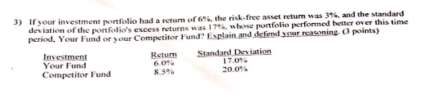 3) if your investment portfolio had a retum of 6% the risk-free asset return was 3%, and the standard deviation of the portfolio's excess returns was 17 period, Your Fund or your Competor Fund?I %, whose portfolio performed better over this time splain and defend yourrsonine (3 points) Investment Your Fund Competitor Fund ReturmStandard 60% 8.5% Deviation 17.0% 20.0%
b) calculate the standard deviation of the portfolio. c) calculate the beta of the portfolio. d)...
 b) calculate the standard deviation of the portfolio.
c) calculate the beta of the portfolio.
d) is the systematic risk of the portfolio is more or less than
the market?
Question 7 (15 pts): retums for There are three states of economy and you are given the following probabilities and each stock for each state of economy. You invest 30% in stock X and 70% in stock Y. The betas for cach stock are also given below Returns if State...
b) calculate the standard deviation of the portfolio.
c) calculate the beta of the portfolio.
d) is the systematic risk of the portfolio is more or less than
the market?
Question 7 (15 pts): retums for There are three states of economy and you are given the following probabilities and each stock for each state of economy. You invest 30% in stock X and 70% in stock Y. The betas for cach stock are also given below Returns if State...
An analyst gathered the following information about a portfolio's performance over the past ten years: Mean...
An analyst gathered the following information about a portfolio's performance over the past ten years: Mean annual return: 11.8% Standard deviation of annual returns: 15.7% Portfolio Beta:1.2 If the mean return on the risk-free asset over the same period was 5.0%, the Sharpe ratio for the portfolio is closest to: Sharpe ratio A 0.23 B 0.36 C 0.43
You have a portfolio with a standard deviation of 28% and an expected return of 17%....
 You have a portfolio with a standard deviation of 28% and an expected return of 17%. You are considering adding one of the two stocks in the following table. If after adding the stock you will have 30% of your money in the new stock and 70% of your money in your existing portfolio, which one should you add? Expected Return 16% 16% Standard Deviation 21% 16% Correlation with Your Portfolio's Returns Stock A Stock B 0.3 0.7 Standard deviation...
0.43 Portfolio return and standard deviation Jamie Wong is thinking of building an investment portfolio containing...
 0.43 Portfolio return and standard deviation Jamie Wong is thinking of building an investment portfolio containing two stocks, L and M. Stock L will represent 40% of the dollar value of the portfolio, and stock M will account for the other 60%. The historical returns over the last 6 years, 2013-2018, for each of these stocks are shown in the following table. Year Expected return Stock L Stock M 14% 20% 14 16 2013 2014 2015 2016 2017 2018 a....
The standard deviation of the market-index portfolio is 30%. Stock A has a beta of 1.50 and a res...
 The standard deviation of the market-index portfolio is 30%. Stock A has a beta of 1.50 and a residual standard deviation of 40%. a-1. Calculate the total variance for an increase of 0.10 in its beta? (Do not round intermediate calculations. Round your answer to 4 decimal places.) Total variance 0.3904 a-2 Calculate the total variance for an increase of 3.35% in its residual standard deviation? (Do not round intermediate calculations. Round your answer to 4 decimal places.) Total variance...
6. Calculating a beta coefficient for a single stock Suppose that the standard deviation of returns...
 6. Calculating a beta coefficient for a single stock Suppose that the standard deviation of returns for a single stock A IS A = 25%, and the standard deviation of the market return is on = 15%. If the correlation between stock A and the market is PAM - 0.6, then the stock's beta is prns against the market returns will equal the true value of Is it reasonable to expect that the beta value estimated via the regression of...
Please enter the return standard deviations for MICROSOFT INC. and for the portfolio during the last...
Please enter the return standard deviations for MICROSOFT INC. and for the portfolio during the last calendar year (2017). Please use daily returns, and make sure to show your work. Please keep in mind that the standard deviation you will get using daily data is the daily standard deviation. In finance, the practice is to annualize the standard deviation by multiplying the daily standard deviation by sqrt(252) - there are approximately 252 trading days in a year. This is especially...
You have invested $12,000 in a portfolio with an annual expected return of 5.6% and standard deviation of 7.1%. Compute...
 You have invested $12,000 in a portfolio with an annual expected
return of 5.6% and standard deviation of 7.1%. Compute your
portfolio’s 5% VaR. Express your answer both in percentage and
dollar term.
You have invested $12,000 in a portfolio with an annual expected return of 5.6% and standard deviation of 7.1%. Compute your portfolio's 5% VaR. Express your answer both in percentage and dollar term.
You have invested $12,000 in a portfolio with an annual expected return of 5.6%...
You have invested $12,000 in a portfolio with an annual expected
return of 5.6% and standard deviation of 7.1%. Compute your
portfolio’s 5% VaR. Express your answer both in percentage and
dollar term.
You have invested $12,000 in a portfolio with an annual expected return of 5.6% and standard deviation of 7.1%. Compute your portfolio's 5% VaR. Express your answer both in percentage and dollar term.
You have invested $12,000 in a portfolio with an annual expected return of 5.6%...
Problem #5 (12 Marks) You have a portfolio with a standard deviation of 30% and an...
 Problem #5 (12 Marks) You have a portfolio with a standard deviation of 30% and an expected return of 18%. You are considering adding one of the two stocks in the table below to your portfolio. After adding the stock, you will have 20% of your money in the new stock and 80% of your money in your existing portfolio. A) Calculate the risk and return of a new portfolio with 20% invested in stock A and 80% in your...
 3) if your investment portfolio had a retum of 6% the risk-free asset return was 3%, and the standard deviation of the portfolio's excess returns was 17 period, Your Fund or your Competor Fund?I %, whose portfolio performed better over this time splain and defend yourrsonine (3 points) Investment Your Fund Competitor Fund ReturmStandard 60% 8.5% Deviation 17.0% 20.0%
 b) calculate the standard deviation of the portfolio.
c) calculate the beta of the portfolio.
d) is the systematic risk of the portfolio is more or less than
the market?
Question 7 (15 pts): retums for There are three states of economy and you are given the following probabilities and each stock for each state of economy. You invest 30% in stock X and 70% in stock Y. The betas for cach stock are also given below Returns if State...
b) calculate the standard deviation of the portfolio.
c) calculate the beta of the portfolio.
d) is the systematic risk of the portfolio is more or less than
the market?
Question 7 (15 pts): retums for There are three states of economy and you are given the following probabilities and each stock for each state of economy. You invest 30% in stock X and 70% in stock Y. The betas for cach stock are also given below Returns if State...
 You have a portfolio with a standard deviation of 28% and an expected return of 17%. You are considering adding one of the two stocks in the following table. If after adding the stock you will have 30% of your money in the new stock and 70% of your money in your existing portfolio, which one should you add? Expected Return 16% 16% Standard Deviation 21% 16% Correlation with Your Portfolio's Returns Stock A Stock B 0.3 0.7 Standard deviation...
 0.43 Portfolio return and standard deviation Jamie Wong is thinking of building an investment portfolio containing two stocks, L and M. Stock L will represent 40% of the dollar value of the portfolio, and stock M will account for the other 60%. The historical returns over the last 6 years, 2013-2018, for each of these stocks are shown in the following table. Year Expected return Stock L Stock M 14% 20% 14 16 2013 2014 2015 2016 2017 2018 a....
 The standard deviation of the market-index portfolio is 30%. Stock A has a beta of 1.50 and a residual standard deviation of 40%. a-1. Calculate the total variance for an increase of 0.10 in its beta? (Do not round intermediate calculations. Round your answer to 4 decimal places.) Total variance 0.3904 a-2 Calculate the total variance for an increase of 3.35% in its residual standard deviation? (Do not round intermediate calculations. Round your answer to 4 decimal places.) Total variance...
 6. Calculating a beta coefficient for a single stock Suppose that the standard deviation of returns for a single stock A IS A = 25%, and the standard deviation of the market return is on = 15%. If the correlation between stock A and the market is PAM - 0.6, then the stock's beta is prns against the market returns will equal the true value of Is it reasonable to expect that the beta value estimated via the regression of...
 You have invested $12,000 in a portfolio with an annual expected
return of 5.6% and standard deviation of 7.1%. Compute your
portfolio’s 5% VaR. Express your answer both in percentage and
dollar term.
You have invested $12,000 in a portfolio with an annual expected return of 5.6% and standard deviation of 7.1%. Compute your portfolio's 5% VaR. Express your answer both in percentage and dollar term.
You have invested $12,000 in a portfolio with an annual expected return of 5.6%...
You have invested $12,000 in a portfolio with an annual expected
return of 5.6% and standard deviation of 7.1%. Compute your
portfolio’s 5% VaR. Express your answer both in percentage and
dollar term.
You have invested $12,000 in a portfolio with an annual expected return of 5.6% and standard deviation of 7.1%. Compute your portfolio's 5% VaR. Express your answer both in percentage and dollar term.
You have invested $12,000 in a portfolio with an annual expected return of 5.6%...
 Problem #5 (12 Marks) You have a portfolio with a standard deviation of 30% and an expected return of 18%. You are considering adding one of the two stocks in the table below to your portfolio. After adding the stock, you will have 20% of your money in the new stock and 80% of your money in your existing portfolio. A) Calculate the risk and return of a new portfolio with 20% invested in stock A and 80% in your...
Most questions answered within 3 hours.
-
Where is the error in this code sequence?
String s1 = "Hello";
String s2 = "ello";...
asked 11 months ago -
Financial data for Joel de Paris, Inc., for last year
follow:
Joel de Paris, Inc.
Balance...
asked 11 months ago -
Consider this reaction:
Al2(SO4)3 (aq)+ BaCl3
(aq) Al2Cl6 (aq)- +
3BaSO4(s) . What is the...
asked 11 months ago -
Suppose that Savneet is considering increasing her
recent random sample from 20 car rentals to 40...
asked 11 months ago -
Trucks arrive at an unloading terminal at an average rate of 120
per hour.
Trucks arrive...
asked 11 months ago -
Why are methanol and ethanol completely soluble in water while
octanol is not very little soluble....
asked 11 months ago -
A facilities manager at a university reads in a research report
that the mean amount of...
asked 11 months ago -
When the CuSO4 is rehydrated by adding water to the anhydrous
compound, is this an endothermic...
asked 11 months ago -
A ray of sunlight is passing from diamond into crown glass; the
angle of incidence is...
asked 11 months ago -
A block of mass 0.249 kg is placed on top of a light, vertical
spring of...
asked 11 months ago -
how do the kidneys compensate in the presences of acidosis
a) trigger hyperventilate
b) reserve acid...
asked 11 months ago -
Question 501 pts
The rental rate of capital to the firm increases. Which of the
following...
asked 11 months ago