A block of iron ore A of mass m = 350 kg and specific heat capacity...
A block of iron ore A of mass m = 350 kg and specific heat capacity C = 460 kJ/(kg·K) obeys the constitutive relations where T is temperature. The block of metal is initially at temperature T1 = 700 K and it is placed in a perfectly-sealed, constant-pressure container B containing 64 kg of air initially at 320 K and atmospheric pressure 101.3 kPa. The air in container B can be modeled as a perfect gas with specific heat capacity at constant pressure Cp = 1.0 kJ/(kg.K) and gas constant R = 0.287 kJ/(kg K).
Energy E: E2 − E1 = mC (T2 − T1)
Entropy S: S2 − S1 = mC ln (T2/T1)
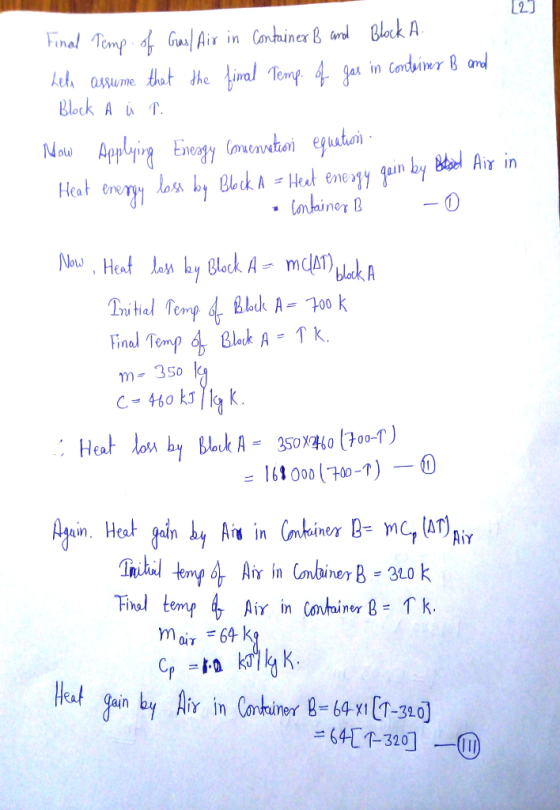
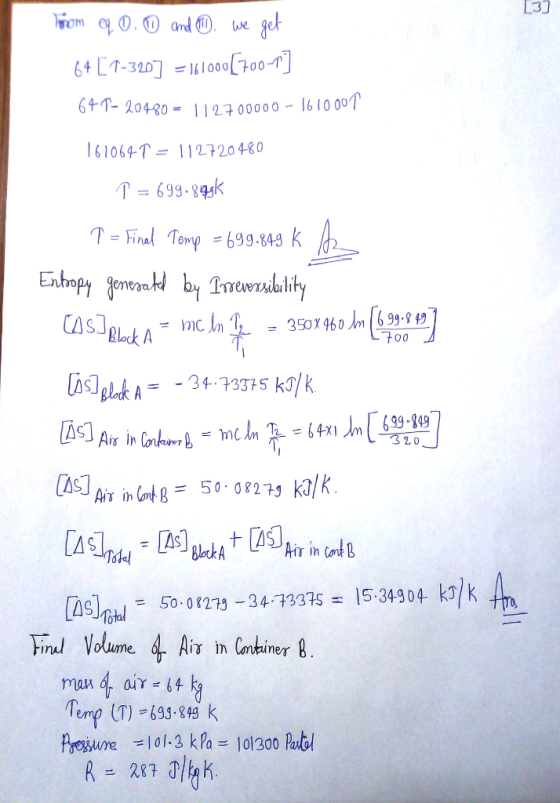
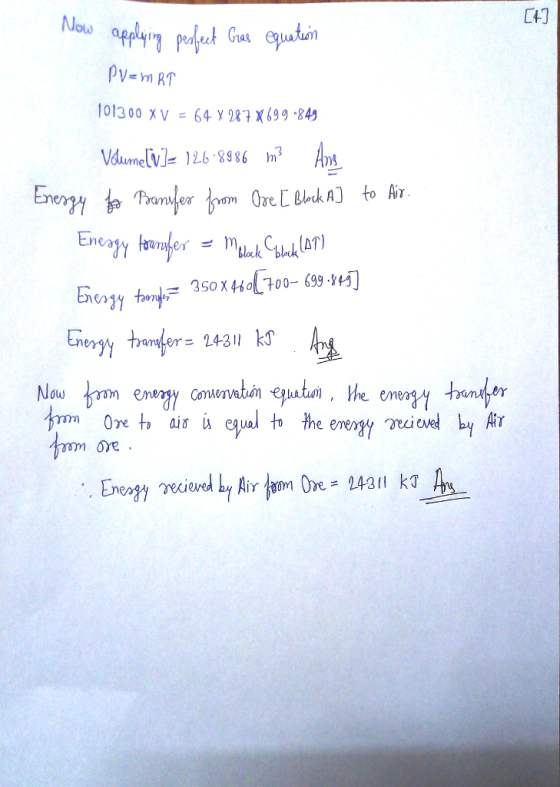
(a) Find the initial volume of air in container B. If the only allowable interaction is a heat interaction between iron block A and the air in container B, find the final temperature of block A and of the air in container B, the entropy generated by irreversibility, the final volume of the air in container B, the energy transferred from the ore to the air, and the energy received from the ore by the air.
(b) Determine the adiabatic availability of the combination of block A and the air in container B, the final temperatures of the ore A and air in container B, the final volume of the air in container B, the energy transferred from the ore to the air, and the energy received from the ore by the air.
(c) If block A and the air in container B are also allowed to interact with the local reservoir R which is at temperature TR =298 K, what is the maximum temperature that the air in container B can reach while interacting with block A and reservoir R? What is the final volume of the air in container B? What is the energy transferred from the ore in this case? What is the energy received by the air in this case? [Hint: write the equations you would use to solve the problem, formulate into one equation as a function of final temperature of air, and solve the equation graphically or numerically]
(d) What is the available energy of the ore and air in their initial state?
(e) In a practical application only 30% of the available energy is extracted. What is the entropy generated by irreversibility?
Homework Answers
This is a simple question of thermodynamics and simply solved by
using Ideal Gas equation, Energy transfer formula and Entropy
formula. 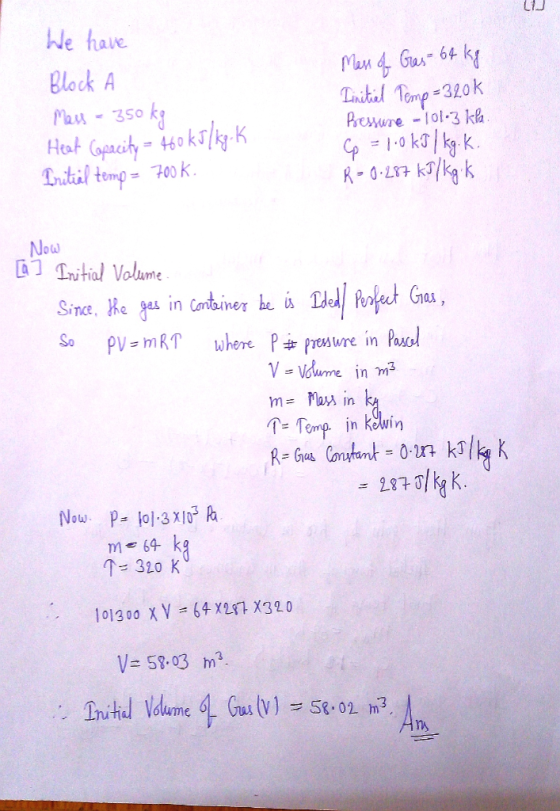
Add Answer to:
A block of iron ore A of mass m = 350 kg and specific heat
capacity...
Problem 2: (10 pts) A 30-kg iron block at initial temperature 200°C and a 40-kg copper...
 Problem 2: (10 pts) A 30-kg iron block at initial temperature 200°C and a 40-kg copper block at initial temperature 100°C are dropped into a very large lake at 20°C. Thermal equilibrium is established after a while as a result of heat transfer between the blocks and lake water. Both blocks have constant specific heats, i.e. Ciron = 0.45 kJ/kg. K and Ccopper = 0.386 kJ/kg. K. Hint: The very large lake can be treated as a heat reservoir and...
6.50 m A closed, rigid tank contains 5 kg of air initially at 300 K, 1...
 6.50 m A closed, rigid tank contains 5 kg of air initially at 300 K, 1 bar. As illustrated in Fig. P6.50, the tank is in contact with a thermal reservoir at 600 K and heat transfer occurs at the boundary where the temperature is 600 K. A stirring rod transfers 600 kJ of energy to the air. The final temperature is 600 K. The air can be modeled as an ideal gas with cy = 0.733 kJ/kg . K...
a) Define entropy as a thermodynamic state variable. b) Determine the final temperature when a block of copper at 0 °C...
 a) Define entropy as a thermodynamic state variable. b) Determine the final temperature when a block of copper at 0 °C is added to 1.0 kg liquid water at 80 °C in an insulated container at constant atmospheric pressure. The copper has a heat capacity of 0.01 kJ kg1 and the specific heat of water is 4.2 kJ kg1 K (both assumed constant with temperature) c) Calculate the change in entropy of the system in b). s it appropriate to...
6.) A closed, rigid tank contains 5 kg of air initially at 300 K, 1 bar....
 6.) A closed, rigid tank contains 5 kg of air initially at 300 K, 1 bar. The diagram below shows a tank in contact with a thermal reservoir at 600 K and heat transfer occurs at the boundary where the temperature is 600 K. A stirring rod transfers 600 kJ of energy to the air. The final temperature is 600 K. The air can be modeled as an ideal gas with c 0.733 k.J/kg K and kinetic and potential energy...
An aluminum block weighing 32 kg initially at 140°C is brought into contact with a block...
 An aluminum block weighing 32 kg initially at 140°C is brought into contact with a block of iron weighing 44 kg at 60°C in an insulated enclosure. Determine the final equilibrium temperature and the total entropy change for this process. The specific heat of aluminum at 400 K is Cp0.949 kJ/kg.K. The specific heat of iron at room temperature is Cp=0.45 kJ/kg.K. The final equilibrium temperature is 108,35 K. The total entropy change for this process is 397 kJ/K
A 34 kg iron block and a 48-kg copper block, both initially at 80°C, are dropped...
 A 34 kg iron block and a 48-kg copper block, both initially at 80°C, are dropped into a large lake at 15°C. Thermal equilibrium is established after a while as a result of heat transfer between the blocks and the lake water. Determine the total entropy change for this process. The specific heat of Iron at room temperature is cp0.45 kJ/kg.K. The specific heat of copper at 27°C is ep 0,386 kJ/kg.K. Iron Lake 15°C Copper The total entropy change...
1) A block of iron at Tiiron- 500°C is placed on top of a block of...
 1) A block of iron at Tiiron- 500°C is placed on top of a block of ice (solid water) at Ti water-50°C in an insulating container so no heat can be transferred into or out of the container. Parts of the graphs of Tvs energy added for the three-phase model are shown to the right. Use these graphs to find the approximate final equilibrium temperatures, Tf iron and Tfwater, the final phases of the iron and water, and the approximate...
What is the heat capacity of a 20.2-kg block of ice? The specific heat capacity of...
 What is the heat capacity of a 20.2-kg block of ice? The specific heat capacity of ice is 2.10 kJ/kg K. kJ/K It takes 880 J to raise the temperature of 350 g of lead from 0°C to 20.0°C. What is the specific heat of lead? kJ/(kg K) A heating coil inside an electric kettle delivers 3.20 kW of electric power to the water in the kettle. How long will it take to raise the temperature of 0.390 kg of...
Propane is compressed from an initial state with a pressure of 100 lbf/in2 and a quality...
Propane is compressed from an initial state with a pressure of 100 lbf/in2 and a quality of 0.40 to a final saturated liquid state with a temperature is 50°F. Is it possible for this process to occur adiabatically? Justify your answer. Air is contained in a rigid, well-insulated container of volume 3 m3. The air undergoes a process from an initial state with a pressure of 200 kPa and temperature of 300 K. During the process, the air receives 720...
A rigid container initially contains 0.6 kg of oxygen at 4,000 kPa and 300 K, the...
A rigid container initially contains 0.6 kg of oxygen at 4,000 kPa and 300 K, the gas cools by lowering the pressure to 3,200 kPa. Determine: (a) the volume of the reservoir, in m3; (b) the final temperature, in K and (c) the total heat transferred, in kJ. That's all I have.
 Problem 2: (10 pts) A 30-kg iron block at initial temperature 200°C and a 40-kg copper block at initial temperature 100°C are dropped into a very large lake at 20°C. Thermal equilibrium is established after a while as a result of heat transfer between the blocks and lake water. Both blocks have constant specific heats, i.e. Ciron = 0.45 kJ/kg. K and Ccopper = 0.386 kJ/kg. K. Hint: The very large lake can be treated as a heat reservoir and...
 6.50 m A closed, rigid tank contains 5 kg of air initially at 300 K, 1 bar. As illustrated in Fig. P6.50, the tank is in contact with a thermal reservoir at 600 K and heat transfer occurs at the boundary where the temperature is 600 K. A stirring rod transfers 600 kJ of energy to the air. The final temperature is 600 K. The air can be modeled as an ideal gas with cy = 0.733 kJ/kg . K...
 a) Define entropy as a thermodynamic state variable. b) Determine the final temperature when a block of copper at 0 °C is added to 1.0 kg liquid water at 80 °C in an insulated container at constant atmospheric pressure. The copper has a heat capacity of 0.01 kJ kg1 and the specific heat of water is 4.2 kJ kg1 K (both assumed constant with temperature) c) Calculate the change in entropy of the system in b). s it appropriate to...
 6.) A closed, rigid tank contains 5 kg of air initially at 300 K, 1 bar. The diagram below shows a tank in contact with a thermal reservoir at 600 K and heat transfer occurs at the boundary where the temperature is 600 K. A stirring rod transfers 600 kJ of energy to the air. The final temperature is 600 K. The air can be modeled as an ideal gas with c 0.733 k.J/kg K and kinetic and potential energy...
 An aluminum block weighing 32 kg initially at 140°C is brought into contact with a block of iron weighing 44 kg at 60°C in an insulated enclosure. Determine the final equilibrium temperature and the total entropy change for this process. The specific heat of aluminum at 400 K is Cp0.949 kJ/kg.K. The specific heat of iron at room temperature is Cp=0.45 kJ/kg.K. The final equilibrium temperature is 108,35 K. The total entropy change for this process is 397 kJ/K
 A 34 kg iron block and a 48-kg copper block, both initially at 80°C, are dropped into a large lake at 15°C. Thermal equilibrium is established after a while as a result of heat transfer between the blocks and the lake water. Determine the total entropy change for this process. The specific heat of Iron at room temperature is cp0.45 kJ/kg.K. The specific heat of copper at 27°C is ep 0,386 kJ/kg.K. Iron Lake 15°C Copper The total entropy change...
 1) A block of iron at Tiiron- 500°C is placed on top of a block of ice (solid water) at Ti water-50°C in an insulating container so no heat can be transferred into or out of the container. Parts of the graphs of Tvs energy added for the three-phase model are shown to the right. Use these graphs to find the approximate final equilibrium temperatures, Tf iron and Tfwater, the final phases of the iron and water, and the approximate...
 What is the heat capacity of a 20.2-kg block of ice? The specific heat capacity of ice is 2.10 kJ/kg K. kJ/K It takes 880 J to raise the temperature of 350 g of lead from 0°C to 20.0°C. What is the specific heat of lead? kJ/(kg K) A heating coil inside an electric kettle delivers 3.20 kW of electric power to the water in the kettle. How long will it take to raise the temperature of 0.390 kg of...
Most questions answered within 3 hours.
-
Where is the error in this code sequence?
String s1 = "Hello";
String s2 = "ello";...
asked 11 months ago -
Financial data for Joel de Paris, Inc., for last year
follow:
Joel de Paris, Inc.
Balance...
asked 11 months ago -
Consider this reaction:
Al2(SO4)3 (aq)+ BaCl3
(aq) Al2Cl6 (aq)- +
3BaSO4(s) . What is the...
asked 11 months ago -
Suppose that Savneet is considering increasing her
recent random sample from 20 car rentals to 40...
asked 11 months ago -
Trucks arrive at an unloading terminal at an average rate of 120
per hour.
Trucks arrive...
asked 11 months ago -
Why are methanol and ethanol completely soluble in water while
octanol is not very little soluble....
asked 11 months ago -
A facilities manager at a university reads in a research report
that the mean amount of...
asked 11 months ago -
When the CuSO4 is rehydrated by adding water to the anhydrous
compound, is this an endothermic...
asked 11 months ago -
A ray of sunlight is passing from diamond into crown glass; the
angle of incidence is...
asked 11 months ago -
A block of mass 0.249 kg is placed on top of a light, vertical
spring of...
asked 11 months ago -
how do the kidneys compensate in the presences of acidosis
a) trigger hyperventilate
b) reserve acid...
asked 11 months ago -
Question 501 pts
The rental rate of capital to the firm increases. Which of the
following...
asked 11 months ago