Q1) A one-dimensional conservative potential is given by U(x)=7x2J, with x measured in meters. If a...
Q1) A one-dimensional conservative potential is given by U(x)=7x2J, with x measured in meters. If a 4kg particle starts at x=1 with a velocity of +10m/s, how fast will it be going when it reaches x=2 meters?
please explain how you solved for this.
Q2)
A hand grenade has a mass of 6kg and it explodes into three pieces each of the same mass. Two of them go off, each with a speed of 17m/s with an angle of 60° between their trajectories. What is the speed of the third?
Homework Answers
Dear student
As per Chegg policy, I am answering the first question only.
Thanks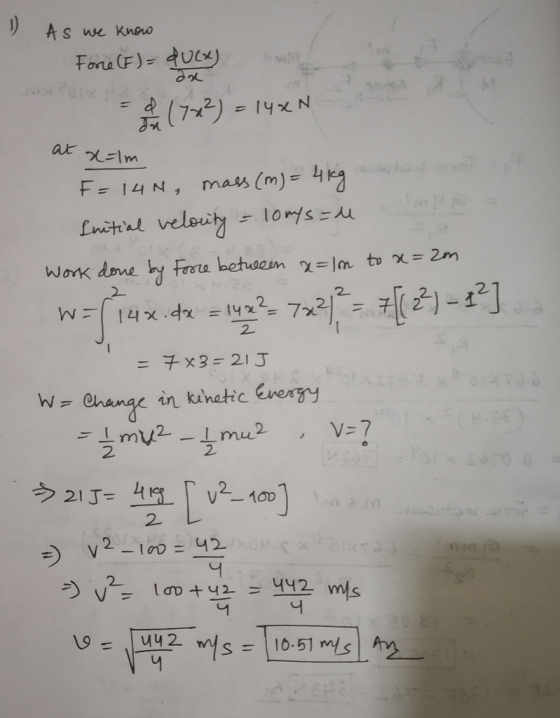
Add Answer to:
Q1) A one-dimensional conservative potential is given by
U(x)=7x2J, with x measured in meters. If a...
Q) A one-dimensional potential is given by the formula U(x)=9(x-8)2 J, where x is in meters....
Q) A one-dimensional potential is given by the formula U(x)=9(x-8)2 J, where x is in meters. If a mass of 2kg is placed at rest at the origin, what is the highest speed it will reach in its subsequent motion? ____m/s PLEASE EXPLAIN HOW THIS WAS SOLVED, THANK YOU!! Q2) Two identical blocks of mass 4kg are on a frictionless surface, one stationary, and the other moves towards it at a speed of 6m/s. Afterwards, the previously moving block moves...
Two point charges Q1 = Q2 = +1.3 μC are fixed symmetrically on the x-axis at...
Two point charges Q1 = Q2 = +1.3 μC are fixed symmetrically on the x-axis at x = ±0.172 m. A point particle of charge Q3 = +4.8 μC and mass m = 13 mg can move freely along the y-axis. a) If the particle on the y-axis is released from rest at y1 = 0.024 m, what will be its speed, in meters per second, when it reaches y2 = 0.065 m? Consider electric forces only.
(6%) Problem 10: Two point charges Q1-Q2-+1.8 nC are fixed symmetrically on the x-axis at x...
 (6%) Problem 10: Two point charges Q1-Q2-+1.8 nC are fixed symmetrically on the x-axis at x = ±0.062 m. A point particle of charge Q3 = +4.4 μ.C and mass m 13 mg can move freely along the y-axis If the particle on the y-axis is released from rest at y-0.016 m, what will be its speed, in meters per second, when it reaches y2 0079 m? Consider electric forces only.
A positive charge q1=2*10^-9 C is held fixed at the origin. A small particle with mass...
A positive charge q1=2*10^-9 C is held fixed at the origin. A small particle with mass m=.004 kg and a negative charge q2=-5*10^-9 C is placed on the x-axis at point A, which is at x=.5m. The particle is released from rest and moves along the x-axis towards the origin. What is the speed of the particle when it reaches point B, which is at x=.3 m? Answer is .00775 m/s Please show work on how to get here
A particle of mass m moves in one dimension. Its potential energy is given by U(x)...
 A particle of mass m moves in one dimension. Its potential energy is given by U(x) = -Voe-22/22 where U, and a are constants. (a) Draw an energy diagram showing the potential energy U(). Choose some value for the total mechanical energy E such that -U, < E < 0. Mark the kinetic energy, the potential energy and the total energy for the particle at some point of your choosing. (b) Find the force on the particle as a function...
Q1 A small object with a momentum of magnitude 2.71 kg m/s approaches head-on a large...
Q1 A small object with a momentum of magnitude 2.71 kg m/s approaches head-on a large object at rest. The small object bounces straight back with a momentum of magnitude 6.19 kg m/s. What is the magnitude of the small object's momentum change in kg m/s? Q2 A force acts on a 4.708 kg mass as follows: the force starts at zero and rises to 60.334 N linearly in 2.24 seconds, it remains at 60.334 N for another 5.756 seconds,...
(15 points) Encounter with a semi-infinite potential "well" In this problem we will investigate one situation involving a a semi-infinite one-dimensional po- tential well (Figure 1) U=0 regio...
 (15 points) Encounter with a semi-infinite potential "well" In this problem we will investigate one situation involving a a semi-infinite one-dimensional po- tential well (Figure 1) U=0 region 1 region 2 region 3 Figure 1: Semi-infinite potential for Problem 3 This potential is piecewise defined as follows where Uo is some positive value of energy. The three intervals in x have been labeled region 1,2 and 3 in Figure 1 Consider a particle of mass m f 0 moving in...
These questions concern a space station, consisting of a long thin uniform rod of mass 4.3 x 10^6 kg and length 769 meters, with two identical uniform hollow spheres, each of mass 1.7 x 10^6 kg and ra...
 These questions concern a space station, consisting of a long
thin uniform rod of mass 4.3 x 10^6 kg and length 769 meters, with
two identical uniform hollow spheres, each of mass 1.7 x 10^6 kg
and radius 218 meters, attached at the ends of the rod, as shown
below. Please note that none of the diagrams shown is drawn to
scale.
A. Suppose that the station starts out at rest (not rotating).
What we want is to get it...
These questions concern a space station, consisting of a long
thin uniform rod of mass 4.3 x 10^6 kg and length 769 meters, with
two identical uniform hollow spheres, each of mass 1.7 x 10^6 kg
and radius 218 meters, attached at the ends of the rod, as shown
below. Please note that none of the diagrams shown is drawn to
scale.
A. Suppose that the station starts out at rest (not rotating).
What we want is to get it...
QUESTION 1 Two skaters, one of mass 80 kg, the other of mass 40 kg, are...
 QUESTION 1 Two skaters, one of mass 80 kg, the other of mass 40 kg, are standing next to each other on frictionless ice rink. The 40 kg skater pushes the 80 kg skater. After the push, the 80 kg skater is going at 1 m/s. How fast and in what direction is the 40 kg skater going after the push? (HINT: use the fact that since there are no external forces, the velocity of the center of mass of...
Please answer these questions! they all are linked to one another! thank you in advance! Bob...
 Please answer these questions! they all are linked to one
another! thank you in advance!
Bob Beamon's long jump at the 1968 Olympics was literally "like nothing seen before. As you will see in the upcoming video he broke the world record by 57 cm (we will probably be converting that to inches in the Exercise). He would have won the 2012 Olympics long jump by a 55 cm! Bob Beamon's historic leap. Chap 6 Quiz Q1 Homework Unanswered In...
Please answer these questions! they all are linked to one
another! thank you in advance!
Bob Beamon's long jump at the 1968 Olympics was literally "like nothing seen before. As you will see in the upcoming video he broke the world record by 57 cm (we will probably be converting that to inches in the Exercise). He would have won the 2012 Olympics long jump by a 55 cm! Bob Beamon's historic leap. Chap 6 Quiz Q1 Homework Unanswered In...
 (6%) Problem 10: Two point charges Q1-Q2-+1.8 nC are fixed symmetrically on the x-axis at x = ±0.062 m. A point particle of charge Q3 = +4.4 μ.C and mass m 13 mg can move freely along the y-axis If the particle on the y-axis is released from rest at y-0.016 m, what will be its speed, in meters per second, when it reaches y2 0079 m? Consider electric forces only.
 A particle of mass m moves in one dimension. Its potential energy is given by U(x) = -Voe-22/22 where U, and a are constants. (a) Draw an energy diagram showing the potential energy U(). Choose some value for the total mechanical energy E such that -U, < E < 0. Mark the kinetic energy, the potential energy and the total energy for the particle at some point of your choosing. (b) Find the force on the particle as a function...
 (15 points) Encounter with a semi-infinite potential "well" In this problem we will investigate one situation involving a a semi-infinite one-dimensional po- tential well (Figure 1) U=0 region 1 region 2 region 3 Figure 1: Semi-infinite potential for Problem 3 This potential is piecewise defined as follows where Uo is some positive value of energy. The three intervals in x have been labeled region 1,2 and 3 in Figure 1 Consider a particle of mass m f 0 moving in...
 These questions concern a space station, consisting of a long
thin uniform rod of mass 4.3 x 10^6 kg and length 769 meters, with
two identical uniform hollow spheres, each of mass 1.7 x 10^6 kg
and radius 218 meters, attached at the ends of the rod, as shown
below. Please note that none of the diagrams shown is drawn to
scale.
A. Suppose that the station starts out at rest (not rotating).
What we want is to get it...
These questions concern a space station, consisting of a long
thin uniform rod of mass 4.3 x 10^6 kg and length 769 meters, with
two identical uniform hollow spheres, each of mass 1.7 x 10^6 kg
and radius 218 meters, attached at the ends of the rod, as shown
below. Please note that none of the diagrams shown is drawn to
scale.
A. Suppose that the station starts out at rest (not rotating).
What we want is to get it...
 QUESTION 1 Two skaters, one of mass 80 kg, the other of mass 40 kg, are standing next to each other on frictionless ice rink. The 40 kg skater pushes the 80 kg skater. After the push, the 80 kg skater is going at 1 m/s. How fast and in what direction is the 40 kg skater going after the push? (HINT: use the fact that since there are no external forces, the velocity of the center of mass of...
 Please answer these questions! they all are linked to one
another! thank you in advance!
Bob Beamon's long jump at the 1968 Olympics was literally "like nothing seen before. As you will see in the upcoming video he broke the world record by 57 cm (we will probably be converting that to inches in the Exercise). He would have won the 2012 Olympics long jump by a 55 cm! Bob Beamon's historic leap. Chap 6 Quiz Q1 Homework Unanswered In...
Please answer these questions! they all are linked to one
another! thank you in advance!
Bob Beamon's long jump at the 1968 Olympics was literally "like nothing seen before. As you will see in the upcoming video he broke the world record by 57 cm (we will probably be converting that to inches in the Exercise). He would have won the 2012 Olympics long jump by a 55 cm! Bob Beamon's historic leap. Chap 6 Quiz Q1 Homework Unanswered In...
Most questions answered within 3 hours.
-
Where is the error in this code sequence?
String s1 = "Hello";
String s2 = "ello";...
asked 11 months ago -
Financial data for Joel de Paris, Inc., for last year
follow:
Joel de Paris, Inc.
Balance...
asked 11 months ago -
Consider this reaction:
Al2(SO4)3 (aq)+ BaCl3
(aq) Al2Cl6 (aq)- +
3BaSO4(s) . What is the...
asked 11 months ago -
Suppose that Savneet is considering increasing her
recent random sample from 20 car rentals to 40...
asked 11 months ago -
Trucks arrive at an unloading terminal at an average rate of 120
per hour.
Trucks arrive...
asked 11 months ago -
Why are methanol and ethanol completely soluble in water while
octanol is not very little soluble....
asked 11 months ago -
A facilities manager at a university reads in a research report
that the mean amount of...
asked 11 months ago -
When the CuSO4 is rehydrated by adding water to the anhydrous
compound, is this an endothermic...
asked 11 months ago -
A ray of sunlight is passing from diamond into crown glass; the
angle of incidence is...
asked 11 months ago -
A block of mass 0.249 kg is placed on top of a light, vertical
spring of...
asked 11 months ago -
how do the kidneys compensate in the presences of acidosis
a) trigger hyperventilate
b) reserve acid...
asked 11 months ago -
Question 501 pts
The rental rate of capital to the firm increases. Which of the
following...
asked 11 months ago