#14 Rate Constant and Temperature 1. The rate constant (k) for a reaction was measured as...
#14 Rate Constant and Temperature
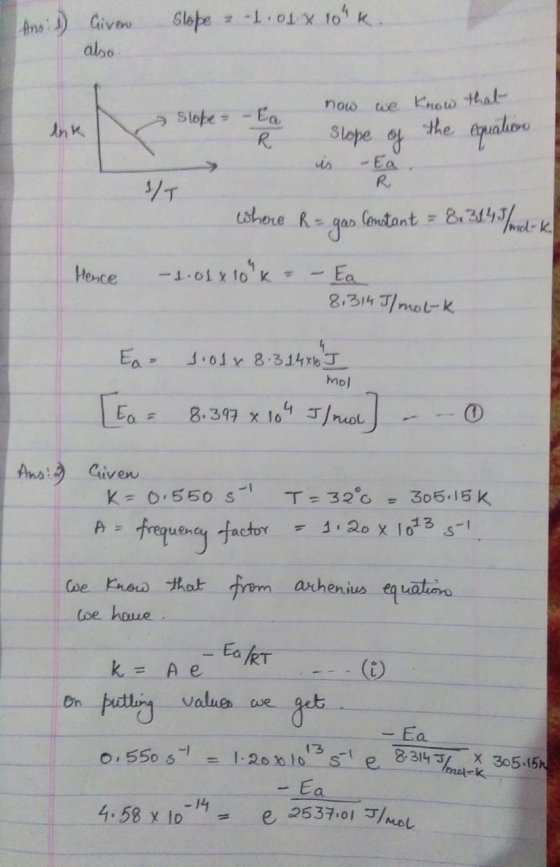
1. The rate constant (k) for a reaction was measured as a function of temperature. A plot of lnk versus 1/T (in K) is linear and has a slope of -1.01 x 10⁴ K. Calculate the activation energy for this reaction.
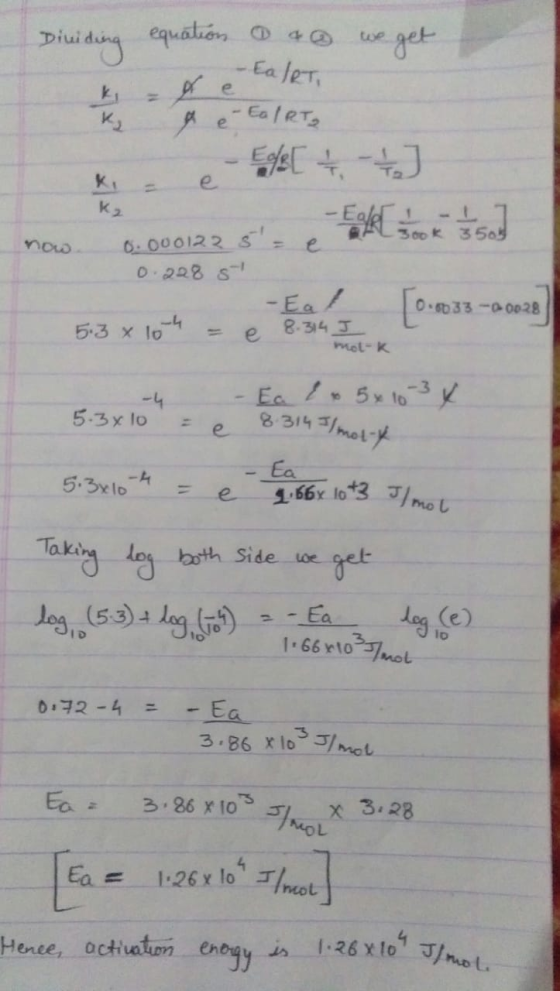
2. The rate constant of a reaction at 32.0oC is 0.0550 s-1. If the frequency factor is
1.20 x 10¹³ s-1, what is the activation energy?
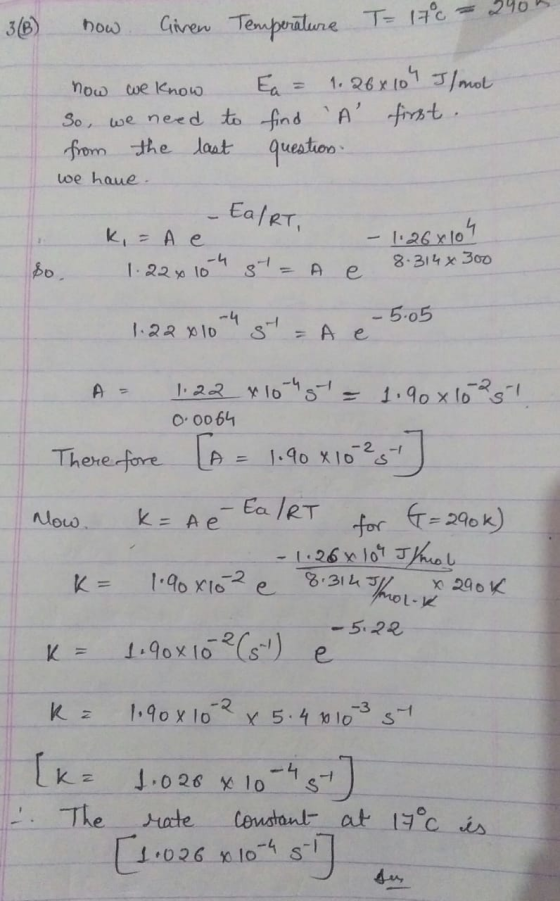
3. A reaction has a rate constant of 0.000122 s-1 at 27.0oC and 0.228 s-1at 77.0oC.
a. Determine the activation energy for this reaction.
b. What is the value of the rate constant at 17.0oC?
4. A slightly bruised apple will rot extensively in about 4.00 days at room temperature, 25.0OC. If the same apple is kept in the refrigerator at 5.0OC, the same extent of rotting takes about 16.0 days. What is the activation energy for the rotting reaction?
Homework Answers
Ans:) Activation energy is a a enrgy that must be given to a system to initiate or start that reaction.In this question basically the arhenius equation is used most. If their is any doubt please ask in commengt section and life if it helps you.


Thank you !
Add Answer to:
#14 Rate Constant and Temperature
1. The rate constant (k) for a reaction was measured as...
4. A slightly bruised apple will rot extensively in about 4.00 days at room temperature 25.0°C....
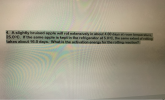 4. A slightly bruised apple will rot extensively in about 4.00 days at room temperature 25.0°C. If the same apple is kept in the refrigerator at 5.0°C, the same extent of rotting takes about 16.0 days. What is the activation energy for the rotting reaction?
A slightly bruised apple will rot extensively in about 4.5 days at room temperature (25.0°C). If...
A slightly bruised apple will rot extensively in about 4.5 days at room temperature (25.0°C). If it is kept in the refrigerator at 0.5°C, the same extent of rotting takes about 18 days. What is the activation energy for the rotting reaction? _____ J/mol
A slightly bruised apple will rot extensively in about 2.0 days at room temperature (26.C). If...
A slightly bruised apple will rot extensively in about 2.0 days at room temperature (26.C). If it is kept in the refrigerator at 1.5 C, the same extent of rotting takes about 17 days. What is the activation energy from the rotting reaction? ...................... J/mol fyi( 5.9 J/mol was marked as wrong)
A bruised pear will rot extensively in about 3.5 days at room temperature (25* C). if...
A bruised pear will rot extensively in about 3.5 days at room temperature (25* C). if it is kept in the refrigerator at 1°C, the same extent of rotting takes about 14 days. What is the activatiom energy for the rotting reaction?
the rate constant (k) for a reaction was measured as a function of temperature. A plot...
the rate constant (k) for a reaction was measured as a function of temperature. A plot of lnk versus 1/T(in K) is linear and has a slope of -9.90•10^3 K. calculate the activation energy for the reaction.
The rate constant (k) for a reaction was measured as a function of temperature. A plot...
The rate constant (k) for a reaction was measured as a function of temperature. A plot of lnk versus 1/T(in K) is linear and has a slope of −1.12×10⁴ K . Calculate the activation energy for the reaction. Express your answer using three significant figures with the appropriate units.
The rate constant (k) for a reaction was measured as a function of temperature. A plot...
The rate constant (k) for a reaction was measured as a function of temperature. A plot of lnk versus 1/T(in K) is linear and has a slope of -7893 K . Part A Calculate the activation energy for the reaction. Express your answer to four significant figures and include the appropriate units.
The rate constant (k) for a reaction was measured as a function of temperature. A plot...
The rate constant (k) for a reaction was measured as a function of temperature. A plot of lnk versus 1/T(in K) is linear and has a slope of −1.30×10⁴ K . You may want to reference (Page) Section 14.5 while completing this problem. Calculate the activation energy for the reaction. Express your answer using three significant figures with the appropriate units.
The rate constant (k) for a reaction was measured as a function of temperature. A plot...
The rate constant (k) for a reaction was measured as a function of temperature. A plot of ln k versus 1/T(ln k) is linear and has a slope of -5375 K. Calculate the activation energy for the reaction.
The rate constant k for a certain reaction is measured at two different temperatures: temperature k...
The rate constant k for a certain reaction is measured at two different temperatures: temperature k 420.0°C ×5.9109 286.0°C ×3.5108 Assuming the rate constant obeys the Arrhenius equation, calculate the activation energy Ea for this reaction. Round your answer to 2 significant digits. =Ea kJmol
 4. A slightly bruised apple will rot extensively in about 4.00 days at room temperature 25.0°C. If the same apple is kept in the refrigerator at 5.0°C, the same extent of rotting takes about 16.0 days. What is the activation energy for the rotting reaction?
Most questions answered within 3 hours.
-
Where is the error in this code sequence?
String s1 = "Hello";
String s2 = "ello";...
asked 10 months ago -
Financial data for Joel de Paris, Inc., for last year
follow:
Joel de Paris, Inc.
Balance...
asked 10 months ago -
Consider this reaction:
Al2(SO4)3 (aq)+ BaCl3
(aq) Al2Cl6 (aq)- +
3BaSO4(s) . What is the...
asked 10 months ago -
Suppose that Savneet is considering increasing her
recent random sample from 20 car rentals to 40...
asked 10 months ago -
Trucks arrive at an unloading terminal at an average rate of 120
per hour.
Trucks arrive...
asked 10 months ago -
Why are methanol and ethanol completely soluble in water while
octanol is not very little soluble....
asked 10 months ago -
A facilities manager at a university reads in a research report
that the mean amount of...
asked 10 months ago -
When the CuSO4 is rehydrated by adding water to the anhydrous
compound, is this an endothermic...
asked 10 months ago -
A ray of sunlight is passing from diamond into crown glass; the
angle of incidence is...
asked 10 months ago -
A block of mass 0.249 kg is placed on top of a light, vertical
spring of...
asked 10 months ago -
how do the kidneys compensate in the presences of acidosis
a) trigger hyperventilate
b) reserve acid...
asked 10 months ago -
Question 501 pts
The rental rate of capital to the firm increases. Which of the
following...
asked 10 months ago