Please prove the following equation with step by step. Note: it related to transfer from the...
Please prove the following equation with step by step.
Note: it related to transfer from the three systems ( Cartesian, Cylindrical, Spherical) coordinates, but I didn't know where to start.
ρdφ=rsinθdϕ
Homework Answers


Add Answer to:
Please prove the following equation with step by step.
Note: it related to transfer from the...
Write neat please. Show step by step please. Show steps for the equation please. Box in answers please from rectangular coordinates to both cylindrical and and evaluate the simplest iterated inte...
 Write neat please. Show step by step please. Show steps for the
equation please. Box in answers please
from rectangular coordinates to both cylindrical and and evaluate the simplest iterated integral.
from rectangular coordinates to both cylindrical and and evaluate the simplest iterated integral.
Write neat please. Show step by step please. Show steps for the
equation please. Box in answers please
from rectangular coordinates to both cylindrical and and evaluate the simplest iterated integral.
from rectangular coordinates to both cylindrical and and evaluate the simplest iterated integral.
Please Do # 1 Thanks 1. From Quiz: Noting that ▽ ×B=Pol + μ。Eoat and ▽...
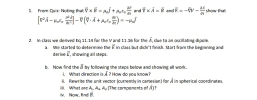 Please Do # 1
Thanks
1. From Quiz: Noting that ▽ ×B=Pol + μ。Eoat and ▽ × Λ-Band E-w-a-show that 2. In class we derived Eq 11.14 for the Vand 11.16 for the A, due to an oscillating dipole. We started to determine the E in class but didn't finish. Start from the beginning and derive E, showing all steps. a. b. Now find the B by following the steps below and showing all work. i. What direction is A...
Please Do # 1
Thanks
1. From Quiz: Noting that ▽ ×B=Pol + μ。Eoat and ▽ × Λ-Band E-w-a-show that 2. In class we derived Eq 11.14 for the Vand 11.16 for the A, due to an oscillating dipole. We started to determine the E in class but didn't finish. Start from the beginning and derive E, showing all steps. a. b. Now find the B by following the steps below and showing all work. i. What direction is A...
Problem 4 The parabolic cylindrical coordinates , , u) are related to the Cartesian coordinat es ...
 Problem 4 The parabolic cylindrical coordinates , , u) are related to the Cartesian coordinat es (x,y, z) by the transformat ion a) The line-element in Cartesian coordinates is given by d82-dr2+dy2+d22-De- termine the lne-elemen expressed in terms of the parabolic cylindrical coordinates b) Given F = 211,2) of the equation V22) F e where F depends only nu. Find the explicit form F-x F kF c) Solve the equation fro b) to find F Useful formulas: Given any ort...
Please skip please skip If iam not satisfied with ur answer i will give 5 dislikes...
 Please skip please skip If iam not satisfied with ur answer i
will give 5 dislikes from me and my friends Answer should be clear
and good handwriting If you don’t know the correct answer its
better to skip Dont copy and paste from previous chegg answers
Problem 1: Cartesian vs. spherical coordinates: the amazing isotropic oscillator. A particle of mass m moves in a three-dimensional isotropic harmonic oscillator potential V(n)= Kr2 (1) with K = mwa positive constant. a)...
Please skip please skip If iam not satisfied with ur answer i
will give 5 dislikes from me and my friends Answer should be clear
and good handwriting If you don’t know the correct answer its
better to skip Dont copy and paste from previous chegg answers
Problem 1: Cartesian vs. spherical coordinates: the amazing isotropic oscillator. A particle of mass m moves in a three-dimensional isotropic harmonic oscillator potential V(n)= Kr2 (1) with K = mwa positive constant. a)...
1. Express the point given in Cartesian coordinates in cylindrical coordinates (r,θ,z). (9(√3/2), 9(1/2), 1)= 2....
 1. Express the point given in Cartesian coordinates in
cylindrical coordinates (r,θ,z). (9(√3/2), 9(1/2), 1)=
2. Express the point given in Cartesian coordinates in spherical
coordinates (ρ,θ,ϕ). (7/3√3,21/4,7/2) =
I know we are only supposed to post 1 per question however for
this one I have 1 part correct, I just need some help with the
rest. Please if you have the time help with question 2. Thank you
for your time and knowledge.
(1 point) Express the point given...
1. Express the point given in Cartesian coordinates in
cylindrical coordinates (r,θ,z). (9(√3/2), 9(1/2), 1)=
2. Express the point given in Cartesian coordinates in spherical
coordinates (ρ,θ,ϕ). (7/3√3,21/4,7/2) =
I know we are only supposed to post 1 per question however for
this one I have 1 part correct, I just need some help with the
rest. Please if you have the time help with question 2. Thank you
for your time and knowledge.
(1 point) Express the point given...
FIG. 2. Setup of Exercise 3 Exercise 3 The electrostatic potential of an electic dipole moment...
 FIG. 2. Setup of Exercise 3 Exercise 3 The electrostatic potential of an electic dipole moment d located at the origin takes the following form d-T Tr where r is the vector joining the origin to the point X (7 is called the "position vector" in the textbook). See Fig. 2 (i) Chosing the z axis to be aligned with the electric dipole moment, express φ in terms of cartesian, cylindrical, (ii) The electric field is obtained from E-- Compute...
please help. Note: u(t) is unit-step function Consider the system with the differential equation: dyt) +...
 please help.
Note: u(t) is unit-step function Consider the system with the differential equation: dyt) + 2 dy(t) + 2y(t) = dr(t) – r(e) dt2 dt where r(t) is input and y(t) is output. 1. Find the transfer function of the system. Note that transfer function is Laplace transform ratio of input and output under the assumption that all initial conditions are zero. 2. Find the impulse response of the system. 3. Find the unit step response of the system...
please help.
Note: u(t) is unit-step function Consider the system with the differential equation: dyt) + 2 dy(t) + 2y(t) = dr(t) – r(e) dt2 dt where r(t) is input and y(t) is output. 1. Find the transfer function of the system. Note that transfer function is Laplace transform ratio of input and output under the assumption that all initial conditions are zero. 2. Find the impulse response of the system. 3. Find the unit step response of the system...
Cartesian elimination. Please prove the statement AND explain the difference if A is empty. my main...
 Cartesian elimination. Please prove the statement AND
explain the difference if A is empty. my main question is how do I,
once I convert the equation to (a in A and b in B)=(a in A and b in
B), remove the a in A from both sides? I'm not sure what the proper
justification for that is.
4. Cartesian Elimination (15 points) Let A, B, and C be non-empty sets. Prove that (A x B= AXC) → B=C. What...
Cartesian elimination. Please prove the statement AND
explain the difference if A is empty. my main question is how do I,
once I convert the equation to (a in A and b in B)=(a in A and b in
B), remove the a in A from both sides? I'm not sure what the proper
justification for that is.
4. Cartesian Elimination (15 points) Let A, B, and C be non-empty sets. Prove that (A x B= AXC) → B=C. What...
Prove the following about two objects colliding elastically in one dimension. Note: each step hel...
 Prove the following about two objects colliding elastically in one dimension. Note: each step helps with the next, and all of this is useful for 1D elastic collisions of two objects. (a) For an incident particle A of mass mA and a target particle B (mB), the initial (vA,o and vB,o) and final (vA,f and vB,f) velocities are related as follows: (b) If the target B is initially stationary (VB,0 -0), show that the final velocity of particle A is:...
Please explain every step! And please write clearly. Thank you! Let V be a the shape...
 Please explain every step! And please write clearly. Thank
you!
Let V be a the shape described by the following criteria in cylindrical coordinates: 0 < z <r, Find the average square of the distance from the origin of V.
Please explain every step! And please write clearly. Thank
you!
Let V be a the shape described by the following criteria in cylindrical coordinates: 0 < z <r, Find the average square of the distance from the origin of V.
 Write neat please. Show step by step please. Show steps for the
equation please. Box in answers please
from rectangular coordinates to both cylindrical and and evaluate the simplest iterated integral.
from rectangular coordinates to both cylindrical and and evaluate the simplest iterated integral.
Write neat please. Show step by step please. Show steps for the
equation please. Box in answers please
from rectangular coordinates to both cylindrical and and evaluate the simplest iterated integral.
from rectangular coordinates to both cylindrical and and evaluate the simplest iterated integral.
 Please Do # 1
Thanks
1. From Quiz: Noting that ▽ ×B=Pol + μ。Eoat and ▽ × Λ-Band E-w-a-show that 2. In class we derived Eq 11.14 for the Vand 11.16 for the A, due to an oscillating dipole. We started to determine the E in class but didn't finish. Start from the beginning and derive E, showing all steps. a. b. Now find the B by following the steps below and showing all work. i. What direction is A...
Please Do # 1
Thanks
1. From Quiz: Noting that ▽ ×B=Pol + μ。Eoat and ▽ × Λ-Band E-w-a-show that 2. In class we derived Eq 11.14 for the Vand 11.16 for the A, due to an oscillating dipole. We started to determine the E in class but didn't finish. Start from the beginning and derive E, showing all steps. a. b. Now find the B by following the steps below and showing all work. i. What direction is A...
 Problem 4 The parabolic cylindrical coordinates , , u) are related to the Cartesian coordinat es (x,y, z) by the transformat ion a) The line-element in Cartesian coordinates is given by d82-dr2+dy2+d22-De- termine the lne-elemen expressed in terms of the parabolic cylindrical coordinates b) Given F = 211,2) of the equation V22) F e where F depends only nu. Find the explicit form F-x F kF c) Solve the equation fro b) to find F Useful formulas: Given any ort...
 Please skip please skip If iam not satisfied with ur answer i
will give 5 dislikes from me and my friends Answer should be clear
and good handwriting If you don’t know the correct answer its
better to skip Dont copy and paste from previous chegg answers
Problem 1: Cartesian vs. spherical coordinates: the amazing isotropic oscillator. A particle of mass m moves in a three-dimensional isotropic harmonic oscillator potential V(n)= Kr2 (1) with K = mwa positive constant. a)...
Please skip please skip If iam not satisfied with ur answer i
will give 5 dislikes from me and my friends Answer should be clear
and good handwriting If you don’t know the correct answer its
better to skip Dont copy and paste from previous chegg answers
Problem 1: Cartesian vs. spherical coordinates: the amazing isotropic oscillator. A particle of mass m moves in a three-dimensional isotropic harmonic oscillator potential V(n)= Kr2 (1) with K = mwa positive constant. a)...
 1. Express the point given in Cartesian coordinates in
cylindrical coordinates (r,θ,z). (9(√3/2), 9(1/2), 1)=
2. Express the point given in Cartesian coordinates in spherical
coordinates (ρ,θ,ϕ). (7/3√3,21/4,7/2) =
I know we are only supposed to post 1 per question however for
this one I have 1 part correct, I just need some help with the
rest. Please if you have the time help with question 2. Thank you
for your time and knowledge.
(1 point) Express the point given...
1. Express the point given in Cartesian coordinates in
cylindrical coordinates (r,θ,z). (9(√3/2), 9(1/2), 1)=
2. Express the point given in Cartesian coordinates in spherical
coordinates (ρ,θ,ϕ). (7/3√3,21/4,7/2) =
I know we are only supposed to post 1 per question however for
this one I have 1 part correct, I just need some help with the
rest. Please if you have the time help with question 2. Thank you
for your time and knowledge.
(1 point) Express the point given...
 FIG. 2. Setup of Exercise 3 Exercise 3 The electrostatic potential of an electic dipole moment d located at the origin takes the following form d-T Tr where r is the vector joining the origin to the point X (7 is called the "position vector" in the textbook). See Fig. 2 (i) Chosing the z axis to be aligned with the electric dipole moment, express φ in terms of cartesian, cylindrical, (ii) The electric field is obtained from E-- Compute...
 please help.
Note: u(t) is unit-step function Consider the system with the differential equation: dyt) + 2 dy(t) + 2y(t) = dr(t) – r(e) dt2 dt where r(t) is input and y(t) is output. 1. Find the transfer function of the system. Note that transfer function is Laplace transform ratio of input and output under the assumption that all initial conditions are zero. 2. Find the impulse response of the system. 3. Find the unit step response of the system...
please help.
Note: u(t) is unit-step function Consider the system with the differential equation: dyt) + 2 dy(t) + 2y(t) = dr(t) – r(e) dt2 dt where r(t) is input and y(t) is output. 1. Find the transfer function of the system. Note that transfer function is Laplace transform ratio of input and output under the assumption that all initial conditions are zero. 2. Find the impulse response of the system. 3. Find the unit step response of the system...
 Cartesian elimination. Please prove the statement AND
explain the difference if A is empty. my main question is how do I,
once I convert the equation to (a in A and b in B)=(a in A and b in
B), remove the a in A from both sides? I'm not sure what the proper
justification for that is.
4. Cartesian Elimination (15 points) Let A, B, and C be non-empty sets. Prove that (A x B= AXC) → B=C. What...
Cartesian elimination. Please prove the statement AND
explain the difference if A is empty. my main question is how do I,
once I convert the equation to (a in A and b in B)=(a in A and b in
B), remove the a in A from both sides? I'm not sure what the proper
justification for that is.
4. Cartesian Elimination (15 points) Let A, B, and C be non-empty sets. Prove that (A x B= AXC) → B=C. What...
 Prove the following about two objects colliding elastically in one dimension. Note: each step helps with the next, and all of this is useful for 1D elastic collisions of two objects. (a) For an incident particle A of mass mA and a target particle B (mB), the initial (vA,o and vB,o) and final (vA,f and vB,f) velocities are related as follows: (b) If the target B is initially stationary (VB,0 -0), show that the final velocity of particle A is:...
 Please explain every step! And please write clearly. Thank
you!
Let V be a the shape described by the following criteria in cylindrical coordinates: 0 < z <r, Find the average square of the distance from the origin of V.
Please explain every step! And please write clearly. Thank
you!
Let V be a the shape described by the following criteria in cylindrical coordinates: 0 < z <r, Find the average square of the distance from the origin of V.
Most questions answered within 3 hours.
-
Where is the error in this code sequence?
String s1 = "Hello";
String s2 = "ello";...
asked 10 months ago -
Financial data for Joel de Paris, Inc., for last year
follow:
Joel de Paris, Inc.
Balance...
asked 10 months ago -
Consider this reaction:
Al2(SO4)3 (aq)+ BaCl3
(aq) Al2Cl6 (aq)- +
3BaSO4(s) . What is the...
asked 10 months ago -
Suppose that Savneet is considering increasing her
recent random sample from 20 car rentals to 40...
asked 10 months ago -
Trucks arrive at an unloading terminal at an average rate of 120
per hour.
Trucks arrive...
asked 10 months ago -
Why are methanol and ethanol completely soluble in water while
octanol is not very little soluble....
asked 10 months ago -
A facilities manager at a university reads in a research report
that the mean amount of...
asked 10 months ago -
When the CuSO4 is rehydrated by adding water to the anhydrous
compound, is this an endothermic...
asked 10 months ago -
A ray of sunlight is passing from diamond into crown glass; the
angle of incidence is...
asked 10 months ago -
A block of mass 0.249 kg is placed on top of a light, vertical
spring of...
asked 10 months ago -
how do the kidneys compensate in the presences of acidosis
a) trigger hyperventilate
b) reserve acid...
asked 10 months ago -
Question 501 pts
The rental rate of capital to the firm increases. Which of the
following...
asked 10 months ago