To stretch a certain spring by 3.00 cm from its equilibrium position requires 7.50 J of...
|
To stretch a certain spring by 3.00 cm from its equilibrium position requires 7.50 J of work. |
Part A What is the force constant of this spring?
SubmitRequest Answer Part B What was the maximum force required to stretch it by that distance?
SubmitRequest Answer Return to AssignmentProvide Feedback |
Homework Answers
Given that to stretch the spring by 3.00 cm from its equilibrium position requires 7.50 J of work
Workdone, 
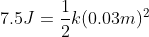

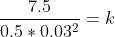
Part A) ANSWER: 
=================================
Part B) What was the maximum force required to stretch it by that distance?
Use formula 

ANSWER: 
====================
Add Answer to:
To stretch a certain spring by 3.00 cm from its equilibrium
position requires 7.50 J of...
Please answer parts A and B: To stretch a certain spring by 2.20 cm from its...
Please answer parts A and B: To stretch a certain spring by 2.20 cm from its equilibrium position requires 8.50 J of work. Part A : What is the force constant of this spring? k k = N/m Part B : What was the maximum force required to stretch it by that distance?
To stretch a spring a distance of 0.3 m from the equilibrium position, 135 J of...
To stretch a spring a distance of 0.3 m from the equilibrium position, 135 J of work is done. What is the value of the spring constant k? The value of the spring constant k is N/m.
If it requires 7.0 J of work to stretch a particular spring by 1.9 cm from...
 If it requires 7.0 J of work to stretch a particular spring by 1.9 cm from its equilibrium length, how much more work will be required to stretch it an additional 3.8 cm? Express your answer using two significant figures. Η ΑΣΦ ? W - 63 J You have already submitted this answer. Enter a new answer No credit lost. Try again Submit Previous Answers Request Answer Provide Feedback
To stretch an ideal spring 9.00 cm from its unstretched length, 19.0 J of work must...
To stretch an ideal spring 9.00 cm from its unstretched length, 19.0 J of work must be done. Part A What is the force constant of this spring? Express your answer with the appropriate units. Part B What magnitude force is needed to stretch the spring 9.00 cm from its unstretched length? Express your answer with the appropriate units. Part C How much work must be done to compress this spring 4.00 cm from its unstretched length? Express your answer...
If it requires 3.0 J of work to stretch a particular spring by 2.1 cm from...
If it requires 3.0 J of work to stretch a particular spring by 2.1 cm from its equilibrium length, how much more work will be required to stretch it an additional 3.7 cm ? Express your answer using two significant figures.
A massless and frictionless spring stretches 4.16 cm from the relaxed position when a 1.47 N...
A massless and frictionless spring stretches 4.16 cm from the relaxed position when a 1.47 N pull is exerted on it. a.) What is the force constant in of this spring in units of N/m ? b.) If the maximum distance it will be able to stretch from the relaxed position is 4.48 cm, what is the greatest force it will be able to exert? c.) An external agent extends the end of the spring from 2.00 cm from the...
If it requires 8.0 J of work to stretch a particular spring by 2.0 cm from...
If it requires 8.0 J of work to stretch a particular spring by 2.0 cm from its equilibrium length, how much more work will be required to stretch it an additional 4.0 cm?
If it requires 8.0 J of work to stretch a particular spring by 2.0 cm from...
If it requires 8.0 J of work to stretch a particular spring by 2.0 cm from its equilibrium length, how much more work will be required to stretch it an additional 4.0 cm? W=
A force of 4.9 N is required to stretch a certain spring by 1.3 cm. Part...
A force of 4.9 N is required to stretch a certain spring by 1.3 cm. Part A: How far must this spring be stretched for its potential energy to be 0.025 J? Part B: How much stretch is required for the spring potential energy to be 0.075 J?
If it requires 9.2 J of work to compress a spring by 4 cm from equilibrium,...
 If it requires 9.2 J of work to compress a spring by 4 cm from equilibrium, how much work would it require to stretch the spring by 6 cm from equilibrium?
 If it requires 7.0 J of work to stretch a particular spring by 1.9 cm from its equilibrium length, how much more work will be required to stretch it an additional 3.8 cm? Express your answer using two significant figures. Η ΑΣΦ ? W - 63 J You have already submitted this answer. Enter a new answer No credit lost. Try again Submit Previous Answers Request Answer Provide Feedback
 If it requires 9.2 J of work to compress a spring by 4 cm from equilibrium, how much work would it require to stretch the spring by 6 cm from equilibrium?
Most questions answered within 3 hours.
-
Where is the error in this code sequence?
String s1 = "Hello";
String s2 = "ello";...
asked 10 months ago -
Financial data for Joel de Paris, Inc., for last year
follow:
Joel de Paris, Inc.
Balance...
asked 10 months ago -
Consider this reaction:
Al2(SO4)3 (aq)+ BaCl3
(aq) Al2Cl6 (aq)- +
3BaSO4(s) . What is the...
asked 10 months ago -
Suppose that Savneet is considering increasing her
recent random sample from 20 car rentals to 40...
asked 10 months ago -
Trucks arrive at an unloading terminal at an average rate of 120
per hour.
Trucks arrive...
asked 10 months ago -
Why are methanol and ethanol completely soluble in water while
octanol is not very little soluble....
asked 10 months ago -
A facilities manager at a university reads in a research report
that the mean amount of...
asked 10 months ago -
When the CuSO4 is rehydrated by adding water to the anhydrous
compound, is this an endothermic...
asked 10 months ago -
A ray of sunlight is passing from diamond into crown glass; the
angle of incidence is...
asked 10 months ago -
A block of mass 0.249 kg is placed on top of a light, vertical
spring of...
asked 10 months ago -
how do the kidneys compensate in the presences of acidosis
a) trigger hyperventilate
b) reserve acid...
asked 10 months ago -
Question 501 pts
The rental rate of capital to the firm increases. Which of the
following...
asked 10 months ago