Small quantities of oxygen can be prepared in the laboratory by heating potassium chlorate, KClO3(s). The...
Small quantities of oxygen can be prepared in the laboratory by heating potassium chlorate, KClO3(s).
The equation for the reaction is
2KClO3⟶2KCl+3O2⟶2KCl+3O2
Calculate how many grams of O2(g) can be produced from heating 48.8 g KClO3(s).
Homework Answers

Add Answer to:
Small quantities of oxygen can be prepared in the laboratory by
heating potassium chlorate, KClO3(s).
The...
Small quantities of oxygen can be prepared in the laboratory by heating potassium chlorate, KClO3(s). The...
Small quantities of oxygen can be prepared in the laboratory by heating potassium chlorate, KClO3(s). The equation for the reaction is 2KClO3⟶2KCl+3O2 Calculate how many grams of O2(g) can be produced from heating 98.6 g KClO3(s). mass:
Small quantities of oxygen can be prepared in the laboratory by heating potassium chlorate, KClO3(s) ....
Small quantities of oxygen can be prepared in the laboratory by heating potassium chlorate, KClO3(s) . The equation for the reaction is 2KClO3⟶2KCl+3O2 Calculate how many grams of O2(g) can be produced from heating 70.4 g KClO3(s) STRATEGY: Convert the mass of KClO3 to moles. Convert the number of moles of KClO3 to the number of moles of O2 . Convert the number of moles of O2 to grams. Step 1: 70.4 g KClO3 is equal to 0.574 mol KClO3...
Small quantities of oxygen can be prepared in the laboratory by heating potassium chlorate, KCIO, (s)....
 Small quantities of oxygen can be prepared in the laboratory by heating potassium chlorate, KCIO, (s). The equation for the reaction is 2 KCI +302 2 KCIO Calculate how many grams of 0, (g) can be produced from heating 11.6 g KCIO, (s). mass:
Oxygen gas can be prepared by heating potassium chlorate: 2KClO3(s)2KCl(s) + 3O2(g) In one experiment, a...
Oxygen gas can be prepared by heating potassium chlorate: 2KClO3(s)2KCl(s) + 3O2(g) In one experiment, a sample of KClO3 reacts and the gas produced is collected by water displacement. The gas sample has a temperature of 23.00 °C, a volume of 769.0 mL, and a pressure of 742.0 mm Hg. Calculate the amount (in moles) of oxygen gas produced in the reaction. The vapor pressure of water is 21.07 mm Hg at 23.00 °C.
Small quantities of oxygen can be prepared in the laboratory by heating potassium chlorate, KCIO,(s). The...
 Small quantities of oxygen can be prepared in the laboratory by heating potassium chlorate, KCIO,(s). The equation for the reaction is 2 KCIO, 2 KCI+ 30, Calculate how many grams of 0, (g) can be produced from heating 68.1 g KCIO,($). mass Iodine is prepared both in the laboratory and commercially by adding Cl, (g) to an aqueous solution containing 2 Nal(aq) + Cl2(8) — 1(s) + 2 NaCl(aq) How many grams of sodium iodide, Nal, must be used to...
At one time, a common means of forming small quantities of oxygen gas in the laboratory...
At one time, a common means of forming small quantities of oxygen gas in the laboratory was to heat KClO3: 2KClO3(s)→2KCl(s)+3O2(g)ΔH=−89.4kJ Part A For this reaction, calculate ΔH for the formation of 1.35 mol of O2 . Part B For this reaction, calculate ΔH for the formation of 10.1 g of KCl. Part C The decomposition of KClO3 proceeds spontaneously when it is heated. Do you think that the reverse reaction, the formation of KClO3 from KCl and O2, is...
5. Potassium chlorate decomposes upon heating as follows: 2KClO3 (s) → 2KCl(s) + 3O2 (g) A...
5. Potassium chlorate decomposes upon heating as follows: 2KClO3 (s) → 2KCl(s) + 3O2 (g) A 2.72-g sample of KClO3 decomposes, and the oxygen at 23.4°C and 0.935 atm is collected. What volume of oxygen gas will be collected, assuming 100% yield?
Small quantitles of axygen can be prepared in the laboratory by heating potassum chlorate, KCios(9 The...
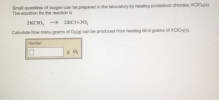 Small quantitles of axygen can be prepared in the laboratory by heating potassum chlorate, KCios(9 The equation for the reactión is Calculate how many grams of Og) can be produced from heating 66.8 grams of KCIOs(s) Number 0 g o
1. Small amounts of oxygen gas can be produced for laboratory use by heating potassium chlorate,...
1. Small amounts of oxygen gas can be produced for laboratory use by heating potassium chlorate, which causes it to decompose by the following reaction: ___KClO3(s) → ____KCl(s) + ___O2(g) (unbalanced) Balance the equation, and determine the mass of oxygen that will be formed if 15.0 g of potassium chlorate decomposes. a. 11.7 g b. 57.5 g c. 173 g d. 5.88 g e. 86.1 g
Oxygen gas can be prepared in the laboratory by heating potassium chlorate, so that it decomposes...
 Oxygen gas can be prepared in the laboratory by heating potassium chlorate, so that it decomposes according to the equation: What would the pressure of O2 be in a 2.50 L glass container at 220°C if 6.50 g of KCIO3 is decomposed? Multiple Choice 0.0796 atm 178 atm 662 atm < Prev 6 of 16 Nht >
 Small quantities of oxygen can be prepared in the laboratory by heating potassium chlorate, KCIO, (s). The equation for the reaction is 2 KCI +302 2 KCIO Calculate how many grams of 0, (g) can be produced from heating 11.6 g KCIO, (s). mass:
 Small quantities of oxygen can be prepared in the laboratory by heating potassium chlorate, KCIO,(s). The equation for the reaction is 2 KCIO, 2 KCI+ 30, Calculate how many grams of 0, (g) can be produced from heating 68.1 g KCIO,($). mass Iodine is prepared both in the laboratory and commercially by adding Cl, (g) to an aqueous solution containing 2 Nal(aq) + Cl2(8) — 1(s) + 2 NaCl(aq) How many grams of sodium iodide, Nal, must be used to...
 Small quantitles of axygen can be prepared in the laboratory by heating potassum chlorate, KCios(9 The equation for the reactión is Calculate how many grams of Og) can be produced from heating 66.8 grams of KCIOs(s) Number 0 g o
 Oxygen gas can be prepared in the laboratory by heating potassium chlorate, so that it decomposes according to the equation: What would the pressure of O2 be in a 2.50 L glass container at 220°C if 6.50 g of KCIO3 is decomposed? Multiple Choice 0.0796 atm 178 atm 662 atm < Prev 6 of 16 Nht >
Most questions answered within 3 hours.
-
Where is the error in this code sequence?
String s1 = "Hello";
String s2 = "ello";...
asked 10 months ago -
Financial data for Joel de Paris, Inc., for last year
follow:
Joel de Paris, Inc.
Balance...
asked 10 months ago -
Consider this reaction:
Al2(SO4)3 (aq)+ BaCl3
(aq) Al2Cl6 (aq)- +
3BaSO4(s) . What is the...
asked 10 months ago -
Suppose that Savneet is considering increasing her
recent random sample from 20 car rentals to 40...
asked 10 months ago -
Trucks arrive at an unloading terminal at an average rate of 120
per hour.
Trucks arrive...
asked 10 months ago -
Why are methanol and ethanol completely soluble in water while
octanol is not very little soluble....
asked 10 months ago -
A facilities manager at a university reads in a research report
that the mean amount of...
asked 10 months ago -
When the CuSO4 is rehydrated by adding water to the anhydrous
compound, is this an endothermic...
asked 10 months ago -
A ray of sunlight is passing from diamond into crown glass; the
angle of incidence is...
asked 10 months ago -
A block of mass 0.249 kg is placed on top of a light, vertical
spring of...
asked 10 months ago -
how do the kidneys compensate in the presences of acidosis
a) trigger hyperventilate
b) reserve acid...
asked 10 months ago -
Question 501 pts
The rental rate of capital to the firm increases. Which of the
following...
asked 10 months ago