You are performing an experiment with double slit interferrence in which you need the m =...
Homework Answers
 The
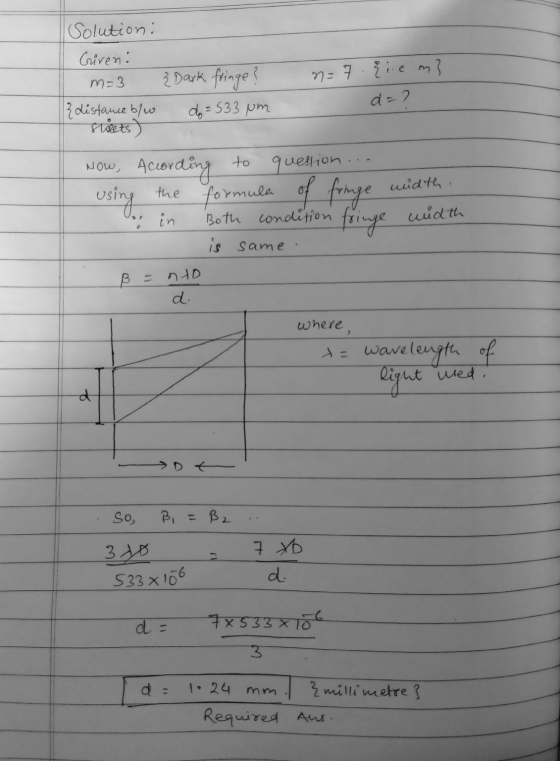
question is solved using the concept of interference perform by
young's i.e double slit experiment ...
The
question is solved using the concept of interference perform by
young's i.e double slit experiment ...
The fringe width is same in both the condition ......
Add Answer to:
You are performing an experiment with double slit
interferrence in which you need the m =...
You are performing an experiment with double-slit interference in which you need the m = 3...
You are performing an experiment with double-slit interference in which you need the m = 3 dark fringe to be at a specific location on the screen, but right now the m = 7 dark fringe is located at that spot. You can’t rearrange the light and screen, but you can replace the double-slit with a different one. The one you currently have has d0 = 533 µm. What d should you replace the current one with?
You are performing an experiment with double slit interferrence in which you need the m=3 dark...
You are performing an experiment with double slit interferrence in which you need the m=3 dark fringe to be at a specific location on the screen, but right now the m = 7 dark fringe is located at that spot. You can’t rearrange the light and screen, but you can replace the double slit with a different one. The one you currently have has d0 = 533 μm. What d should you replace the current one with?
what would the representation look like for this ? Hand-In Homework 8 Name: Rec. Inst.: -...
 what would the representation look like for this ?
Hand-In Homework 8 Name: Rec. Inst.: - Due: Mar Rep: You are performing an experiment with double slit interferrence - ID: in which you need the m = 3 dark fringe to be at a specific 0 0 location on the screen, but right now the m = 7 dark fringe is located at that spot. You can't rearrange the light and screen, Check: 0 but you can replace the double...
what would the representation look like for this ?
Hand-In Homework 8 Name: Rec. Inst.: - Due: Mar Rep: You are performing an experiment with double slit interferrence - ID: in which you need the m = 3 dark fringe to be at a specific 0 0 location on the screen, but right now the m = 7 dark fringe is located at that spot. You can't rearrange the light and screen, Check: 0 but you can replace the double...
In a Young's double-slit experiment, the seventh dark fringe is located 0.033 m to the side...
 In a Young's double-slit experiment, the seventh dark fringe is
located 0.033 m to the side of the central bright fringe on a flat
screen, which is 1.2 m away from the slits. The separation between
the slits is 1.3 × 10⁻⁴ m. What is the wavelength of the light
being used?
Seventh dark fringe ---C Central bright fringe Seventh dark fringe Double slit Screen
In a Young's double-slit experiment, the seventh dark fringe is
located 0.033 m to the side of the central bright fringe on a flat
screen, which is 1.2 m away from the slits. The separation between
the slits is 1.3 × 10⁻⁴ m. What is the wavelength of the light
being used?
Seventh dark fringe ---C Central bright fringe Seventh dark fringe Double slit Screen
In a Young's double-slit experiment, the seventh dark fringe is located 0.030 m to the side...
 In a Young's double-slit
experiment, the seventh dark fringe is located 0.030 m to the side
of the central bright fringe on a flat screen, which is 1.0 m away
from the slits. The separation between the slits is 1.5
In a Young's double-slit experiment, the seventh dark fringe is located 0.030 m to the side of the central bright fringe on a flat screen, which is 1.0 m away from the slits. The separation between the slits is 1.5...
In a Young's double-slit
experiment, the seventh dark fringe is located 0.030 m to the side
of the central bright fringe on a flat screen, which is 1.0 m away
from the slits. The separation between the slits is 1.5
In a Young's double-slit experiment, the seventh dark fringe is located 0.030 m to the side of the central bright fringe on a flat screen, which is 1.0 m away from the slits. The separation between the slits is 1.5...
Chapter 27, Problem 05 In a Young's double-slit experiment, the seventh dark fringe is located 0.034...
 Chapter 27, Problem 05 In a Young's double-slit experiment, the seventh dark fringe is located 0.034 m to the side of the central bright fringe on a flat screen, which is 1.0 m away from the slits. The separation between the slits is 1.6 x 10⁻⁴ m. What is the wavelength of the light being used? Seventh dark fringe - Central bright fringe e Seventh dark fringe Screen Double slit Number Units the tolerance is +/-2% Click if you would...
In a Young's double-slit experiment, the seventh dark fringe is located 0.031 m to the side...
In a Young's double-slit experiment, the seventh dark fringe is located 0.031 m to the side of the central bright fringe on a flat screen, which is 1.1 m away from the slits. The separation between the slits is 1.7 × 10⁻⁴ m. What is the wavelength of the light being used?
In a Young's double-slit experiment, the seventh dark fringe is located 0.025 m to the side...
In a Young's double-slit experiment, the seventh dark fringe is located 0.025 m to the side of the central bright fringe on a flat screen, which is 1.1 m away from the slits. The separation between the slits is 1.5 × 10⁻⁴ m. What is the wavelength of the light being used? To 3 significant figures
1( A) In a Young's double-slit experiment, a set of parallel slits with a separation of...
1( A) In a Young's double-slit experiment, a set of parallel slits with a separation of 0.102 mm is illuminated by light having a wavelength of 576 nm and the interference pattern observed on a screen 3.50 m from the slits. What is the difference in path lengths from the two slits to the location of a third order bright fringe on the screen? 1(B) In a Young's double-slit experiment, a set of parallel slits with a separation of 0.102...
1. In a double-slit experiment with a slit spacing of 0.35 mm, the center-to-center distance between a dark region and the nearest bright spot is 1.1 mm, on a screen that is 1.4 m away. Assume small...
 1. In a double-slit experiment with a slit spacing of 0.35 mm, the center-to-center distance between a dark region and the nearest bright spot is 1.1 mm, on a screen that is 1.4 m away. Assume small angles. (a) How wide is the bright fringe? (b) How wide is the central maximum? TIm (c) How wide is the first dark fringe? TTIM (d) How far apart are adjacent maxima? (e) How far apart are adjacent minima? mIm (0 What is...
 what would the representation look like for this ?
Hand-In Homework 8 Name: Rec. Inst.: - Due: Mar Rep: You are performing an experiment with double slit interferrence - ID: in which you need the m = 3 dark fringe to be at a specific 0 0 location on the screen, but right now the m = 7 dark fringe is located at that spot. You can't rearrange the light and screen, Check: 0 but you can replace the double...
what would the representation look like for this ?
Hand-In Homework 8 Name: Rec. Inst.: - Due: Mar Rep: You are performing an experiment with double slit interferrence - ID: in which you need the m = 3 dark fringe to be at a specific 0 0 location on the screen, but right now the m = 7 dark fringe is located at that spot. You can't rearrange the light and screen, Check: 0 but you can replace the double...
 In a Young's double-slit experiment, the seventh dark fringe is
located 0.033 m to the side of the central bright fringe on a flat
screen, which is 1.2 m away from the slits. The separation between
the slits is 1.3 × 10⁻⁴ m. What is the wavelength of the light
being used?
Seventh dark fringe ---C Central bright fringe Seventh dark fringe Double slit Screen
In a Young's double-slit experiment, the seventh dark fringe is
located 0.033 m to the side of the central bright fringe on a flat
screen, which is 1.2 m away from the slits. The separation between
the slits is 1.3 × 10⁻⁴ m. What is the wavelength of the light
being used?
Seventh dark fringe ---C Central bright fringe Seventh dark fringe Double slit Screen
 In a Young's double-slit
experiment, the seventh dark fringe is located 0.030 m to the side
of the central bright fringe on a flat screen, which is 1.0 m away
from the slits. The separation between the slits is 1.5
In a Young's double-slit experiment, the seventh dark fringe is located 0.030 m to the side of the central bright fringe on a flat screen, which is 1.0 m away from the slits. The separation between the slits is 1.5...
In a Young's double-slit
experiment, the seventh dark fringe is located 0.030 m to the side
of the central bright fringe on a flat screen, which is 1.0 m away
from the slits. The separation between the slits is 1.5
In a Young's double-slit experiment, the seventh dark fringe is located 0.030 m to the side of the central bright fringe on a flat screen, which is 1.0 m away from the slits. The separation between the slits is 1.5...
 Chapter 27, Problem 05 In a Young's double-slit experiment, the seventh dark fringe is located 0.034 m to the side of the central bright fringe on a flat screen, which is 1.0 m away from the slits. The separation between the slits is 1.6 x 10⁻⁴ m. What is the wavelength of the light being used? Seventh dark fringe - Central bright fringe e Seventh dark fringe Screen Double slit Number Units the tolerance is +/-2% Click if you would...
 1. In a double-slit experiment with a slit spacing of 0.35 mm, the center-to-center distance between a dark region and the nearest bright spot is 1.1 mm, on a screen that is 1.4 m away. Assume small angles. (a) How wide is the bright fringe? (b) How wide is the central maximum? TIm (c) How wide is the first dark fringe? TTIM (d) How far apart are adjacent maxima? (e) How far apart are adjacent minima? mIm (0 What is...
Most questions answered within 3 hours.
-
Where is the error in this code sequence?
String s1 = "Hello";
String s2 = "ello";...
asked 10 months ago -
Financial data for Joel de Paris, Inc., for last year
follow:
Joel de Paris, Inc.
Balance...
asked 10 months ago -
Consider this reaction:
Al2(SO4)3 (aq)+ BaCl3
(aq) Al2Cl6 (aq)- +
3BaSO4(s) . What is the...
asked 10 months ago -
Suppose that Savneet is considering increasing her
recent random sample from 20 car rentals to 40...
asked 10 months ago -
Trucks arrive at an unloading terminal at an average rate of 120
per hour.
Trucks arrive...
asked 10 months ago -
Why are methanol and ethanol completely soluble in water while
octanol is not very little soluble....
asked 10 months ago -
A facilities manager at a university reads in a research report
that the mean amount of...
asked 10 months ago -
When the CuSO4 is rehydrated by adding water to the anhydrous
compound, is this an endothermic...
asked 10 months ago -
A ray of sunlight is passing from diamond into crown glass; the
angle of incidence is...
asked 10 months ago -
A block of mass 0.249 kg is placed on top of a light, vertical
spring of...
asked 10 months ago -
how do the kidneys compensate in the presences of acidosis
a) trigger hyperventilate
b) reserve acid...
asked 10 months ago -
Question 501 pts
The rental rate of capital to the firm increases. Which of the
following...
asked 10 months ago