A water skier lets go of the tow rope upon leaving the end of a jump...
A water skier lets go of the tow rope upon leaving the end of a jump ramp at a speed of 17.0 m/s. As the drawing indicates, the skier has a speed of 12.0 m/s at the highest point of the jump. Ignoring air resistance, determine the skier's height H above the top of the ramp at the highest point.
Homework Answers


Add Answer to:
A water skier lets go of the tow rope upon leaving the end of a
jump...
A water-skier is being pulled by a tow rope attached to a boat. As the driver...
A water-skier is being pulled by a tow rope attached to a boat. As the driver pushes the throttle forward, the skier accelerates. A 61.3-kg water-skier has an initial speed of 5.5 m/s. Later, the speed increases to 11.3 m/s. Determine the work done by the net external force acting on the skier.
A skier specialized in the jump mode, descends on a ramp, which we will assume an...
A skier specialized in the jump mode, descends on a ramp, which we will assume an inclined plane that forms 23 degrees with the horizontal and 150 m long. The lower end of the ramp is 14m above the horizontal ground. ignoring friction and assuming you are resting, calculate: a) the speed you will have when leaving the ramp b) the distance it travels in the air before reaching the ground
Chapter 04, Problem 075 Review Conceptual Example 16 as background for this problem. The water skier...
 Chapter 04, Problem 075 Review Conceptual Example 16 as background for this problem. The water skier there has a mass of 65.0 kg. Find the magnitude of the net force acting on the skier when (a) she is accelerated from rest to a speed of 15.0 m/s in 7.00 s and (b) she lets go of the tow rope and glides to a halt in 22.0 s. (a) Number Units | (b) Number Units
39) After leaving the end of a ski ramp, a skier jumps and manages to land...
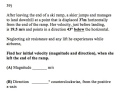 39) After leaving the end of a ski ramp, a skier jumps and manages to land downhill at a point that is displaced 37m horizontally from the end of the ramp. Her velocity, just before landing, is 19.5 m/s and points in a direction 43° below the horizontal Neglecting air resistance and any lift he experiences while airborne, Find her initial velocity (magnitude and direction), when she left the end of the ramp. (A) Magnitude (B) Direction m/s o counterclockwise,...
The figure below shows a motorcycle leaving the end of a ramp with a speed of...
The figure below shows a motorcycle leaving the end of a ramp with a speed of 39.4 m/s and following the curved path shown. At the peak of the path, a maximum height h above the top of the ramp, the motorcycle's speed is 37.5 m/s. What is the maximum height h? Ignore friction and air resistance. (Enter your answer in m.)
The figure below shows a motorcycle leaving the end of a ramp with a speed of...
The figure below shows a motorcycle leaving the end of a ramp with a speed of 38.7 m/s and following the curved path shown. At the peak of the path, a maximum height h above the top of the ramp, the motorcycle's speed is 37.2 m/s. What is the maximum height h? Ignore friction and air resistance. (Enter your answer in m.)
Choose the Correct Answer: 1. A skier leaves a ski jump with a horizontal velocity of...
 Choose the Correct Answer: 1. A skier leaves a ski jump with a horizontal velocity of 27.0 m/s (and no vertical velocity component). The skier lands 2.50 seconds later. What is the magnitude of the skier's displacement during the jump (a) 67.5 m (b) 98.2 m (c) 74.1 m (d) 30.7 m 2. The x and y positions (in meters) of a particle are given by: x(t) 253 t, and y(t)-12.0 t2+ 155 t100. The speed of the particle at...
A man on a motorcycle plans to make a jump as shown in the figure. If...
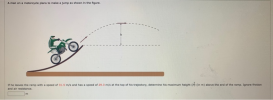 A man on a motorcycle plans to make a jump as shown in the figure. If he leaves the ramp with a speed of 31.5 m/s and has a speed of 29.3 m/s at the top of his trajectory, determine his maximum height (cin m) above the end of the ramp. Ignore friction and air resistance
A man on a motorcycle plans to make a jump as shown in the figure. If...
 A man on a motorcycle plans to make a jump as shown in the figure. If he leaves the ramp with a speed of 40.0 m/s and has a speed of 37.7 m/s at the top of his trajectory, determine his maximum height (n) (in m) above the end of the ramp. Ignore friction and air resistance. m
A particle, starting from point A in the drawing (the height at A is 3.00 m),...
A particle, starting from point A in the drawing (the height at A is 3.00 m), is projected down the curved runway. Upon leaving the runway at point B, the particle is traveling straight upward and reaches a height of 6.25 above the floor before falling back down. Ignoring friction and air resistance, find the speed of the particle at point A
 Chapter 04, Problem 075 Review Conceptual Example 16 as background for this problem. The water skier there has a mass of 65.0 kg. Find the magnitude of the net force acting on the skier when (a) she is accelerated from rest to a speed of 15.0 m/s in 7.00 s and (b) she lets go of the tow rope and glides to a halt in 22.0 s. (a) Number Units | (b) Number Units
 39) After leaving the end of a ski ramp, a skier jumps and manages to land downhill at a point that is displaced 37m horizontally from the end of the ramp. Her velocity, just before landing, is 19.5 m/s and points in a direction 43° below the horizontal Neglecting air resistance and any lift he experiences while airborne, Find her initial velocity (magnitude and direction), when she left the end of the ramp. (A) Magnitude (B) Direction m/s o counterclockwise,...
 Choose the Correct Answer: 1. A skier leaves a ski jump with a horizontal velocity of 27.0 m/s (and no vertical velocity component). The skier lands 2.50 seconds later. What is the magnitude of the skier's displacement during the jump (a) 67.5 m (b) 98.2 m (c) 74.1 m (d) 30.7 m 2. The x and y positions (in meters) of a particle are given by: x(t) 253 t, and y(t)-12.0 t2+ 155 t100. The speed of the particle at...
 A man on a motorcycle plans to make a jump as shown in the figure. If he leaves the ramp with a speed of 31.5 m/s and has a speed of 29.3 m/s at the top of his trajectory, determine his maximum height (cin m) above the end of the ramp. Ignore friction and air resistance
 A man on a motorcycle plans to make a jump as shown in the figure. If he leaves the ramp with a speed of 40.0 m/s and has a speed of 37.7 m/s at the top of his trajectory, determine his maximum height (n) (in m) above the end of the ramp. Ignore friction and air resistance. m
Most questions answered within 3 hours.
-
Where is the error in this code sequence?
String s1 = "Hello";
String s2 = "ello";...
asked 11 months ago -
Financial data for Joel de Paris, Inc., for last year
follow:
Joel de Paris, Inc.
Balance...
asked 11 months ago -
Consider this reaction:
Al2(SO4)3 (aq)+ BaCl3
(aq) Al2Cl6 (aq)- +
3BaSO4(s) . What is the...
asked 11 months ago -
Suppose that Savneet is considering increasing her
recent random sample from 20 car rentals to 40...
asked 11 months ago -
Trucks arrive at an unloading terminal at an average rate of 120
per hour.
Trucks arrive...
asked 11 months ago -
Why are methanol and ethanol completely soluble in water while
octanol is not very little soluble....
asked 11 months ago -
A facilities manager at a university reads in a research report
that the mean amount of...
asked 11 months ago -
When the CuSO4 is rehydrated by adding water to the anhydrous
compound, is this an endothermic...
asked 11 months ago -
A ray of sunlight is passing from diamond into crown glass; the
angle of incidence is...
asked 11 months ago -
A block of mass 0.249 kg is placed on top of a light, vertical
spring of...
asked 11 months ago -
how do the kidneys compensate in the presences of acidosis
a) trigger hyperventilate
b) reserve acid...
asked 11 months ago -
Question 501 pts
The rental rate of capital to the firm increases. Which of the
following...
asked 11 months ago