3. a) Account for two kinds of semiconductor and use schemes to explain charge flow between...
Homework Answers
a) There are two types of semiconductor. Ptype and N type.
P type semiconductor
It is obtained when the trivalent impurity is added to the intrinsic semiconductor. Trivalent impurities are boron, aluminium gallium etc. They are called acceptor impurities.Silicon has four electrons in the outermost shell. When they combine with trivalent impurities, a vacant space is created. This is known as hole. Holes are the majority carriers in p type semiconductor.
N type semiconductor
It is obtained when the pentavalent impurity is added to the intrinsic semiconductor. pentavalent impurities are phosphurus, arsenic antimony etc. They are called donor impurities.Silicon has four electrons in the outermost shell. When they combine with pentavalent impurities, an extra electron is created. These electrons are the majority carriers in n type semiconductor.
Charge flow between p type and n type semiconductors
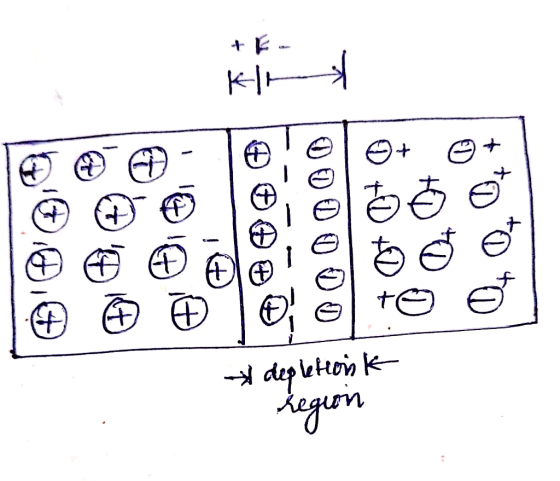
If we join two semiconductors together, we will get a PN junction. When the N-type semiconductor and P-type semiconductor materials are joined together , some of the free electrons from the donor impurity atoms move towards the junction to fill up the holes in the P-type material producing negative ions. This movement of electrons towards the junction creates a positively charged ions in the n- region. The region near the junction with immobile ions is known as depletion region or space charge region.
Add Answer to:
3. a) Account for two kinds of semiconductor and use schemes
to explain charge flow between...
a) Account for two kinds of semiconductor and use schemes to explain charge flow between n-type...
a) Account for two kinds of semiconductor and use schemes to explain charge flow between n-type and p-type semiconductors in the dark condition without a bias b) A substance known to have a cubic unit cell gives reflections with Cu Ka radiation (wavelength 154 pm) at the glancing angle of 32.6°. The reflection is known to be due to the (220) plane. Index the reflection at the glancing angle of 39.4°
Most questions answered within 3 hours.
-
Where is the error in this code sequence?
String s1 = "Hello";
String s2 = "ello";...
asked 11 months ago -
Financial data for Joel de Paris, Inc., for last year
follow:
Joel de Paris, Inc.
Balance...
asked 11 months ago -
Consider this reaction:
Al2(SO4)3 (aq)+ BaCl3
(aq) Al2Cl6 (aq)- +
3BaSO4(s) . What is the...
asked 11 months ago -
Suppose that Savneet is considering increasing her
recent random sample from 20 car rentals to 40...
asked 11 months ago -
Trucks arrive at an unloading terminal at an average rate of 120
per hour.
Trucks arrive...
asked 11 months ago -
Why are methanol and ethanol completely soluble in water while
octanol is not very little soluble....
asked 11 months ago -
A facilities manager at a university reads in a research report
that the mean amount of...
asked 11 months ago -
When the CuSO4 is rehydrated by adding water to the anhydrous
compound, is this an endothermic...
asked 11 months ago -
A ray of sunlight is passing from diamond into crown glass; the
angle of incidence is...
asked 11 months ago -
A block of mass 0.249 kg is placed on top of a light, vertical
spring of...
asked 11 months ago -
how do the kidneys compensate in the presences of acidosis
a) trigger hyperventilate
b) reserve acid...
asked 11 months ago -
Question 501 pts
The rental rate of capital to the firm increases. Which of the
following...
asked 11 months ago