A catfish is 2.4 m below the surface of a smooth lake. (a) What is the...
A catfish is 2.4 m below the surface of a smooth lake. (a) What is the diameter of the circle on the surface through which the fish can see the world outside the water? (b) If the fish descends, does the diameter of the circle increase, decrease, or remain the same? Assume that the index of refraction of water is 1.333.
Homework Answers
The fish can see the outside world until the angle of incidence
becomes greater than critical angle from water to air. We use this
to find the required solution as shown below.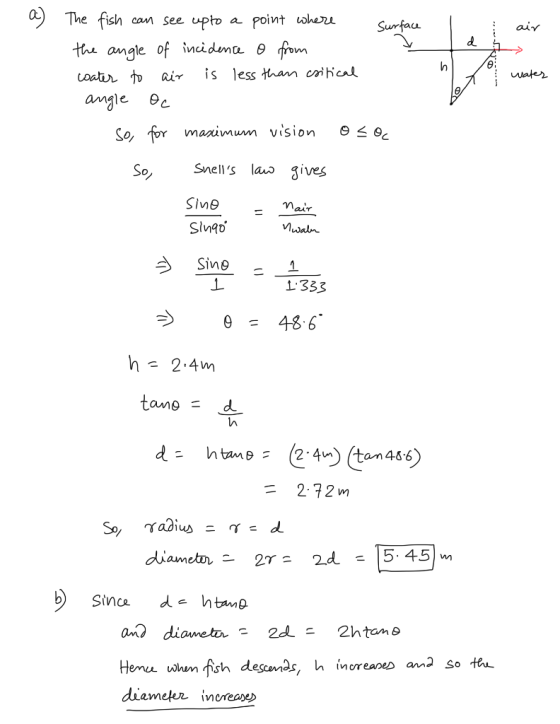
***********************************************************************************************
This concludes the answers. If there is any mistake or
omission, let me know in the comments immediately and I will fix
it....
Add Answer to:
A catfish is 2.4 m below the surface of a smooth lake.
(a) What is the...
A catfish is 2.5 m below the surface of a smooth lake. (a) What is the...
A catfish is 2.5 m below the surface of a smooth lake. (a) What is the diameter of the circle on the surface through which the fish can see the world outside the water? (b) If the fish descends, does the diameter of the circle increase, decrease, or remain the same? Assume that the index of refraction of water is 1.333. t
A point source of light is submerged 2.1 m below the surface of a lake and...
A point source of light is submerged 2.1 m below the surface of a lake and emits rays in all directions. On the surface of the lake, directly above the source, the area illuminated is a circle. What is the maximum radius that this circle could have? Take the refraction index of water to be 1.333.
The waves on the surface of a lake form a nearly spherical surface near peak of...
The waves on the surface of a lake form a nearly spherical surface near peak of the wave, as shown in the image below. A bug is flying some distance above the surface of the water, as shown, and is being watched by a fish. The index of refraction of the water is ?=1.3 n = 1.3 . The fish is at a depth of 180cm, and the bug is flying a distance 32cm above the surface. The radius of...
A fish is 1.0 m below the surface of a lake. How far below the surface...
A fish is 1.0 m below the surface of a lake. How far below the surface of the lake will the fish appear to be when viewed directly from above at normal incidence ?
A point source of light is 115 cm below the surface of a body of water....
A point source of light is 115 cm below the surface of a body of water. Find the diameter of the circle at the surface through which light emerges from the water. Water has an index of refraction of 1.33.
PRINTER VERSION 4 Аск Chapter 26, Problem 028 A point source of light is submerged 3.0...
 PRINTER VERSION 4 Аск Chapter 26, Problem 028 A point source of light is submerged 3.0 m below the surface of a lake and emits rays in all directions. On the surface of the lake, directly above the source, the area illuminated circle. What is the maximum radius that this cirde could have? Take the refraction index of water to be 1.333. Number Units the tolerance is +/-5% SHOW HINT
circle please Problem 2 A submarine is a distance L = 500 m below the surface...
 circle please
Problem 2 A submarine is a distance L = 500 m below the surface of the ocean and sends a radio signal up to a battleship at the surface of the ocean Some of the signal is reflected at the surface back into the ocean. Some of the signal passes through the surface refracted. The signal that passes through the surface will make a cirele of diameter d. The battleship must be within that cirele to receive the...
circle please
Problem 2 A submarine is a distance L = 500 m below the surface of the ocean and sends a radio signal up to a battleship at the surface of the ocean Some of the signal is reflected at the surface back into the ocean. Some of the signal passes through the surface refracted. The signal that passes through the surface will make a cirele of diameter d. The battleship must be within that cirele to receive the...
If you dive to 15 m below the surface of a lake, what is the pressure...
If you dive to 15 m below the surface of a lake, what is the pressure due to the water alone? Assume that the density of water is 1000 kg/m3; g = 9.8 m/s2; and PATM = 1.01 x 10⁵ Pa.
A point source of light is submerged 2.90 m below the surface of a lake and...
A point source of light is submerged 2.90 m below the surface of a lake and emits rays in all directions. On the surface of the lake, directly above the source, the area illuminated is a circle. What is the maximum radius that this circle could have?
(2) A pump is located H1-2 m above the water surface of a lake. The pump...
 (2) A pump is located H1-2 m above the water surface of a lake. The pump has an intake pipe diameter of D-20 cm and the head loss in the pipe that runs from the lake to the pump is hi 0.5 m. The outlet pipe diameter is d-30 cm. The pump has an efficiency of n 0.88 and uses P-15,000 ft.lb/s to pump water to a pond H2- 40 m above the lower lake surface. The head loss in...
 PRINTER VERSION 4 Аск Chapter 26, Problem 028 A point source of light is submerged 3.0 m below the surface of a lake and emits rays in all directions. On the surface of the lake, directly above the source, the area illuminated circle. What is the maximum radius that this cirde could have? Take the refraction index of water to be 1.333. Number Units the tolerance is +/-5% SHOW HINT
 circle please
Problem 2 A submarine is a distance L = 500 m below the surface of the ocean and sends a radio signal up to a battleship at the surface of the ocean Some of the signal is reflected at the surface back into the ocean. Some of the signal passes through the surface refracted. The signal that passes through the surface will make a cirele of diameter d. The battleship must be within that cirele to receive the...
circle please
Problem 2 A submarine is a distance L = 500 m below the surface of the ocean and sends a radio signal up to a battleship at the surface of the ocean Some of the signal is reflected at the surface back into the ocean. Some of the signal passes through the surface refracted. The signal that passes through the surface will make a cirele of diameter d. The battleship must be within that cirele to receive the...
 (2) A pump is located H1-2 m above the water surface of a lake. The pump has an intake pipe diameter of D-20 cm and the head loss in the pipe that runs from the lake to the pump is hi 0.5 m. The outlet pipe diameter is d-30 cm. The pump has an efficiency of n 0.88 and uses P-15,000 ft.lb/s to pump water to a pond H2- 40 m above the lower lake surface. The head loss in...
Most questions answered within 3 hours.
-
Where is the error in this code sequence?
String s1 = "Hello";
String s2 = "ello";...
asked 11 months ago -
Financial data for Joel de Paris, Inc., for last year
follow:
Joel de Paris, Inc.
Balance...
asked 11 months ago -
Consider this reaction:
Al2(SO4)3 (aq)+ BaCl3
(aq) Al2Cl6 (aq)- +
3BaSO4(s) . What is the...
asked 11 months ago -
Suppose that Savneet is considering increasing her
recent random sample from 20 car rentals to 40...
asked 11 months ago -
Trucks arrive at an unloading terminal at an average rate of 120
per hour.
Trucks arrive...
asked 11 months ago -
Why are methanol and ethanol completely soluble in water while
octanol is not very little soluble....
asked 11 months ago -
A facilities manager at a university reads in a research report
that the mean amount of...
asked 11 months ago -
When the CuSO4 is rehydrated by adding water to the anhydrous
compound, is this an endothermic...
asked 11 months ago -
A ray of sunlight is passing from diamond into crown glass; the
angle of incidence is...
asked 11 months ago -
A block of mass 0.249 kg is placed on top of a light, vertical
spring of...
asked 11 months ago -
how do the kidneys compensate in the presences of acidosis
a) trigger hyperventilate
b) reserve acid...
asked 11 months ago -
Question 501 pts
The rental rate of capital to the firm increases. Which of the
following...
asked 11 months ago