Consider a $10k government bond due after 10 years. The bond calls for a payment of...
Consider a $10k government bond due after 10 years. The bond calls for a payment of $500/year at the end of each of the next 10 years and a $10k payment at the end of the 10 years.
a) What interest rate does the bond pay?
b) 5 years go by and the bond is still trading at $10k. But there has been 5 x $500 = $2,500 in interest payments made. What is the interest rate now?
c) At the end of year 6 some and just after the 6th interest payment has been made, the bond trades down from $10k to $9,180. What is the new interest rate on the bond?
Homework Answers
Answer (a):
Bond face value = $10,000
Annual payment = $500
Interest rate =500 / 1000 = 5%
Interest rate the bond pays = 5%
Answer (b):
After 5 years since the bond is still trading at $10,000 (face value at what it was issued), the interest rate remains same.
So:
Interest rate now = 5%
Answer (c):
At the end of year 6 some and just after the 6th interest payment has been made:
Bond price = $9,180
Remaining Time to maturity = 4 years
Annual payment = $500
Hence:
Interest rate = RATE (nper, pmt, pv, fv, type) = RATE (4, 500, -9180, 10000, 0) = 7.45%
New interest rate on the bond = 7.45%
Add Answer to:
Consider a $10k government bond due after 10 years. The bond
calls for a payment of...
Question 7 10 pts A bond has a $10K face value and matures after 8 years....
 Question 7 10 pts A bond has a $10K face value and matures after 8 years. If the bond dividend pays $125 per quarter, what is the coupon rate? Express the answer as a percentage, but do not include percent sign.
Two years ago you bought a Commonwealth Government bond for $1,000 because you liked the 10%...
Two years ago you bought a Commonwealth Government bond for $1,000 because you liked the 10% p.a. coupon interest payment that you would receive for 10 years. Interest on the bond is paid annually. Two years later when the market interest rate has fallen to 8% p.a. what is the value of your Commonwealth Government bond?
Perpetuities. The Canadian Government has once again decided to issue a consol (a bond with a...
Perpetuities. The Canadian Government has once again decided to issue a consol (a bond with a never-ending interest payment and no maturity date). The bond will pay $70 in interest each year (at the end of the year), but it will never return the principal. A) If the current discount rate for Canadian government bonds is 10%, what should this bond sell for in the market? B) If the current discount rate for Canadian government bands would rise to 11%?...
Perpetuities. The Canadian Government has once again decided to issue a consol (a bond with a...
 Perpetuities. The Canadian Government has once again decided to issue a consol (a bond with a never-ending interest payment and no maturity date). The bond will pay $80 in interest each year (at the end of the year), but it will never return the principal. The current discount rate for Canadian government bonds is 9%. What should this consol bond sell for in the market? What if the interest rate should fall to 8%? Rise to 10%? Why does the...
a 10-year 5% ABC company bond is callable after 7 years and trades at par. Regular...
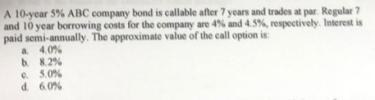 a 10-year 5% ABC company bond is callable after 7 years and
trades at par. Regular 7 and 10-year borrowing costs for the
company are 4 % and 4.5%, respectively. Interest is paid
semi-annually. The approximate value of the call option is.
A 10-year 5% ABC company bond is callable after 7 years and trades at par. Regular and 10 year borrowing costs for the company are 4% and 4.5%, respectively. Interest is paid semi-annually. The approximate value of the...
a 10-year 5% ABC company bond is callable after 7 years and
trades at par. Regular 7 and 10-year borrowing costs for the
company are 4 % and 4.5%, respectively. Interest is paid
semi-annually. The approximate value of the call option is.
A 10-year 5% ABC company bond is callable after 7 years and trades at par. Regular and 10 year borrowing costs for the company are 4% and 4.5%, respectively. Interest is paid semi-annually. The approximate value of the...
A 65,000 annual payment loan is made for a term of 10 years at 7.3% interest....
 A 65,000 annual payment loan is made for a term of 10 years at 7.3% interest. The lender wants only payments of interest until the end of year 10 when the 65,000 must be repaid. The borrower will make level annual year-end payments to a sinking fund earning 4.8%. Find the level sinking fund deposit and the balance in the sinking fund at time 5. find the total payment and the principal in the 6th payment.
Perpetuities. The Canadian Government has once again decided to issue a consol (a bond with a...
 Perpetuities. The Canadian Government has once again decided to issue a consol (a bond with a never-ending interest payment and no maturity date). The bond will pay $50 in interest each year (at the end of the year), but it will never return the principal. The current discount rate for Canadian government bonds is 7%. What should this consol bond sell for in the market? What if the interest rate should fall to 6%? Rise to 8%? Why does the...
9. The British government has a consol bond outstanding paying £200 per year forever. Assume the...
 9. The British government has a consol bond outstanding paying £200 per year forever. Assume the current interest rate is 12% per year a. What is the value of the bond immediately after a payment is made? b. What is the value of the bond immediately before a payment is made? a. What is the value of the bond immediately after a payment is made? The value of the bond immediately after a payment is made is The Value of...
1) Consider a 10-year bond trading at $1150 today. The bond has a face value of...
1) Consider a 10-year bond trading at $1150 today. The bond has a face value of $1,000, and has a coupon rate of 8%. Coupons are paid semiannually, and the next coupon payment is exactly 6 months from now. What is the bond's yield to maturity? 2)A coupon-paying bond is trading below par. How does the bond's YTM compare to its coupon rate? a. Need more info b. YTM = Coupon Rate c. YTM > Coupon Rate d. YTM <...
Consider a simple bond has a coupon payment at the end of 1 year. The Face...
Consider a simple bond has a coupon payment at the end of 1 year. The Face value of the bond is $1,000 and the stated interest rate on the bond is R=0.05 (5%) per year. If you buy this bond today, and then the interest rate on a newly issued bonds of this type goes up to R= 0.10 (10%) right after you buy yours, the most you could sell your bond for right now would be a. $916.67 b....
 Question 7 10 pts A bond has a $10K face value and matures after 8 years. If the bond dividend pays $125 per quarter, what is the coupon rate? Express the answer as a percentage, but do not include percent sign.
 Perpetuities. The Canadian Government has once again decided to issue a consol (a bond with a never-ending interest payment and no maturity date). The bond will pay $80 in interest each year (at the end of the year), but it will never return the principal. The current discount rate for Canadian government bonds is 9%. What should this consol bond sell for in the market? What if the interest rate should fall to 8%? Rise to 10%? Why does the...
 a 10-year 5% ABC company bond is callable after 7 years and
trades at par. Regular 7 and 10-year borrowing costs for the
company are 4 % and 4.5%, respectively. Interest is paid
semi-annually. The approximate value of the call option is.
A 10-year 5% ABC company bond is callable after 7 years and trades at par. Regular and 10 year borrowing costs for the company are 4% and 4.5%, respectively. Interest is paid semi-annually. The approximate value of the...
a 10-year 5% ABC company bond is callable after 7 years and
trades at par. Regular 7 and 10-year borrowing costs for the
company are 4 % and 4.5%, respectively. Interest is paid
semi-annually. The approximate value of the call option is.
A 10-year 5% ABC company bond is callable after 7 years and trades at par. Regular and 10 year borrowing costs for the company are 4% and 4.5%, respectively. Interest is paid semi-annually. The approximate value of the...
 A 65,000 annual payment loan is made for a term of 10 years at 7.3% interest. The lender wants only payments of interest until the end of year 10 when the 65,000 must be repaid. The borrower will make level annual year-end payments to a sinking fund earning 4.8%. Find the level sinking fund deposit and the balance in the sinking fund at time 5. find the total payment and the principal in the 6th payment.
 Perpetuities. The Canadian Government has once again decided to issue a consol (a bond with a never-ending interest payment and no maturity date). The bond will pay $50 in interest each year (at the end of the year), but it will never return the principal. The current discount rate for Canadian government bonds is 7%. What should this consol bond sell for in the market? What if the interest rate should fall to 6%? Rise to 8%? Why does the...
 9. The British government has a consol bond outstanding paying £200 per year forever. Assume the current interest rate is 12% per year a. What is the value of the bond immediately after a payment is made? b. What is the value of the bond immediately before a payment is made? a. What is the value of the bond immediately after a payment is made? The value of the bond immediately after a payment is made is The Value of...
Most questions answered within 3 hours.
-
Where is the error in this code sequence?
String s1 = "Hello";
String s2 = "ello";...
asked 11 months ago -
Financial data for Joel de Paris, Inc., for last year
follow:
Joel de Paris, Inc.
Balance...
asked 11 months ago -
Consider this reaction:
Al2(SO4)3 (aq)+ BaCl3
(aq) Al2Cl6 (aq)- +
3BaSO4(s) . What is the...
asked 11 months ago -
Suppose that Savneet is considering increasing her
recent random sample from 20 car rentals to 40...
asked 11 months ago -
Trucks arrive at an unloading terminal at an average rate of 120
per hour.
Trucks arrive...
asked 11 months ago -
Why are methanol and ethanol completely soluble in water while
octanol is not very little soluble....
asked 11 months ago -
A facilities manager at a university reads in a research report
that the mean amount of...
asked 11 months ago -
When the CuSO4 is rehydrated by adding water to the anhydrous
compound, is this an endothermic...
asked 11 months ago -
A ray of sunlight is passing from diamond into crown glass; the
angle of incidence is...
asked 11 months ago -
A block of mass 0.249 kg is placed on top of a light, vertical
spring of...
asked 11 months ago -
how do the kidneys compensate in the presences of acidosis
a) trigger hyperventilate
b) reserve acid...
asked 11 months ago -
Question 501 pts
The rental rate of capital to the firm increases. Which of the
following...
asked 11 months ago