monopolist will expand output only in the elastic portion of its demand curve. Why?
Homework Answers
Monopolist will always produce at the elastic portion of the demand curve because when demand is inelastic increase in price decreases the quantity demanded by a smaller proportion that increases total revenue. So the firm will have the incentive to increase price. It is only when demand is elastic it is not profitable for the firm is to raise price.
Add Answer to:
monopolist will expand output only in the elastic portion of its
demand curve. Why?
Which of the following is true for a monopolist? It faces a perfectly elastic demand curve....
Which of the following is true for a monopolist? It faces a perfectly elastic demand curve. It must lower its price in order to sell any additional units. Its marginal revenue curve is equal to its demand curve. It faces many competitors
A profit-maximizing monopolist will never produce at an output level where _____. A) demand is elastic...
A profit-maximizing monopolist will never produce at an output level where _____. A) demand is elastic B) demand is inelastic C) demand is perfectly elastic D) it suffers economic losses in the short run E) marginal revenue is zero
When unloading, why is the unloading curve parallel to the elastic portion of the loading curve...
 When unloading, why is the unloading curve parallel to the elastic portion of the loading curve in most metals? Because stiffness is always affected by plastic deformation Because only the elastic strain is recovered Because young's modulus is non-linear variable All of the above 4 UNANSWERED QUESTION 1/4 SKIP FOR NOW 13:27 / 36:04 1x
5) A monopolist faces A) a perfectly elastic demand curve. B) a perfectly inelastic demand curve....
 5) A monopolist faces A) a perfectly elastic demand curve. B) a perfectly inelastic demand curve. C) a horizontal demand curve. D) a downward-sloping demand curve. E) declining market share. 6) Which one of the following about a monopoly is false? A) A monopoly could make profits in the long run B) A monopoly could break even in the long run. C) A monopoly must have some kind of government privilege or government imposed barrier to maintain its monopoly. D)...
As long as the demand curve lies above the marginal revenue curve for a monopolist, at...
 As long as the demand curve lies above the marginal revenue
curve for a monopolist, at its profit-maximizing output level, it
will charge a price for its product that is
Question7 2 pts As long as the demand curve lies above the marginal revenue curve for a monopolist, at its profit-maximizing output level, it will charge a price for its product that is O above total cost. below marginal cost. O above marginal cost. O above average total cost.
As long as the demand curve lies above the marginal revenue
curve for a monopolist, at its profit-maximizing output level, it
will charge a price for its product that is
Question7 2 pts As long as the demand curve lies above the marginal revenue curve for a monopolist, at its profit-maximizing output level, it will charge a price for its product that is O above total cost. below marginal cost. O above marginal cost. O above average total cost.
A: A monopolist faces the following demand curve, marginal revenue curve, total cost curve for its...
A: A monopolist faces the following demand curve, marginal revenue curve, total cost curve for its product: Q=3500-5p MR= 250-Q TC=15Q MC=100 What level of output maximizes total revenue? What is the profit-maximizing level of output? What is the profit-maximizing price? How much profit does the monopolist earn? Suppose that a tax of $10 for each unit produced is imposed by the state government. What is the profit-maximizing level of output?
Suppose market demand is a downward sloping linear curve. The monopolist is considering a price on...
 Suppose market demand is a downward sloping linear curve. The monopolist is considering a price on the unit elastic point of its demand curve. If it LOWERS price by small amount then its profits will
An individual price-taking firm faces a vertical, perfectly elastic demand curve for its output True False
 An individual price-taking firm faces a vertical, perfectly elastic demand curve for its output True False
A monopolist faces the following demand curve, marginal revenue curve, total cost curve for its product
Scenario A: A monopolist faces the following demand curve, marginal revenue curve, total cost curve for its product: Q=3500-5p MR= 250-Q TC=150 MC=100 What level of output maximizes total revenue? What is the profit maximizing level of output? What is profit maximizing price? How much profit does the monopolist earn? Suppose that a tax of $10 for each unit produced is imposed by state government. What is the profit maximizing level of output
Only answer A. 2. Consider a monopolist with the following demand curve 390-20 P = The...
 Only answer A.
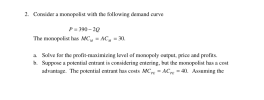
2. Consider a monopolist with the following demand curve 390-20 P = The monopolist has MCM = ACM = 30 a. Solve for the profit-maximizing level of monopoly output, price and profits b. Suppose a potential entrant is considering entering, but the monopolist has a cost advantage. The potential entrant has costs MCPE = ACPE = 40. Assuming the
Only answer A.
2. Consider a monopolist with the following demand curve 390-20 P = The monopolist has MCM = ACM = 30 a. Solve for the profit-maximizing level of monopoly output, price and profits b. Suppose a potential entrant is considering entering, but the monopolist has a cost advantage. The potential entrant has costs MCPE = ACPE = 40. Assuming the
 When unloading, why is the unloading curve parallel to the elastic portion of the loading curve in most metals? Because stiffness is always affected by plastic deformation Because only the elastic strain is recovered Because young's modulus is non-linear variable All of the above 4 UNANSWERED QUESTION 1/4 SKIP FOR NOW 13:27 / 36:04 1x
 5) A monopolist faces A) a perfectly elastic demand curve. B) a perfectly inelastic demand curve. C) a horizontal demand curve. D) a downward-sloping demand curve. E) declining market share. 6) Which one of the following about a monopoly is false? A) A monopoly could make profits in the long run B) A monopoly could break even in the long run. C) A monopoly must have some kind of government privilege or government imposed barrier to maintain its monopoly. D)...
 As long as the demand curve lies above the marginal revenue
curve for a monopolist, at its profit-maximizing output level, it
will charge a price for its product that is
Question7 2 pts As long as the demand curve lies above the marginal revenue curve for a monopolist, at its profit-maximizing output level, it will charge a price for its product that is O above total cost. below marginal cost. O above marginal cost. O above average total cost.
As long as the demand curve lies above the marginal revenue
curve for a monopolist, at its profit-maximizing output level, it
will charge a price for its product that is
Question7 2 pts As long as the demand curve lies above the marginal revenue curve for a monopolist, at its profit-maximizing output level, it will charge a price for its product that is O above total cost. below marginal cost. O above marginal cost. O above average total cost.
 Suppose market demand is a downward sloping linear curve. The monopolist is considering a price on the unit elastic point of its demand curve. If it LOWERS price by small amount then its profits will
 An individual price-taking firm faces a vertical, perfectly elastic demand curve for its output True False
 Only answer A.
2. Consider a monopolist with the following demand curve 390-20 P = The monopolist has MCM = ACM = 30 a. Solve for the profit-maximizing level of monopoly output, price and profits b. Suppose a potential entrant is considering entering, but the monopolist has a cost advantage. The potential entrant has costs MCPE = ACPE = 40. Assuming the
Only answer A.
2. Consider a monopolist with the following demand curve 390-20 P = The monopolist has MCM = ACM = 30 a. Solve for the profit-maximizing level of monopoly output, price and profits b. Suppose a potential entrant is considering entering, but the monopolist has a cost advantage. The potential entrant has costs MCPE = ACPE = 40. Assuming the
Most questions answered within 3 hours.
-
Where is the error in this code sequence?
String s1 = "Hello";
String s2 = "ello";...
asked 10 months ago -
Financial data for Joel de Paris, Inc., for last year
follow:
Joel de Paris, Inc.
Balance...
asked 10 months ago -
Consider this reaction:
Al2(SO4)3 (aq)+ BaCl3
(aq) Al2Cl6 (aq)- +
3BaSO4(s) . What is the...
asked 10 months ago -
Suppose that Savneet is considering increasing her
recent random sample from 20 car rentals to 40...
asked 10 months ago -
Trucks arrive at an unloading terminal at an average rate of 120
per hour.
Trucks arrive...
asked 10 months ago -
Why are methanol and ethanol completely soluble in water while
octanol is not very little soluble....
asked 10 months ago -
A facilities manager at a university reads in a research report
that the mean amount of...
asked 10 months ago -
When the CuSO4 is rehydrated by adding water to the anhydrous
compound, is this an endothermic...
asked 10 months ago -
A ray of sunlight is passing from diamond into crown glass; the
angle of incidence is...
asked 10 months ago -
A block of mass 0.249 kg is placed on top of a light, vertical
spring of...
asked 10 months ago -
how do the kidneys compensate in the presences of acidosis
a) trigger hyperventilate
b) reserve acid...
asked 10 months ago -
Question 501 pts
The rental rate of capital to the firm increases. Which of the
following...
asked 10 months ago