(Discrete Math) Read the following combinatorial proof, and write a theorem that we proved. Explain it...
(Discrete Math) Read the following combinatorial proof, and write a theorem that we proved. Explain it in details.
We count the number of k+1 element subsets of [n+1]. On one hand, it is clearly C(n+1,k+1). On the other hand, we can count these subsets in two steps. First we count the subsets that contain the number n+1. Since have to choose another k elements from {1,2,...,n} for it to make a k+1-element set, the number of these is C(n,k). Then we count the subsets that do not contain the number n+1. This time, we have to choose all k+1 elements from {1,2,...,n}. The number of these is C(n,k+1).
Homework Answers


Add Answer to:
(Discrete Math) Read the following combinatorial proof, and
write a theorem that we proved. Explain it...
Problem 3. Earlier this semester, we proved the Fundamental Theorem of Algebra using an application of...
 Problem 3. Earlier this semester, we proved the Fundamental Theorem of Algebra using an application of Liouville's Theorem. This problem asks you to fill in the details of an alternate proof of the Fundamental Theorem of Algebra that uses Rouché's Theorem. Let p(2) = 20 + 01 + a222 + ... + an-12"-1+ anza be a nonconstant polynomial of degree n > 1. (a) First, we choose R large enough so that, if |:| = R, then ao +213 +222+...+an-12"-1...
In the following problem, we will work through a proof of an important theorem of arithmetic. Your job will be to read the proof carefully and answer some questions about the argument. Theorem (The Di...
 In the following problem, we will work through a proof of an
important theorem of arithmetic. Your job will be to read the proof
carefully and answer some questions about the argument. Theorem
(The Division Algorithm). For any integer n ≥ 0, and for any
positive integer m, there exist integers d and r such that n = dm +
r and 0 ≤ r < m. Proof: (By strong induction on the variable n.)
Let m be an arbitrary...
In the following problem, we will work through a proof of an
important theorem of arithmetic. Your job will be to read the proof
carefully and answer some questions about the argument. Theorem
(The Division Algorithm). For any integer n ≥ 0, and for any
positive integer m, there exist integers d and r such that n = dm +
r and 0 ≤ r < m. Proof: (By strong induction on the variable n.)
Let m be an arbitrary...
Discrete Math: Consider the following theorem: If p is even then p+1 is odd. Can someone...
Discrete Math: Consider the following theorem: If p is even then p+1 is odd. Can someone explain or show how do to these examples? Write a proof by contraposition. (Assume ~q, show ~p) Write a direct proof (Assume p, show ~p) Write a proof by mathematical induction. (Show basis step, assume k^th step, show k+1 step)
Problem 8. (Heap Top-k) Prof Dubious has made the following claim, and has provided a proof Claim. Let n and k be posit...
 Problem 8. (Heap Top-k) Prof Dubious has made the following claim, and has provided a proof Claim. Let n and k be positive integers such that 2*-1n. In amax-heap H of n elements, the top 21 elements are in the first k layers of the heap. Proof. Since is a max-heap, each node in H must satisfy the heap property, i.e., if H, is an element of H with at least one child then Hmaxchldren(H)). We know that every subtree...
1. Both Lagrange's theorem and Cauchy's theorem deal with the relationship between the size of a ...
 1. Both Lagrange's theorem and Cauchy's theorem deal with the relationship between the size of a group and the order of its elements. (a) Explain the difference between the theorems in general terms and by using S7 as an example. Your explanation should include what we can and cannot conclude from each theorem about S7 (b) Which theorem would allow you to prove that if a group contained only elements that had order some power of 2, then the order...
12pts) 1. Both Lagrange's theorem and Cauchy's theorem deal with the relationship between the siz...
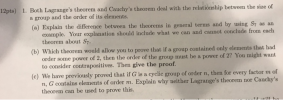 12pts) 1. Both Lagrange's theorem and Cauchy's theorem deal with the relationship between the size of a group and the order of its elements. (a) Explain the difference between the theorems in general terms and by using S, as an example. Your explanation should include what we can and cannot conclude from each theorem about S7. (b) Which theorem would allow you to prove that if a group contained only elements that had order some power of 2, then the...
Discreet mathematics Question 19 6 Assemble an inductive proof to show that the quantity 5-1 is...
 Discreet mathematics
Question 19 6 Assemble an inductive proof to show that the quantity 5-1 is a multiple of 4 for all positive integers n Your proof must not contain redundant elements Write your proof on scratch paper first Base Case: Select Select The n-o case is true, since 5' 1 is a multiple F4 The n=1 case true, since 5 1 = 0 is a multiple of 4 The n-2 case true, since 5 -1- 4 is a multiple...
Discreet mathematics
Question 19 6 Assemble an inductive proof to show that the quantity 5-1 is a multiple of 4 for all positive integers n Your proof must not contain redundant elements Write your proof on scratch paper first Base Case: Select Select The n-o case is true, since 5' 1 is a multiple F4 The n=1 case true, since 5 1 = 0 is a multiple of 4 The n-2 case true, since 5 -1- 4 is a multiple...
10. Read through the following "e-free" proof of the uniform convergence of power series. Does it...
 10. Read through the following "e-free" proof of the uniform convergence of power series. Does it depend on limn→oo lan|1/n or lim supn→oo lan! an)1/n? Explain. 1.3 Theorem. For a given power series Σ ak-a)" define the number R, 0 < R < oo, by n-0 lim sup |an| 1/n, then (a) if |z- a < R, the series converges absolutely (b) if lz-a > R, the terms of the series become unbounded and so the (c) if o<r <...
(A and C) Exercise 1.14. If n and k are integers, define the binomial coeffi- cient...
 (A and C)
Exercise 1.14. If n and k are integers, define the binomial coeffi- cient (m), read n choose k, by n! if 0 <k <n, = 0 otherwise. k!(n - k)! (a) Prove that ("#") = (m) + (-2) for all integers n and k. (b) By definition, () = 1 if k = 0 and 0 otherwise. The recursion relation in (a) gives a computational procedure, Pascal's triangle, for calculating binomial coefficients for small n. Start with...
(A and C)
Exercise 1.14. If n and k are integers, define the binomial coeffi- cient (m), read n choose k, by n! if 0 <k <n, = 0 otherwise. k!(n - k)! (a) Prove that ("#") = (m) + (-2) for all integers n and k. (b) By definition, () = 1 if k = 0 and 0 otherwise. The recursion relation in (a) gives a computational procedure, Pascal's triangle, for calculating binomial coefficients for small n. Start with...
Hi, I would appreciate any help for this problem I don't really understand for discrete math. Tha...
 Hi, I would appreciate any help for this problem I don't really
understand for discrete math. Thanks! (:
15. (P5) Remember, an L-tromino is a shape consisting of three equal squares joined at the edges to form a shape resembling the capital letter L. Consider the following "theorem" "Theorem": For any integer n 1, if one square is removed from a 2·2" × 3·2" checkerboard. the remaining squares can be completely covered by L-shaped trominoes. What follows is a supposed...
Hi, I would appreciate any help for this problem I don't really
understand for discrete math. Thanks! (:
15. (P5) Remember, an L-tromino is a shape consisting of three equal squares joined at the edges to form a shape resembling the capital letter L. Consider the following "theorem" "Theorem": For any integer n 1, if one square is removed from a 2·2" × 3·2" checkerboard. the remaining squares can be completely covered by L-shaped trominoes. What follows is a supposed...
 Problem 3. Earlier this semester, we proved the Fundamental Theorem of Algebra using an application of Liouville's Theorem. This problem asks you to fill in the details of an alternate proof of the Fundamental Theorem of Algebra that uses Rouché's Theorem. Let p(2) = 20 + 01 + a222 + ... + an-12"-1+ anza be a nonconstant polynomial of degree n > 1. (a) First, we choose R large enough so that, if |:| = R, then ao +213 +222+...+an-12"-1...
 In the following problem, we will work through a proof of an
important theorem of arithmetic. Your job will be to read the proof
carefully and answer some questions about the argument. Theorem
(The Division Algorithm). For any integer n ≥ 0, and for any
positive integer m, there exist integers d and r such that n = dm +
r and 0 ≤ r < m. Proof: (By strong induction on the variable n.)
Let m be an arbitrary...
In the following problem, we will work through a proof of an
important theorem of arithmetic. Your job will be to read the proof
carefully and answer some questions about the argument. Theorem
(The Division Algorithm). For any integer n ≥ 0, and for any
positive integer m, there exist integers d and r such that n = dm +
r and 0 ≤ r < m. Proof: (By strong induction on the variable n.)
Let m be an arbitrary...
 Problem 8. (Heap Top-k) Prof Dubious has made the following claim, and has provided a proof Claim. Let n and k be positive integers such that 2*-1n. In amax-heap H of n elements, the top 21 elements are in the first k layers of the heap. Proof. Since is a max-heap, each node in H must satisfy the heap property, i.e., if H, is an element of H with at least one child then Hmaxchldren(H)). We know that every subtree...
 1. Both Lagrange's theorem and Cauchy's theorem deal with the relationship between the size of a group and the order of its elements. (a) Explain the difference between the theorems in general terms and by using S7 as an example. Your explanation should include what we can and cannot conclude from each theorem about S7 (b) Which theorem would allow you to prove that if a group contained only elements that had order some power of 2, then the order...
 12pts) 1. Both Lagrange's theorem and Cauchy's theorem deal with the relationship between the size of a group and the order of its elements. (a) Explain the difference between the theorems in general terms and by using S, as an example. Your explanation should include what we can and cannot conclude from each theorem about S7. (b) Which theorem would allow you to prove that if a group contained only elements that had order some power of 2, then the...
 Discreet mathematics
Question 19 6 Assemble an inductive proof to show that the quantity 5-1 is a multiple of 4 for all positive integers n Your proof must not contain redundant elements Write your proof on scratch paper first Base Case: Select Select The n-o case is true, since 5' 1 is a multiple F4 The n=1 case true, since 5 1 = 0 is a multiple of 4 The n-2 case true, since 5 -1- 4 is a multiple...
Discreet mathematics
Question 19 6 Assemble an inductive proof to show that the quantity 5-1 is a multiple of 4 for all positive integers n Your proof must not contain redundant elements Write your proof on scratch paper first Base Case: Select Select The n-o case is true, since 5' 1 is a multiple F4 The n=1 case true, since 5 1 = 0 is a multiple of 4 The n-2 case true, since 5 -1- 4 is a multiple...
 10. Read through the following "e-free" proof of the uniform convergence of power series. Does it depend on limn→oo lan|1/n or lim supn→oo lan! an)1/n? Explain. 1.3 Theorem. For a given power series Σ ak-a)" define the number R, 0 < R < oo, by n-0 lim sup |an| 1/n, then (a) if |z- a < R, the series converges absolutely (b) if lz-a > R, the terms of the series become unbounded and so the (c) if o<r <...
 (A and C)
Exercise 1.14. If n and k are integers, define the binomial coeffi- cient (m), read n choose k, by n! if 0 <k <n, = 0 otherwise. k!(n - k)! (a) Prove that ("#") = (m) + (-2) for all integers n and k. (b) By definition, () = 1 if k = 0 and 0 otherwise. The recursion relation in (a) gives a computational procedure, Pascal's triangle, for calculating binomial coefficients for small n. Start with...
(A and C)
Exercise 1.14. If n and k are integers, define the binomial coeffi- cient (m), read n choose k, by n! if 0 <k <n, = 0 otherwise. k!(n - k)! (a) Prove that ("#") = (m) + (-2) for all integers n and k. (b) By definition, () = 1 if k = 0 and 0 otherwise. The recursion relation in (a) gives a computational procedure, Pascal's triangle, for calculating binomial coefficients for small n. Start with...
 Hi, I would appreciate any help for this problem I don't really
understand for discrete math. Thanks! (:
15. (P5) Remember, an L-tromino is a shape consisting of three equal squares joined at the edges to form a shape resembling the capital letter L. Consider the following "theorem" "Theorem": For any integer n 1, if one square is removed from a 2·2" × 3·2" checkerboard. the remaining squares can be completely covered by L-shaped trominoes. What follows is a supposed...
Hi, I would appreciate any help for this problem I don't really
understand for discrete math. Thanks! (:
15. (P5) Remember, an L-tromino is a shape consisting of three equal squares joined at the edges to form a shape resembling the capital letter L. Consider the following "theorem" "Theorem": For any integer n 1, if one square is removed from a 2·2" × 3·2" checkerboard. the remaining squares can be completely covered by L-shaped trominoes. What follows is a supposed...
Most questions answered within 3 hours.
-
Where is the error in this code sequence?
String s1 = "Hello";
String s2 = "ello";...
asked 11 months ago -
Financial data for Joel de Paris, Inc., for last year
follow:
Joel de Paris, Inc.
Balance...
asked 11 months ago -
Consider this reaction:
Al2(SO4)3 (aq)+ BaCl3
(aq) Al2Cl6 (aq)- +
3BaSO4(s) . What is the...
asked 11 months ago -
Suppose that Savneet is considering increasing her
recent random sample from 20 car rentals to 40...
asked 11 months ago -
Trucks arrive at an unloading terminal at an average rate of 120
per hour.
Trucks arrive...
asked 11 months ago -
Why are methanol and ethanol completely soluble in water while
octanol is not very little soluble....
asked 11 months ago -
A facilities manager at a university reads in a research report
that the mean amount of...
asked 11 months ago -
When the CuSO4 is rehydrated by adding water to the anhydrous
compound, is this an endothermic...
asked 11 months ago -
A ray of sunlight is passing from diamond into crown glass; the
angle of incidence is...
asked 11 months ago -
A block of mass 0.249 kg is placed on top of a light, vertical
spring of...
asked 11 months ago -
how do the kidneys compensate in the presences of acidosis
a) trigger hyperventilate
b) reserve acid...
asked 11 months ago -
Question 501 pts
The rental rate of capital to the firm increases. Which of the
following...
asked 11 months ago