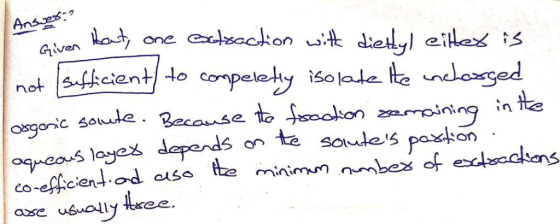
One extraction with diethyl ether is not (blank) to completely isolate the uncharged organic solute. What...
One extraction with diethyl ether is not (blank) to completely isolate the uncharged organic solute. What is the blank?
Homework Answers
For any quires please do
comment in the comment box below. Hope it will helps you. Please
give Thumbs Up!! Thank you for posting the question, All the
best.
Add Answer to:
One extraction with diethyl ether is not (blank) to completely
isolate the uncharged organic solute. What...
A reaction work-up for an aqueous reaction mixture calls for extraction first with diethyl ether and...
A reaction work-up for an aqueous reaction mixture calls for extraction first with diethyl ether and then a wash with saturated aqueous sodium chloride. What two functions does the the saturated sodium chloride wash serve? (usually Brine is not added to the aqueous solution during the first extraction) Group of answer choices It pulls water from the organic layer to dry it. It helps force the organic compound into the organic layer. It degasses the solvent It changes the color...
Extraction of benzoic acid and 9-fluorenone using diethyl ether. (please do not include ethyl 4- aminobenzoate)....
Extraction of benzoic acid and 9-fluorenone using diethyl ether. (please do not include ethyl 4- aminobenzoate). I have to create a flow chart to diagram the key steps of the experiment and isolation of products. 0.100g of benzoic acid and 9-fluorenone are dissolved in diethyl ether. The extraction solvent is 5% sodium hydroxide (to extract the acidic component from the organic phase). Saturated sodium chloride is added to the organic layer. drying the organic solution: anhydrous sodium sulfate is added...
Diethyl ether is a volatile organic compound. The vapor pressure of diethyl ether is 401 mmHg...
Diethyl ether is a volatile organic compound. The vapor pressure of diethyl ether is 401 mmHg at 18oC and the DHvap = 26.0 kJ/mol. Calculate the vapor pressure of diethyl ether at 0oC.
a) If choosing between Dichloromethane and diethyl ether for an extraction solvent, which presents the least...
a) If choosing between Dichloromethane and diethyl ether for an extraction solvent, which presents the least hazard to your health? b) If choosing between ethyl ether and dichloromethane for an extraction solvent, which is safer when considering flammability? c) Is benzoic acid a solid or liquid at room temperature?
Extraction Q1. Why doesn’t the neutral organic compound dissolve in the 1.5 M NaOH solution? Q2....
Extraction Q1. Why doesn’t the neutral organic compound dissolve in the 1.5 M NaOH solution? Q2. Why is diethyl ether a good choice for the organic solvent in this extraction experiment? Q3. What experimental difficulty would you encounter if you neglected to include the drying step before evaporating the ether solution of the neutral organic compound? Q4. Why are the two organic compounds recrystallized before their melting points are determined? Q5. What IR bands are most useful in distinguishing a...
If methylene chloride was used as the organic solvent in solvent extraction, instead of ether, what...
 If methylene chloride was used as the organic solvent in solvent
extraction, instead of ether, what would the top layer be in the
separation step? This is in reference to a Solvent Extraction
experiment.
If methylene chloride was used as the organic solvent in solvent extraction, instead of ether, what would the top layer be in the separation step? 12pt v Paragraph v B I U Av Av Tev :
If methylene chloride was used as the organic solvent in solvent
extraction, instead of ether, what would the top layer be in the
separation step? This is in reference to a Solvent Extraction
experiment.
If methylene chloride was used as the organic solvent in solvent extraction, instead of ether, what would the top layer be in the separation step? 12pt v Paragraph v B I U Av Av Tev :
The two immiscible layers in an extraction are water and diethyl ether. Which compound would you...
The two immiscible layers in an extraction are water and diethyl ether. Which compound would you expect to be the upper layer?
Suppose solute A has a distribution coefficient of 1.0 between water and diethyl ether. Demonstrate that...
Suppose solute A has a distribution coefficient of 1.0 between water and diethyl ether. Demonstrate that if 4.0 mL of a solution of 0.20 g of A in water were extracted with two 1.0-mL portions of ether, a smaller amount of A would remain in the water that if the solution were extracted with one 2.0-mL portion of ether.
5. Suppose you are trying to separate butanoic acid and 4-iodotoluene via extraction with diethyl ether...
 5. Suppose you are trying to separate butanoic acid and 4-iodotoluene via extraction with diethyl ether and water. (a) Look up the structures and draw them below. Predict which reagent would have a greater preference/affinity for the diethyl ether layer (1 pt) (b) Which solvent will be on the bottom in the separatory funnel (or conical vial) (1 pt)? (c) U to the butanoic acid and which layer would it prefer- aqueous or o pon treatment of butanoic acid with...
3. A crude nonacidic product mixture dissolved in diethyl ether contains acetic acid. Describe an extraction...
3. A crude nonacidic product mixture dissolved in diethyl ether contains acetic acid. Describe an extraction procedure that could be used to remove the acetic acid. b. When the two layers form during an ether/water extraction, what would be an easy, convenient way to tell which layer is which if the densities were not available.
 If methylene chloride was used as the organic solvent in solvent
extraction, instead of ether, what would the top layer be in the
separation step? This is in reference to a Solvent Extraction
experiment.
If methylene chloride was used as the organic solvent in solvent extraction, instead of ether, what would the top layer be in the separation step? 12pt v Paragraph v B I U Av Av Tev :
If methylene chloride was used as the organic solvent in solvent
extraction, instead of ether, what would the top layer be in the
separation step? This is in reference to a Solvent Extraction
experiment.
If methylene chloride was used as the organic solvent in solvent extraction, instead of ether, what would the top layer be in the separation step? 12pt v Paragraph v B I U Av Av Tev :
 5. Suppose you are trying to separate butanoic acid and 4-iodotoluene via extraction with diethyl ether and water. (a) Look up the structures and draw them below. Predict which reagent would have a greater preference/affinity for the diethyl ether layer (1 pt) (b) Which solvent will be on the bottom in the separatory funnel (or conical vial) (1 pt)? (c) U to the butanoic acid and which layer would it prefer- aqueous or o pon treatment of butanoic acid with...
Most questions answered within 3 hours.
-
Where is the error in this code sequence?
String s1 = "Hello";
String s2 = "ello";...
asked 10 months ago -
Financial data for Joel de Paris, Inc., for last year
follow:
Joel de Paris, Inc.
Balance...
asked 10 months ago -
Consider this reaction:
Al2(SO4)3 (aq)+ BaCl3
(aq) Al2Cl6 (aq)- +
3BaSO4(s) . What is the...
asked 10 months ago -
Suppose that Savneet is considering increasing her
recent random sample from 20 car rentals to 40...
asked 10 months ago -
Trucks arrive at an unloading terminal at an average rate of 120
per hour.
Trucks arrive...
asked 10 months ago -
Why are methanol and ethanol completely soluble in water while
octanol is not very little soluble....
asked 10 months ago -
A facilities manager at a university reads in a research report
that the mean amount of...
asked 10 months ago -
When the CuSO4 is rehydrated by adding water to the anhydrous
compound, is this an endothermic...
asked 10 months ago -
A ray of sunlight is passing from diamond into crown glass; the
angle of incidence is...
asked 10 months ago -
A block of mass 0.249 kg is placed on top of a light, vertical
spring of...
asked 10 months ago -
how do the kidneys compensate in the presences of acidosis
a) trigger hyperventilate
b) reserve acid...
asked 10 months ago -
Question 501 pts
The rental rate of capital to the firm increases. Which of the
following...
asked 10 months ago