Three liquids are at temperatures of 4 ◦C, 21◦C, and 31◦C, respectively. Equal masses of the...
Three liquids are at temperatures of 4 ◦C, 21◦C, and 31◦C, respectively. Equal masses of the first two liquids are mixed, and the equilibrium temperature is 6◦C. Equal masses of the second and third are then mixed, and the equilibrium temperature is 28◦C. Find the equilibrium temperature when equal masses of the first and third are mixed. Answer in units of ◦C.
Homework Answers
Initial temperature of the first liquid = T1 = 4 oC
Initial temperature of the second liquid = T2 = 21 oC
Initial temperature of the third liquid = T3 = 31 oC
Specific heat of the first liquid = C1
Specific heat of the second liquid = C2
Specific heat of the third liquid = C3
Equilibrium temperature when equal masses of first and second liquid are mixed = T4 = 6 oC
mC1(T4 - T1) = mC2(T2 - T4)
C1(6 - 4) = C2(21 - 6)
C1 = 7.5C2
Equilibrium temperature when equal masses of second and third liquid are mixed = T5 = 28 oC
mC2(T5 - T2) = mC3(T3 - T5)
C2(28 - 21) = C3(31 - 28)
C3 = 2.333C2
Equilibrium temperature when equal masses of first and third liquid are mixed = T6
mC1(T6 - T1) = mC3(T3 - T6)
C1(T6 - 4) = C3(31 - T6)
(7.5C2)(T6 -4) = (2.333C2)(31 - T6)
3.214(T6 - 4) = 31 - T6
3.214T6 - 12.856 = 31 - T6
4.214T6 = 43.856
T6 = 10.407 oC
Equilibrium temperature when equal masses of first and third liquid are mixed is 10.407 oC.
Add Answer to:
Three liquids are at temperatures of 4 ◦C, 21◦C, and 31◦C,
respectively. Equal masses of the...
Three liquids are at temperatures of 8◦C, 21◦C, and 31◦C, respectively. Equal masses of the first...
Three liquids are at temperatures of 8◦C, 21◦C, and 31◦C, respectively. Equal masses of the first two liquids are mixed, and the equi- librium temperature is 13◦C. Equal masses of the second and third are then mixed, and the equilibrium temperature is 23.2◦C. Find the equilibrium temperature when equal masses of the first and third are mixed. Answer in units of ◦C.
Three different liquids are mixed together in a calorimeter. The masses of the liquids are: m1...
Three different liquids are mixed together in a calorimeter. The masses of the liquids are: m1 = 885 g, m2 = 490 g, m3 = 735 g. The specific heats are: c1 = 220 J/kg°C, c2 = 520 J/kg°C, c3 = 885 J/kg°C. The initial temperatures of the liquids are: T1 = 22.5 °C, T2 = 56.0 °C, T3 = 87.0 °C. What will be the temperature of the mixture in Celsius? (Enter only a number without a unit.) The...
Three different liquids are mixed together in a calorimeter. The masses of the liquids are: m1...
Three different liquids are mixed together in a calorimeter. The masses of the liquids are: m1 = 375 g, m2 = 835 g, m3 = 495 g. The specific heats are: c1 = 240 J/kg°C, c2 = 580 J/kg°C, c3 = 900 J/kg°C. The initial temperatures of the liquids are: T1 = 20.5 °C, T2 = 51.5 °C, T3 = 84.5 °C. What will be the temperature of the mixture in Celsius? (Enter only a number without a unit.)
Three different liquids are mixed together in a calorimeter. The masses of the liquids are: m1...
Three different liquids are mixed together in a calorimeter. The masses of the liquids are: m1 = 590 g, m2 = 830 g, m3 = 445 g. The specific heats are: c1 = 285 J/kg°C, c2 = 575 J/kg°C, c3 = 840 J/kg°C. The initial temperatures of the liquids are: T1 = 29.0 °C, T2 = 55.5 °C, T3 = 83.0 °C. What will be the temperature of the mixture in Celsius? (Enter only a number without a unit.)
Three different liquids are mixed together in a calorimeter. The masses of the liquids are: m1...
Three different liquids are mixed together in a calorimeter. The masses of the liquids are: m1 = 725 g, m2 = 615 g, m3 = 785 g. The specific heats are: c1 = 205 J/kg°C, c2 = 500 J/kg°C, c3 = 875 J/kg°C. The initial temperatures of the liquids are: T1 = 30.0 °C, T2 = 60.0 °C, T3 = 80.5 °C. What will be the temperature of the mixture in Celsius? (Enter only a number without a unit.)
Two reservoirs with identical volumes contain different ideal gases. The total masses of the gases are m1 and m2, the temperatures and pressures are equal. When the reservoirs are connected to each o...
 Two reservoirs with identical volumes contain different ideal gases. The total masses of the gases are m1 and m2, the temperatures and pressures are equal. When the reservoirs are connected to each other, the gases mix due to diffusion. Find the entropy change during this process, if the molar masses of the gases are known. (2p)
Two reservoirs with identical volumes contain different ideal gases. The total masses of the gases are m1 and m2, the temperatures and pressures are...
Two reservoirs with identical volumes contain different ideal gases. The total masses of the gases are m1 and m2, the temperatures and pressures are equal. When the reservoirs are connected to each other, the gases mix due to diffusion. Find the entropy change during this process, if the molar masses of the gases are known. (2p)
Two reservoirs with identical volumes contain different ideal gases. The total masses of the gases are m1 and m2, the temperatures and pressures are...
4. Show that two phases are in thermal equilibrium only if the temperatures are the same...
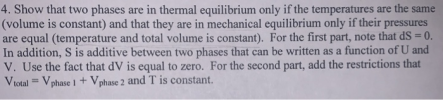 4. Show that two phases are in thermal equilibrium only if the temperatures are the same (volume is constant) and that they are in mechanical equilibrium only if their pressures are equal (temperature and total volume is constant). For the first part, note that ds = 0. In addition, S is additive between two phases that can be written as a function of U and V. Use the fact that dV is equal to zero. For the second part, add...
4. Two masses mi and m2 are connected to three springs of negligible mass having spring constants...
 4. Two masses mi and m2 are connected to three springs of negligible mass having spring constants k1, k2 and k3, respectively. x2=0 Il k, Let xi and x2 represent The motion of the equations: displacements of masses mi and m2 from their equilibrium positions . coupled system is represented by the system of second-order differential d2x dt2 d2x2 Using Laplace transform to solve the system when k1 1 and x1(0) = 0, xi (0)--1 , x2(0) = 0, x(0)-1....
Two initially separated objects, make thermal contact, m_1, c_1 and T_1 are respectively the mass, specific...
Two initially separated objects, make thermal contact, m_1, c_1 and T_1 are respectively the mass, specific heat and temperature of the first object and m_2, c_2 and T_2 are respectively the corresponding of the second object. The initial temperatures are T_20 <T_10. While body 1 slowly cools, 2 heats up slowly. a) Calculate T_2 (T_1) b) Find the change in deltropy entropy as a function of T_1 c) show that deltaS is a maximum when both bodies reach thermal equilibrium
You have two containers of the same liquid. The first container has 110.0 g at T1°C...
You have two containers of the same liquid. The first container has 110.0 g at T1°C and the second has 25 g at 21°C. In order to consolidate and save space, you mix the two liquids into one container and find that the two portions have now reached an equilibrium temperature of 42.6°C. What was the initial temperature of the liquid in the first container?
 Two reservoirs with identical volumes contain different ideal gases. The total masses of the gases are m1 and m2, the temperatures and pressures are equal. When the reservoirs are connected to each other, the gases mix due to diffusion. Find the entropy change during this process, if the molar masses of the gases are known. (2p)
Two reservoirs with identical volumes contain different ideal gases. The total masses of the gases are m1 and m2, the temperatures and pressures are...
Two reservoirs with identical volumes contain different ideal gases. The total masses of the gases are m1 and m2, the temperatures and pressures are equal. When the reservoirs are connected to each other, the gases mix due to diffusion. Find the entropy change during this process, if the molar masses of the gases are known. (2p)
Two reservoirs with identical volumes contain different ideal gases. The total masses of the gases are m1 and m2, the temperatures and pressures are...
 4. Show that two phases are in thermal equilibrium only if the temperatures are the same (volume is constant) and that they are in mechanical equilibrium only if their pressures are equal (temperature and total volume is constant). For the first part, note that ds = 0. In addition, S is additive between two phases that can be written as a function of U and V. Use the fact that dV is equal to zero. For the second part, add...
 4. Two masses mi and m2 are connected to three springs of negligible mass having spring constants k1, k2 and k3, respectively. x2=0 Il k, Let xi and x2 represent The motion of the equations: displacements of masses mi and m2 from their equilibrium positions . coupled system is represented by the system of second-order differential d2x dt2 d2x2 Using Laplace transform to solve the system when k1 1 and x1(0) = 0, xi (0)--1 , x2(0) = 0, x(0)-1....
Most questions answered within 3 hours.
-
Where is the error in this code sequence?
String s1 = "Hello";
String s2 = "ello";...
asked 11 months ago -
Financial data for Joel de Paris, Inc., for last year
follow:
Joel de Paris, Inc.
Balance...
asked 11 months ago -
Consider this reaction:
Al2(SO4)3 (aq)+ BaCl3
(aq) Al2Cl6 (aq)- +
3BaSO4(s) . What is the...
asked 11 months ago -
Suppose that Savneet is considering increasing her
recent random sample from 20 car rentals to 40...
asked 11 months ago -
Trucks arrive at an unloading terminal at an average rate of 120
per hour.
Trucks arrive...
asked 11 months ago -
Why are methanol and ethanol completely soluble in water while
octanol is not very little soluble....
asked 11 months ago -
A facilities manager at a university reads in a research report
that the mean amount of...
asked 11 months ago -
When the CuSO4 is rehydrated by adding water to the anhydrous
compound, is this an endothermic...
asked 11 months ago -
A ray of sunlight is passing from diamond into crown glass; the
angle of incidence is...
asked 11 months ago -
A block of mass 0.249 kg is placed on top of a light, vertical
spring of...
asked 11 months ago -
how do the kidneys compensate in the presences of acidosis
a) trigger hyperventilate
b) reserve acid...
asked 11 months ago -
Question 501 pts
The rental rate of capital to the firm increases. Which of the
following...
asked 11 months ago