Which of the following complexes exhibit geometrical but not optical isomerism? I. Ni(NH3)2Cl2 (square planar) II....
Which of the following complexes exhibit geometrical but not
optical isomerism?
I. Ni(NH3)2Cl2 (square
planar)
II. [Rh(en)3]2+
III. [CoCl2Br
I and III
II
III
II and III
I, II and III
I
I and II
Homework Answers

Add Answer to:
Which of the following complexes exhibit geometrical but not
optical isomerism?
I. Ni(NH3)2Cl2 (square
planar)
II....
Write all the geometrical isomers of [Pt(NH3)(Br)(Cl)(py)] and how many of these will exhibit optical isomerism...
Write all the geometrical isomers of [Pt(NH3)(Br)(Cl)(py)] and how many of these will exhibit optical isomerism ? Here, py = Pyridine
which one of the following can exhibity geometrical isomerism 17. Which one of the following complexes...
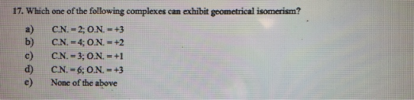 which one of the following can exhibity geometrical
isomerism
17. Which one of the following complexes can exhibit geometrical isomerism? CN. =2;ON =+3 b) CN. =4;0N. - 2 CN. = 3; O.N. = +1 d) CN. = 6; O.N. - +3 None of the above
which one of the following can exhibity geometrical
isomerism
17. Which one of the following complexes can exhibit geometrical isomerism? CN. =2;ON =+3 b) CN. =4;0N. - 2 CN. = 3; O.N. = +1 d) CN. = 6; O.N. - +3 None of the above
Draw structures for the following square planar and octahedral complexes and identify, using appropriate schematics, whether...
Draw structures for the following square planar and octahedral complexes and identify, using appropriate schematics, whether coordination or optical isomerism can exist for each complex: [PdCl2(NH3)2] [Pt(NH3)4]2+ [Ru(2,2´-bipyridine)3]2+ [CoCl3(NH3)3]
Draw structures for the following square planar and octahedral complexes and identify, using appropriate schematics, whether...
Draw structures for the following square planar and octahedral complexes and identify, using appropriate schematics, whether coordination or optical isomerism can exist for each complex: [PdCl2(NH3)2] [Pt(NH3)4]2+ [Ru(2,2´-bipyridine)3]2+ [CoCl3(NH3)3]
State the types of isomerism that may be exhibited by the following complexes, and draw structures...
State the types of isomerism that may be exhibited by the following complexes, and draw structures of the isomers: (a) [Co(en)2(ox)]+ (b) [Cr(ox)2(OH2)2]-, (c) [PtCl2(PPh3)2], (d) [PtCl2(Ph2PCH2CH2PPh2)] and (e) [Co(en)(NH3)2Cl2]+.
5) (20 Pts) a) Ni(II) tends to form a variety of complexes w square-planar geometries, while Pd(I...
 show cft diagram
5) (20 Pts) a) Ni(II) tends to form a variety of complexes w square-planar geometries, while Pd(IID) and PtII) form predominately square-planar complexes, explain using crystal field theory. b) Another striking difference between these three metals is that the NiIV) oxidation state is very rare, while Pd(IV) is more common and Pt(IV) is very common, explain. Show the CFT diagrams for full credit. ith octahedral, tetrahedral and
5) (20 Pts) a) Ni(II) tends to form a variety...
show cft diagram
5) (20 Pts) a) Ni(II) tends to form a variety of complexes w square-planar geometries, while Pd(IID) and PtII) form predominately square-planar complexes, explain using crystal field theory. b) Another striking difference between these three metals is that the NiIV) oxidation state is very rare, while Pd(IV) is more common and Pt(IV) is very common, explain. Show the CFT diagrams for full credit. ith octahedral, tetrahedral and
5) (20 Pts) a) Ni(II) tends to form a variety...
Below is just an example to help answer my questions. 1. What is the difference betweeen...
 Below is just an example to help answer my questions.
1. What is the difference betweeen geometric and optical isomers
and how can you identify them?
17. Which complexes exhibit geometric isomerism? I. [Cr(NH3)s(OH)]2* I. [Cr(en)2C2] III. [Cr(H2O)(NH3)3Cl2] A. I and II B. I and III C. Il and III D. All of them 18. Which of the following complexes has an optical isomer? NH2 A. I only B. Il only C. Both D. Neither NH3, NH3, Br Br NH3...
Below is just an example to help answer my questions.
1. What is the difference betweeen geometric and optical isomers
and how can you identify them?
17. Which complexes exhibit geometric isomerism? I. [Cr(NH3)s(OH)]2* I. [Cr(en)2C2] III. [Cr(H2O)(NH3)3Cl2] A. I and II B. I and III C. Il and III D. All of them 18. Which of the following complexes has an optical isomer? NH2 A. I only B. Il only C. Both D. Neither NH3, NH3, Br Br NH3...
Which of the following complex ions can display optical isomerism ? O [Pt(NH3)4]2+ O [Co(en)3]3+ [CO(NH3)6]3+...
 Which of the following complex ions can display optical isomerism ? O [Pt(NH3)4]2+ O [Co(en)3]3+ [CO(NH3)6]3+ O [CO(NH3)5Cl]2+ O [Pt(NH3)2C12]
Group 10 M(II) complexes are often four-coordinate. For Pd and Pt, these molecules are square planar...
Group 10 M(II) complexes are often four-coordinate. For Pd and Pt, these molecules are square planar (with few exceptions). However, for Ni(II), tetrahedral complexes are common. Give at least one plausible explanation for this observation.
Which of the following compounds can exhibit fac-mer isomerism? [V(NH3)2(H2O)4]2+ [Cu(CO)5I]+ [Cr(H2O)4Br2]+ [Ni(CO)5NO2]2+ [Fe(H2O)3(CO)3]3+
Which of the following compounds can exhibit fac-mer isomerism? [V(NH3)2(H2O)4]2+ [Cu(CO)5I]+ [Cr(H2O)4Br2]+ [Ni(CO)5NO2]2+ [Fe(H2O)3(CO)3]3+
 which one of the following can exhibity geometrical
isomerism
17. Which one of the following complexes can exhibit geometrical isomerism? CN. =2;ON =+3 b) CN. =4;0N. - 2 CN. = 3; O.N. = +1 d) CN. = 6; O.N. - +3 None of the above
which one of the following can exhibity geometrical
isomerism
17. Which one of the following complexes can exhibit geometrical isomerism? CN. =2;ON =+3 b) CN. =4;0N. - 2 CN. = 3; O.N. = +1 d) CN. = 6; O.N. - +3 None of the above
 show cft diagram
5) (20 Pts) a) Ni(II) tends to form a variety of complexes w square-planar geometries, while Pd(IID) and PtII) form predominately square-planar complexes, explain using crystal field theory. b) Another striking difference between these three metals is that the NiIV) oxidation state is very rare, while Pd(IV) is more common and Pt(IV) is very common, explain. Show the CFT diagrams for full credit. ith octahedral, tetrahedral and
5) (20 Pts) a) Ni(II) tends to form a variety...
show cft diagram
5) (20 Pts) a) Ni(II) tends to form a variety of complexes w square-planar geometries, while Pd(IID) and PtII) form predominately square-planar complexes, explain using crystal field theory. b) Another striking difference between these three metals is that the NiIV) oxidation state is very rare, while Pd(IV) is more common and Pt(IV) is very common, explain. Show the CFT diagrams for full credit. ith octahedral, tetrahedral and
5) (20 Pts) a) Ni(II) tends to form a variety...
 Below is just an example to help answer my questions.
1. What is the difference betweeen geometric and optical isomers
and how can you identify them?
17. Which complexes exhibit geometric isomerism? I. [Cr(NH3)s(OH)]2* I. [Cr(en)2C2] III. [Cr(H2O)(NH3)3Cl2] A. I and II B. I and III C. Il and III D. All of them 18. Which of the following complexes has an optical isomer? NH2 A. I only B. Il only C. Both D. Neither NH3, NH3, Br Br NH3...
Below is just an example to help answer my questions.
1. What is the difference betweeen geometric and optical isomers
and how can you identify them?
17. Which complexes exhibit geometric isomerism? I. [Cr(NH3)s(OH)]2* I. [Cr(en)2C2] III. [Cr(H2O)(NH3)3Cl2] A. I and II B. I and III C. Il and III D. All of them 18. Which of the following complexes has an optical isomer? NH2 A. I only B. Il only C. Both D. Neither NH3, NH3, Br Br NH3...
 Which of the following complex ions can display optical isomerism ? O [Pt(NH3)4]2+ O [Co(en)3]3+ [CO(NH3)6]3+ O [CO(NH3)5Cl]2+ O [Pt(NH3)2C12]
Most questions answered within 3 hours.
-
Where is the error in this code sequence?
String s1 = "Hello";
String s2 = "ello";...
asked 10 months ago -
Financial data for Joel de Paris, Inc., for last year
follow:
Joel de Paris, Inc.
Balance...
asked 10 months ago -
Consider this reaction:
Al2(SO4)3 (aq)+ BaCl3
(aq) Al2Cl6 (aq)- +
3BaSO4(s) . What is the...
asked 10 months ago -
Suppose that Savneet is considering increasing her
recent random sample from 20 car rentals to 40...
asked 10 months ago -
Trucks arrive at an unloading terminal at an average rate of 120
per hour.
Trucks arrive...
asked 10 months ago -
Why are methanol and ethanol completely soluble in water while
octanol is not very little soluble....
asked 10 months ago -
A facilities manager at a university reads in a research report
that the mean amount of...
asked 10 months ago -
When the CuSO4 is rehydrated by adding water to the anhydrous
compound, is this an endothermic...
asked 10 months ago -
A ray of sunlight is passing from diamond into crown glass; the
angle of incidence is...
asked 10 months ago -
A block of mass 0.249 kg is placed on top of a light, vertical
spring of...
asked 10 months ago -
how do the kidneys compensate in the presences of acidosis
a) trigger hyperventilate
b) reserve acid...
asked 10 months ago -
Question 501 pts
The rental rate of capital to the firm increases. Which of the
following...
asked 10 months ago