when a gas molecule dissolve in liquids to form a saturated system, the process is usually
Homework Answers
Answer :-
The process os usually exothermic because heat is being released by gaseous molecules in the solution.
Add Answer to:
when a gas molecule dissolve in liquids to form a saturated system,
the process is usually
When some crystals of NH4NO3 dissolve in water in a beaker, the temperature of the water...
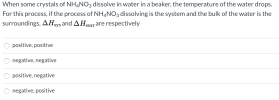 When some crystals of NH4NO3 dissolve in water in a beaker, the temperature of the water drops. For this process, if the process of NH4NO3 dissolving is the system and the bulk of the water is the surroundings, AHsys and AHsurr are respectively o positive, positive o negative, negative o positive, negative o negative, positive
How does the entropy of the system change when: a.) the temperature of the system increases b.) the volume of a gas...
How does the entropy of the system change when: a.) the temperature of the system increases b.) the volume of a gas increases c.) equal volumes of ethanol and water are mixed to form a solution Please provide why it increases or decreases.
9) An increase in the temperature of a solution usually A) increases the boiling point. B)...
 9) An increase in the temperature of a solution usually A) increases the boiling point. B) increases the solubility of a gas in the solution. C) increases the solubility of a solid solute in the solution. D) decreases the solubility of a solid solute in the solution. E) decreases the solubility of a liquid solute in the solution. 10) The solubility of Kl is 50 g in 100 g of H20 at 20°C. If 110 grams of Kl are added...
Carbonated beverages are manufactured to dissolve carbon dioxide gas at high pressure that is released when...
Carbonated beverages are manufactured to dissolve carbon dioxide gas at high pressure that is released when the can is opened so that the beverage is more refreshing to the consumer. How many grams of dissolved carbon dioxide is in a 355mL can of soda at 20 degrees Celcius if the manufacturer used a pressure of 2.4 atm of CO2 to carbonate the pop? The Henry's law constant for carbon dioxide dissolving in water is 3.5*10-2 mol/L*atm at 20 degrees Celcius.
The work done on an ideal gas system in an isothermal gas process is negative 400...
The work done on an ideal gas system in an isothermal gas process is negative 400 space J o u l e s. What is the change in internal (thermal) energy of the gas? a. 0 joules b. -400j c. 400j b. 200
Hydrogen gas combusts when combined with oxygen gas to form water gas. Write a complete chemical...
Hydrogen gas combusts when combined with oxygen gas to form water gas. Write a complete chemical reaction, included phases of products and reactants.
When two volatile liquids, X and Y, are mixed, the solution process involves 1. breaking the...
 When two volatile liquids, X and Y, are mixed, the solution process involves 1. breaking the intermolecular X--X and Y...Y attractions, and 2. forming new X...Y attractions. Complete the table describing how the relative strengths of these attractive forces affect vapor pressure and enthalpy of solution. Raoult's law deviations AH Strength of the attractive forces X X , Y..Y, and X...Y are equal X...Y is strongest X...Y is weakest Answer Bank negative positive zero
-Indicate the state (solid, liquid, gas, aqueous) -Some precipitates may dissolve in excess reagent to form...
 -Indicate the state (solid, liquid, gas, aqueous)
-Some precipitates may dissolve in excess reagent to form
complex ion SO4
- If no reaction write NR
For only #1-4, & #6-7, write the balanced molecular, ionic,
and net ionic equations:
1. AlCl3(aq) + AgNO3 (aq) 2. K2CO3(aq) + H2SO4 (aq) 3. MgCl2(aq) + NaOH (aq) 4. CuSO4(aq) + excess NH3(aq) 5. Ba(NO3)2(aq) + ZnSO4(aq) 6. Mg(OH)2(aq) + NaOH(aq) 7. AlCl3(aq) + excess NaOH(aq) 8. ZnSO4(aq) + NH3(aq) 9. Ba(NO3)2(aq) + AlCl3(aq)...
-Indicate the state (solid, liquid, gas, aqueous)
-Some precipitates may dissolve in excess reagent to form
complex ion SO4
- If no reaction write NR
For only #1-4, & #6-7, write the balanced molecular, ionic,
and net ionic equations:
1. AlCl3(aq) + AgNO3 (aq) 2. K2CO3(aq) + H2SO4 (aq) 3. MgCl2(aq) + NaOH (aq) 4. CuSO4(aq) + excess NH3(aq) 5. Ba(NO3)2(aq) + ZnSO4(aq) 6. Mg(OH)2(aq) + NaOH(aq) 7. AlCl3(aq) + excess NaOH(aq) 8. ZnSO4(aq) + NH3(aq) 9. Ba(NO3)2(aq) + AlCl3(aq)...
Identify the highest energy molecular process that occurs when a molecule absorbs a microwave photon. Identify...
 Identify the highest energy molecular process that occurs when a molecule absorbs a microwave photon. Identify the highest energy molecular process that occurs when a molecule absorbs an infrared photon. O molecular rotation O bond breakage O molecular vibration O electronic excitation O molecular vibration O bond breakage O electronic excitation O molecular rotation Identify the highest energy molecular process that occurs when a molecule absorbs a visible photon. Identify the highest energy molecular process that occurs when a molecule...
During a constant pressure, nonflow (closed system) process, a gas loses 103 BTUs of heat to...
During a constant pressure, nonflow (closed system) process, a gas loses 103 BTUs of heat to the surroundings while it's volume changes from 2.2 ft3 to 0.7 ft3. If the temperature of the gas decreases by 7 oF and the system contains 3.3 lbm of gas, find the absolute pressure of the system in lbf/in2. cV for this gas is 0.229 BTU/lbm-oF. (Hint: For this process, ∆U = mcV∆T even though the process is not carried out at constant volume). State...
 When some crystals of NH4NO3 dissolve in water in a beaker, the temperature of the water drops. For this process, if the process of NH4NO3 dissolving is the system and the bulk of the water is the surroundings, AHsys and AHsurr are respectively o positive, positive o negative, negative o positive, negative o negative, positive
 9) An increase in the temperature of a solution usually A) increases the boiling point. B) increases the solubility of a gas in the solution. C) increases the solubility of a solid solute in the solution. D) decreases the solubility of a solid solute in the solution. E) decreases the solubility of a liquid solute in the solution. 10) The solubility of Kl is 50 g in 100 g of H20 at 20°C. If 110 grams of Kl are added...
 When two volatile liquids, X and Y, are mixed, the solution process involves 1. breaking the intermolecular X--X and Y...Y attractions, and 2. forming new X...Y attractions. Complete the table describing how the relative strengths of these attractive forces affect vapor pressure and enthalpy of solution. Raoult's law deviations AH Strength of the attractive forces X X , Y..Y, and X...Y are equal X...Y is strongest X...Y is weakest Answer Bank negative positive zero
 -Indicate the state (solid, liquid, gas, aqueous)
-Some precipitates may dissolve in excess reagent to form
complex ion SO4
- If no reaction write NR
For only #1-4, & #6-7, write the balanced molecular, ionic,
and net ionic equations:
1. AlCl3(aq) + AgNO3 (aq) 2. K2CO3(aq) + H2SO4 (aq) 3. MgCl2(aq) + NaOH (aq) 4. CuSO4(aq) + excess NH3(aq) 5. Ba(NO3)2(aq) + ZnSO4(aq) 6. Mg(OH)2(aq) + NaOH(aq) 7. AlCl3(aq) + excess NaOH(aq) 8. ZnSO4(aq) + NH3(aq) 9. Ba(NO3)2(aq) + AlCl3(aq)...
-Indicate the state (solid, liquid, gas, aqueous)
-Some precipitates may dissolve in excess reagent to form
complex ion SO4
- If no reaction write NR
For only #1-4, & #6-7, write the balanced molecular, ionic,
and net ionic equations:
1. AlCl3(aq) + AgNO3 (aq) 2. K2CO3(aq) + H2SO4 (aq) 3. MgCl2(aq) + NaOH (aq) 4. CuSO4(aq) + excess NH3(aq) 5. Ba(NO3)2(aq) + ZnSO4(aq) 6. Mg(OH)2(aq) + NaOH(aq) 7. AlCl3(aq) + excess NaOH(aq) 8. ZnSO4(aq) + NH3(aq) 9. Ba(NO3)2(aq) + AlCl3(aq)...
 Identify the highest energy molecular process that occurs when a molecule absorbs a microwave photon. Identify the highest energy molecular process that occurs when a molecule absorbs an infrared photon. O molecular rotation O bond breakage O molecular vibration O electronic excitation O molecular vibration O bond breakage O electronic excitation O molecular rotation Identify the highest energy molecular process that occurs when a molecule absorbs a visible photon. Identify the highest energy molecular process that occurs when a molecule...
Most questions answered within 3 hours.
-
Where is the error in this code sequence?
String s1 = "Hello";
String s2 = "ello";...
asked 10 months ago -
Financial data for Joel de Paris, Inc., for last year
follow:
Joel de Paris, Inc.
Balance...
asked 10 months ago -
Consider this reaction:
Al2(SO4)3 (aq)+ BaCl3
(aq) Al2Cl6 (aq)- +
3BaSO4(s) . What is the...
asked 10 months ago -
Suppose that Savneet is considering increasing her
recent random sample from 20 car rentals to 40...
asked 10 months ago -
Trucks arrive at an unloading terminal at an average rate of 120
per hour.
Trucks arrive...
asked 10 months ago -
Why are methanol and ethanol completely soluble in water while
octanol is not very little soluble....
asked 10 months ago -
A facilities manager at a university reads in a research report
that the mean amount of...
asked 10 months ago -
When the CuSO4 is rehydrated by adding water to the anhydrous
compound, is this an endothermic...
asked 10 months ago -
A ray of sunlight is passing from diamond into crown glass; the
angle of incidence is...
asked 10 months ago -
A block of mass 0.249 kg is placed on top of a light, vertical
spring of...
asked 10 months ago -
how do the kidneys compensate in the presences of acidosis
a) trigger hyperventilate
b) reserve acid...
asked 10 months ago -
Question 501 pts
The rental rate of capital to the firm increases. Which of the
following...
asked 10 months ago