At t = 0, a particle is located at x = 35 m and has a...
At t = 0, a particle is located at x = 35 m and has a velocity of 25 m/s in the positive x direction. The acceleration of the particle varies with time as shown in the diagram. What is the velocity of the particle at t = 5.0 s?
Homework Answers
 Here
please comment your accelaration curve. Thank you. Please like the
answer ASAP.
Here
please comment your accelaration curve. Thank you. Please like the
answer ASAP.
A particle starts from the origin at t = 0 and moves along the positive x axis. A graph of the velocity of the particle as a function of the time is shown in the figure;
 A particle starts from the origin at t = 0 and moves along the positive x axis. A graph of the velocity of the particle as a function of the time is shown in the figure; the v-axis scale is set by vs = 6.0 m/s. (a) what is the coordinate of the particle at t = 5.0 s? (b) what is the velocity of the particle at t = 5.0 s? (c) what is the acceleration of the particle...
The velocity of a particle moving along the x axis is given for t > 0...
The velocity of a particle moving along the x axis is given for t > 0 by vx = (32.0 − 2.00t2) m/s, where t is in s. What is the acceleration of the particle when (after t = 0) it achieves its maximum displacement in the positive x direction?
At t = 0, a particle leaves the origin with a velocity of 9 0 m/s...
 At t = 0, a particle leaves the origin with a velocity of 9 0 m/s in the positive y direction and moves in the xy plane with a constant acceleration of (2.0i - 4.0j)m/s^2. At the instant the x coordinate of the particle is 15 m, what is the speed of the particle? 10m/S 16 m/s 12 m/s 14 m/s 26 m/s
A particle initially located at the origin has an acceleration of vector a = 2.00ĵ m/s2...
A particle initially located at the origin has an acceleration of vector a = 2.00ĵ m/s2 and an initial velocity of vector v i = 6.00î m/s. (a) Find the vector position of the particle at any time t (where t is measured in seconds). ( t î + t2 ĵ) m (b) Find the velocity of the particle at any time t. ( î + t ĵ) m/s (c) Find the coordinates of the particle at t = 3.00...
A particle initially located at the origin has an acceleration of vector a = 4.00ĵ m/s2...
A particle initially located at the origin has an acceleration of vector a = 4.00ĵ m/s2 and an initial velocity of vector v i = 9.00î m/s. (a) Find the vector position of the particle at any time t (where t is measured in seconds). ( t î + t2 ĵ) m (b) Find the velocity of the particle at any time t. ( î + t ĵ) m/s (c) Find the coordinates of the particle at t = 9.00...
A particle starts from the origin at t = 0 with an initial velocity of 5.0...
 A particle starts from the origin at t = 0 with an initial
velocity of 5.0 m/s along the positive x axis. If the acceleration
is (–3.0i + 4.5j) m/s^2, determine the velocity and position of the
particle at the moment it reaches its maximum x coordinate.
Can someone explain why
when the particle reaches it maximum x coordinate?
A particle starts from the origin at t = 0 with an initial
velocity of 5.0 m/s along the positive x axis. If the acceleration
is (–3.0i + 4.5j) m/s^2, determine the velocity and position of the
particle at the moment it reaches its maximum x coordinate.
Can someone explain why
when the particle reaches it maximum x coordinate?
At time t = 0, a 4.0 kg particle with velocity v = (5.0 m/s) i...
 At time t = 0, a 4.0 kg particle with velocity v = (5.0 m/s) i - (6.0 m/s) j is at x = 6.0 m, y = 5.0 m. It is pulled by a 2.0 N force in the negative x direction. What is the angular momentum of the particle about the origin? (Express your answer in vector form.) What torque about the origin acts on the particle? (Express your answer in vector form.) At what rate is the...
At time t = 0, a particle has a charge of 11 pc, is located in...
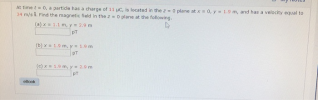 At time t = 0, a particle has a charge of 11 pc, is located in the z = 0 plane at x = 0, y = 1.9 m, and has a velocity equal to 34 m/s i. Find the magnetic field in the z = 0 plane at the following. (a) x = 1.1 m, y = 2.9 m PT (b) x = 1.9 m, y = 1.9 m DT (c) x = 1.9 m, y = 2.9 m...
A particle initially located at the origin has an initial velocity of vi = 30.0 î...
A particle initially located at the origin has an initial velocity of vi = 30.0 î m/s + 50.0 ĵ m/s. If the velocity of the particle at t = 5.0 s is v = 12.0 î m/s + 60.0 ĵ m/s, what is the particle's acceleration (in m/s2)? (Express your answer in vector form.)
I'm having problems figuring out the equations for these questions. a detailed explanation would be great...
 I'm having problems figuring out the equations for
these questions. a detailed explanation would be great in showing
which equations was used and solving them, thank you much.
At 1-0, a particle is located at x-25 m and has a velocity of 15 m/s in the positive x direction. The acceleration of the particle varies with time as shown in the diagram. What is the velocity of the particle at t 5.0 s? ex (mis) 6.0 50 40 30 20...
I'm having problems figuring out the equations for
these questions. a detailed explanation would be great in showing
which equations was used and solving them, thank you much.
At 1-0, a particle is located at x-25 m and has a velocity of 15 m/s in the positive x direction. The acceleration of the particle varies with time as shown in the diagram. What is the velocity of the particle at t 5.0 s? ex (mis) 6.0 50 40 30 20...
 At t = 0, a particle leaves the origin with a velocity of 9 0 m/s in the positive y direction and moves in the xy plane with a constant acceleration of (2.0i - 4.0j)m/s^2. At the instant the x coordinate of the particle is 15 m, what is the speed of the particle? 10m/S 16 m/s 12 m/s 14 m/s 26 m/s
 A particle starts from the origin at t = 0 with an initial
velocity of 5.0 m/s along the positive x axis. If the acceleration
is (–3.0i + 4.5j) m/s^2, determine the velocity and position of the
particle at the moment it reaches its maximum x coordinate.
Can someone explain why
when the particle reaches it maximum x coordinate?
A particle starts from the origin at t = 0 with an initial
velocity of 5.0 m/s along the positive x axis. If the acceleration
is (–3.0i + 4.5j) m/s^2, determine the velocity and position of the
particle at the moment it reaches its maximum x coordinate.
Can someone explain why
when the particle reaches it maximum x coordinate?
 At time t = 0, a 4.0 kg particle with velocity v = (5.0 m/s) i - (6.0 m/s) j is at x = 6.0 m, y = 5.0 m. It is pulled by a 2.0 N force in the negative x direction. What is the angular momentum of the particle about the origin? (Express your answer in vector form.) What torque about the origin acts on the particle? (Express your answer in vector form.) At what rate is the...
 At time t = 0, a particle has a charge of 11 pc, is located in the z = 0 plane at x = 0, y = 1.9 m, and has a velocity equal to 34 m/s i. Find the magnetic field in the z = 0 plane at the following. (a) x = 1.1 m, y = 2.9 m PT (b) x = 1.9 m, y = 1.9 m DT (c) x = 1.9 m, y = 2.9 m...
 I'm having problems figuring out the equations for
these questions. a detailed explanation would be great in showing
which equations was used and solving them, thank you much.
At 1-0, a particle is located at x-25 m and has a velocity of 15 m/s in the positive x direction. The acceleration of the particle varies with time as shown in the diagram. What is the velocity of the particle at t 5.0 s? ex (mis) 6.0 50 40 30 20...
I'm having problems figuring out the equations for
these questions. a detailed explanation would be great in showing
which equations was used and solving them, thank you much.
At 1-0, a particle is located at x-25 m and has a velocity of 15 m/s in the positive x direction. The acceleration of the particle varies with time as shown in the diagram. What is the velocity of the particle at t 5.0 s? ex (mis) 6.0 50 40 30 20...
Most questions answered within 3 hours.
-
Where is the error in this code sequence?
String s1 = "Hello";
String s2 = "ello";...
asked 11 months ago -
Financial data for Joel de Paris, Inc., for last year
follow:
Joel de Paris, Inc.
Balance...
asked 11 months ago -
Consider this reaction:
Al2(SO4)3 (aq)+ BaCl3
(aq) Al2Cl6 (aq)- +
3BaSO4(s) . What is the...
asked 11 months ago -
Suppose that Savneet is considering increasing her
recent random sample from 20 car rentals to 40...
asked 11 months ago -
Trucks arrive at an unloading terminal at an average rate of 120
per hour.
Trucks arrive...
asked 11 months ago -
Why are methanol and ethanol completely soluble in water while
octanol is not very little soluble....
asked 11 months ago -
A facilities manager at a university reads in a research report
that the mean amount of...
asked 11 months ago -
When the CuSO4 is rehydrated by adding water to the anhydrous
compound, is this an endothermic...
asked 11 months ago -
A ray of sunlight is passing from diamond into crown glass; the
angle of incidence is...
asked 11 months ago -
A block of mass 0.249 kg is placed on top of a light, vertical
spring of...
asked 11 months ago -
how do the kidneys compensate in the presences of acidosis
a) trigger hyperventilate
b) reserve acid...
asked 11 months ago -
Question 501 pts
The rental rate of capital to the firm increases. Which of the
following...
asked 11 months ago