Which of the following statements are true and which are false ? Correct the false one...
Which of the following statements are true and which are false ? Correct the false one
a. Labor wages are a variable cost.
b. A book cost is just another word for a cost that
generates a cash flow.
c. Total overhead costs are independent of the capacity
of an operation (e.g., the size of a manufacturing
plant).
d. Depreciation is a type of cash flow.
e. Thesizeofsunkcostsshouldnotaffecttheprojection
of future cash flows.
f. The sale of assets can be used to offset disposal costs.
g. For a perfect monopoly to exist, there must be no
substitute goods available.
h. The opportunity cost of money is usually measured
by the interest that could be earned by depositing
the money.
i. All firms want to operate at the level of economic
breakeven.
j. Perfect competition incorporates the free entry and
exit of firms in the market.
k. The cost-volume relationship indicates that firms
ought to operate at the point of maximum revenue.
l. Life-cycle costs are the sum of all costs associated
with a product over its lifespan.
m. Direct costs are commonly referred to as the
overhead costs of a manufacturing plant.
n. The fastest increase in cumulative committed life-
cycle costs occurs in the acquisition phase.
o. Private cars are consumer goods while trucks are
producer goods.
p. The non-refundable cost of setting up an operation
(e.g., the cost of building a factory) is not considered
a type of opportunity cost.
q. There is no D
∗
for this situation: p = 50 − 0.1D and
C
T
= $100 + $30D.
r. More than one economic breakeven point may exist
for a given manufacturing plant.
s. Firms attempt to reduce costs so as to increase the
level of production at which economic breakeven
occurs.
Homework Answers
a. Labour wages are considered to come under both fixed as well as variable cost. In other words its semi-variable cost. Wages paid to workers for their regular hours are a fixed cost. Any extra time they spend on the job is a variable cost.
b. False. A book cost is not a cash flow, but it is an accounting entry that represents some change in a given value.
c. False. Total Overhead Cost are expenses associated with the maintenance and administration of a business on a day-to-day basis. The total operating cost for a company includes the cost of goods sold, operating expenses as well as overhead expenses.
d. True. depreciation affects cash flow by reducing the amount of cash a business must pay in income taxes.
e. False. Sunk costs are the cost that has already occured in the past and are thus irrecoverable.
f. False. Sale proceeds are shown in the credit side of the asset account , when the asset is sold at their end of its useful life. The Profit or The Loss incurred is shown in the P/L Acount
g. True.
h. False. Opportunity cost is the value of the next best alternative or option. This value may or may not be measured in money.
i.True.
j.True.
k. True.
l.True.
m. False. Indirect cost are the overhead expense of manufacturing plant.
n.
o. True.
p. True.
q.
r. True.
s.True.
Add Answer to:
Which of the following statements are true and which are false ?
Correct the false one...
Question 2 Part A (2 points): Select "True" or "False" and correct false statements and mark...
 Question 2 Part A (2 points): Select "True" or "False" and correct false statements and mark your answers in the talte ast page: 1. When developing feasible alternatives, the "nominal group technique" aims at incorporating individual ideas into a group consensus. It also removes the undesirable effect of classical brainstorming. True False 2. For solutions to engineering problems to be economically acceptable, the long-term benefits of these solutions must be equal or more than their long-term costs, among other things....
1. Which of the following statements is false? a. Explicit costs of using market-supplied resources entail...
1. Which of the following statements is false? a. Explicit costs of using market-supplied resources entail an opportunity cost equal to the dollar cost of obtaining the resources in the market. b. When economic profit is zero, the firm’s owners could NOT have done better putting their resources in some other industry of comparable risk. c. If economic profit is positive, accounting profit must also be positive. d. If economic profit is negative, accounting profit must also be negative. e....
Indicate the following statements as true or false. If the statement is true, write a "T" as the answer; otherwise, write an "F 1. COGS is the material cost in making a product In a p...
 Indicate the following statements as true or false. If the statement is true, write a "T" as the answer; otherwise, write an "F 1. COGS is the material cost in making a product In a perfect world, COGS would be fully variable. 2. SG&A is a measure of the variable cost of an incremental sale. 3. Fortunes of a manufacturing company are tied to the total sales of the company. 4. The information of COGS cannot be found in publicly...
Question 2 [10] TRUE/FALSE QUESTIONS Consider the following list of statements. Each statement is either true...
 Question 2 [10] TRUE/FALSE QUESTIONS Consider the following list of statements. Each statement is either true or false. You must read each statement carefully and then select the option that you believe is correct as your answer. Write down only the question number and next to the number either True or False. 2.1 A change in the size of the population due to a change in birth or death rates will not shift the market supply labour curve. Normal profit...
[48 marks-6 marks each] True, False, or Uncertain Explain why each of the following statements is...
 [48 marks-6 marks each] True, False, or Uncertain Explain why each of the following statements is True, False, or Uncertain according to economic principles. Use diagrams where appropriate. Unsupported answers will receive no marks. It is the explanation that is important tin tiels ... TL A1-4. If a country has a standard production possibilities boundary (PPB) between national defense goods and "other goods", then an increase in defense spending means that the opportunity cost of "other goods" will rise A1-5....
Indicate if the following questions are True or False. Explain “Why” your answer is True or False. It is good to incur high opportunity costs for an activity one is engaged in. Why? Price of elastici...
Indicate if the following questions are True or False. Explain “Why” your answer is True or False. It is good to incur high opportunity costs for an activity one is engaged in. Why? Price of elasticity measures vary along the demand curve. Why? Employing economic cost/profit instead of accounting cost/profit when making business decisions tend to generate more efficient or superior economic results for firms. Why? Firms do not try to maximize their output. Why?
Which of the following does NOT apply? Monopolistically competitive firms operate (produce) where marginal cost crosses...
Which of the following does NOT apply? Monopolistically competitive firms operate (produce) where marginal cost crosses marginal revenue. violate the efficiency conditions because they don’t produce the maximum number of goods and services possible (not producing where the average cost curve is at the bottom). meet the conditions of equity, because all costs (including opportunity costs) are under (or tangent to) the demand curve (average revenue). earn economic profit (economic rent, producer surplus) in the long run. 2.)At long-run equilibrium...
7) Which of the following statements is FALSE? A) The IRR investment rule will identify the...
 7) Which of the following statements is FALSE? A) The IRR investment rule will identify the correct decision in many, but not all, situations. B) By setting the NPV equal to zero and solving for r, we find the IRR. C) If you are unsure of your cost of capital estimate, it is important to determine how sensitive your analysis is to errors in this estimate. D) The simplest investment rule is the NPV investment rule. 8) Which of the...
(a) Which one of the following statements is not correct? Built-in stability implies there is automatic...
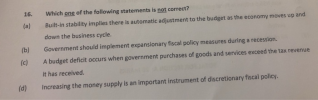 (a) Which one of the following statements is not correct? Built-in stability implies there is automatic adjustment to the budget as the economy moves up and down the business cycle. Government should implement expansionary fiscal policy measures during a recession. A budget deficit occurs when government purchases of goods and services exceed the tax revenue it has received Increasing the money supply is an important instrument of discretionary fiscal policy. (d)
Please indicate whether the following statements are true or false by circling a T or an...
Please indicate whether the following statements are true or false by circling a T or an F (true or false) 1. Direct and indirect materials may both come from the same source [ ] [ ] 2. Factory overhead includes the cost of selling and advertising the product [ ] [ ] 3. Fixed costs remain constant in total, the average fixed costs becomes progressively smaller as the level of activity increases [ ] [ ] 4....
 Question 2 Part A (2 points): Select "True" or "False" and correct false statements and mark your answers in the talte ast page: 1. When developing feasible alternatives, the "nominal group technique" aims at incorporating individual ideas into a group consensus. It also removes the undesirable effect of classical brainstorming. True False 2. For solutions to engineering problems to be economically acceptable, the long-term benefits of these solutions must be equal or more than their long-term costs, among other things....
 Indicate the following statements as true or false. If the statement is true, write a "T" as the answer; otherwise, write an "F 1. COGS is the material cost in making a product In a perfect world, COGS would be fully variable. 2. SG&A is a measure of the variable cost of an incremental sale. 3. Fortunes of a manufacturing company are tied to the total sales of the company. 4. The information of COGS cannot be found in publicly...
 Question 2 [10] TRUE/FALSE QUESTIONS Consider the following list of statements. Each statement is either true or false. You must read each statement carefully and then select the option that you believe is correct as your answer. Write down only the question number and next to the number either True or False. 2.1 A change in the size of the population due to a change in birth or death rates will not shift the market supply labour curve. Normal profit...
 [48 marks-6 marks each] True, False, or Uncertain Explain why each of the following statements is True, False, or Uncertain according to economic principles. Use diagrams where appropriate. Unsupported answers will receive no marks. It is the explanation that is important tin tiels ... TL A1-4. If a country has a standard production possibilities boundary (PPB) between national defense goods and "other goods", then an increase in defense spending means that the opportunity cost of "other goods" will rise A1-5....
 7) Which of the following statements is FALSE? A) The IRR investment rule will identify the correct decision in many, but not all, situations. B) By setting the NPV equal to zero and solving for r, we find the IRR. C) If you are unsure of your cost of capital estimate, it is important to determine how sensitive your analysis is to errors in this estimate. D) The simplest investment rule is the NPV investment rule. 8) Which of the...
 (a) Which one of the following statements is not correct? Built-in stability implies there is automatic adjustment to the budget as the economy moves up and down the business cycle. Government should implement expansionary fiscal policy measures during a recession. A budget deficit occurs when government purchases of goods and services exceed the tax revenue it has received Increasing the money supply is an important instrument of discretionary fiscal policy. (d)
Most questions answered within 3 hours.
-
Where is the error in this code sequence?
String s1 = "Hello";
String s2 = "ello";...
asked 11 months ago -
Financial data for Joel de Paris, Inc., for last year
follow:
Joel de Paris, Inc.
Balance...
asked 11 months ago -
Consider this reaction:
Al2(SO4)3 (aq)+ BaCl3
(aq) Al2Cl6 (aq)- +
3BaSO4(s) . What is the...
asked 11 months ago -
Suppose that Savneet is considering increasing her
recent random sample from 20 car rentals to 40...
asked 11 months ago -
Trucks arrive at an unloading terminal at an average rate of 120
per hour.
Trucks arrive...
asked 11 months ago -
Why are methanol and ethanol completely soluble in water while
octanol is not very little soluble....
asked 11 months ago -
A facilities manager at a university reads in a research report
that the mean amount of...
asked 11 months ago -
When the CuSO4 is rehydrated by adding water to the anhydrous
compound, is this an endothermic...
asked 11 months ago -
A ray of sunlight is passing from diamond into crown glass; the
angle of incidence is...
asked 11 months ago -
A block of mass 0.249 kg is placed on top of a light, vertical
spring of...
asked 11 months ago -
how do the kidneys compensate in the presences of acidosis
a) trigger hyperventilate
b) reserve acid...
asked 11 months ago -
Question 501 pts
The rental rate of capital to the firm increases. Which of the
following...
asked 11 months ago