using your average value for the equilibrium constant, calculate the equilibrium NCS- concentration in your solution...
using your average value for the equilibrium constant, calculate the equilibrium NCS- concentration in your solution of "known concentration"
Average K = 620.4
Volume of "known concentration" = 0.02L
Known Concentration = 10.0mL of 0.05 M Fe(NO3)3 in 1M HNO3, 2.0mL of 0.0005M NaNCS, and 8.0mL of distilled water.
(you can assume that all the NCS- is converted to FeNCS2+)
Homework Answers


Add Answer to:
using your average value for the equilibrium constant, calculate
the equilibrium NCS- concentration in your solution...
What's the concentration of [FeSCN2+] using limiting reactant theory and equation? For each test tube solution...
 What's the concentration of [FeSCN2+] using limiting
reactant theory and equation?
For each test tube solution enter the initial concentration of Fe+ and SCNthe equilibrium concentration of FeSCN2: into the ICE table given. Complete entries for the rest of the table and calculate the K value for each of the tables. The values of K should be confined to a narrow range to reflect constancy. Comment on the quality of your work in this regard and calculate the average K....
What's the concentration of [FeSCN2+] using limiting
reactant theory and equation?
For each test tube solution enter the initial concentration of Fe+ and SCNthe equilibrium concentration of FeSCN2: into the ICE table given. Complete entries for the rest of the table and calculate the K value for each of the tables. The values of K should be confined to a narrow range to reflect constancy. Comment on the quality of your work in this regard and calculate the average K....
I am struggling with this. Using the average volume of NaOH, calculate the molar concentration of...
I am struggling with this. Using the average volume of NaOH, calculate the molar concentration of your vinegar solution. The average volume of 0.10 NaOH is 7.524ml There is 1ml of vinegar 10ml of distilled water
Calculate the initial concentration of Fe3+ in test tubes 1-4. (you will need to take the...
 Calculate the initial concentration of Fe3+ in test tubes 1-4. (you will need to take the dilution in to account) Calculate the initial concentration of SCN-in each of test tubes 1-4. (you will need to take the dilution in to account) 2. Label four 20 x 150 mm test tubes 1-4. Pour about 30 mL of 0.0020 M Fe(NO3)3 into a clean, dry 100-ml beaker. Pipet 5.0 mL of this solution into each of the four labeled test tubes. Use...
Determine the equilibrium concentration of FeSCN2+ in each solution. (Page below are the initial concentrations of...
 Determine the equilibrium concentration of FeSCN2+ in each
solution. (Page below are the initial concentrations of FE3+ and
scn- for each solution )
Secondly, use stoichiometry to determine equilibrium FE3+ and
SCN -. ( concentration used for FE and KSCN are both 0.002M )
the absorbance of each standard in the same test tube used to blank the spectrophoto standards from least to most concentrated, rinsing with a small amount of the next sta tilling the test tube. Record absorbance...
Determine the equilibrium concentration of FeSCN2+ in each
solution. (Page below are the initial concentrations of FE3+ and
scn- for each solution )
Secondly, use stoichiometry to determine equilibrium FE3+ and
SCN -. ( concentration used for FE and KSCN are both 0.002M )
the absorbance of each standard in the same test tube used to blank the spectrophoto standards from least to most concentrated, rinsing with a small amount of the next sta tilling the test tube. Record absorbance...
G-10 Assume the equilibrium constant K 1 for a reaction A + B 2 C. You...
 G-10 Assume the equilibrium constant K 1 for a reaction A + B 2 C. You prepare a solution that has the following initial concentrations. For each solution, calculate the reaction quotient Q and state if the concentrations of reactants and products will (increase, decrease, or stay the same). a) [A] 1 M, [B] 1M, [C] 2 M. b) [A] 2 M, [B] 1 M,(C] 1 M. Answers: Q 4 >K, [A, B] increase, [C] decreases Q=0.5 < K, [A,...
Beers law solve for E3 and E4 showing work Part II. Equilibrium Constant Calculations Calculate the...
 Beers law solve for E3 and E4 showing work
Part II. Equilibrium Constant Calculations
Calculate the initial moles of Fe3+ and SCN- for solutions E2
through E6 and record these values in the table on your Data Sheet.
You obtain the moles of the reactants by multiplying their molarity
by the volume (in L) of their solution used.
Determine the equilibrium concentration of FeSCN2+ for each of
the solutions E2-E6 from your Beer’s Law plot. Using these
equilibrium concentrations, the...
Beers law solve for E3 and E4 showing work
Part II. Equilibrium Constant Calculations
Calculate the initial moles of Fe3+ and SCN- for solutions E2
through E6 and record these values in the table on your Data Sheet.
You obtain the moles of the reactants by multiplying their molarity
by the volume (in L) of their solution used.
Determine the equilibrium concentration of FeSCN2+ for each of
the solutions E2-E6 from your Beer’s Law plot. Using these
equilibrium concentrations, the...
Write the equilibrium-constant expression for the reaction shown in terms of [NO], [0, 1, and [NO,...
 Write the equilibrium-constant expression for the reaction shown in terms of [NO], [0, 1, and [NO, J. 2 NO(g) + O2(g) = 2 NO, (g) Ke, which is sometimes symbolized as Kor Key, denotes that the equilibrium constant is expressed using molar concentrations. For this question, Kmeans the same thing as K and Ke. K. = [C] [D]2 [4][B] At 25 °C, only 0.0670 mol of the generic salt AB, is soluble in 1.00 L of water. What is the...
Iul See Periodic Table See Hint Calculate the equilibrium concentration of Ag (aq) in a solution...
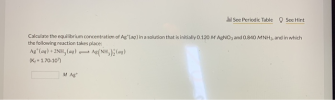 Iul See Periodic Table See Hint Calculate the equilibrium concentration of Ag (aq) in a solution that is initially 0.120 M AgNO, and 0.840 MNH3, and in which the following reaction takes place: Ag (aq) + 2NH, (aq) (NH)2(aq) (K - 1.70.10) M Ag One millimole of Ni(NO3)2 dissolves in 270.0 mL of a solution that is 0.500 M in ammonia The formation constant of Ni(NH3)2 is 5,5x10% 1st attempt Part 1 (1 point) i See Periodic Table See Hint...
at must be the equilibrium concentration of Question 1 (5 pts). A. If the equilibrium concentration...
 at must be the equilibrium concentration of Question 1 (5 pts). A. If the equilibrium concentration of Ce is 0.00010 M, what must be the oqu Cod in the solution? K (Ce (CO)) -59% 10%. (Answer: 3.9 x 10M] B. If the concentration of Ca?" of the solution in 1A is in will some CaCO, begin to precipitate? K (Caco) -1.3 x 10". (Hint: What is the the association of Caland Co, at these concentrations and how does that compare...
1.a)The average osmotic pressure of sea water is 30 atm (atmospheres). Calculate the concentration of urea...
1.a)The average osmotic pressure of sea water is 30 atm (atmospheres). Calculate the concentration of urea (CH4ON2) at 25 ° C that exerts the same pressure as seawater. R = 0.082 atm L/ mol K 1.b) There is a 1M solution of CH3COOH (acetic acid) in a total volume of 450 mL. What is the molality (m) of the solution? (ρ solution = 1.15 g / mL).
 What's the concentration of [FeSCN2+] using limiting
reactant theory and equation?
For each test tube solution enter the initial concentration of Fe+ and SCNthe equilibrium concentration of FeSCN2: into the ICE table given. Complete entries for the rest of the table and calculate the K value for each of the tables. The values of K should be confined to a narrow range to reflect constancy. Comment on the quality of your work in this regard and calculate the average K....
What's the concentration of [FeSCN2+] using limiting
reactant theory and equation?
For each test tube solution enter the initial concentration of Fe+ and SCNthe equilibrium concentration of FeSCN2: into the ICE table given. Complete entries for the rest of the table and calculate the K value for each of the tables. The values of K should be confined to a narrow range to reflect constancy. Comment on the quality of your work in this regard and calculate the average K....
 Calculate the initial concentration of Fe3+ in test tubes 1-4. (you will need to take the dilution in to account) Calculate the initial concentration of SCN-in each of test tubes 1-4. (you will need to take the dilution in to account) 2. Label four 20 x 150 mm test tubes 1-4. Pour about 30 mL of 0.0020 M Fe(NO3)3 into a clean, dry 100-ml beaker. Pipet 5.0 mL of this solution into each of the four labeled test tubes. Use...
 Determine the equilibrium concentration of FeSCN2+ in each
solution. (Page below are the initial concentrations of FE3+ and
scn- for each solution )
Secondly, use stoichiometry to determine equilibrium FE3+ and
SCN -. ( concentration used for FE and KSCN are both 0.002M )
the absorbance of each standard in the same test tube used to blank the spectrophoto standards from least to most concentrated, rinsing with a small amount of the next sta tilling the test tube. Record absorbance...
Determine the equilibrium concentration of FeSCN2+ in each
solution. (Page below are the initial concentrations of FE3+ and
scn- for each solution )
Secondly, use stoichiometry to determine equilibrium FE3+ and
SCN -. ( concentration used for FE and KSCN are both 0.002M )
the absorbance of each standard in the same test tube used to blank the spectrophoto standards from least to most concentrated, rinsing with a small amount of the next sta tilling the test tube. Record absorbance...
 G-10 Assume the equilibrium constant K 1 for a reaction A + B 2 C. You prepare a solution that has the following initial concentrations. For each solution, calculate the reaction quotient Q and state if the concentrations of reactants and products will (increase, decrease, or stay the same). a) [A] 1 M, [B] 1M, [C] 2 M. b) [A] 2 M, [B] 1 M,(C] 1 M. Answers: Q 4 >K, [A, B] increase, [C] decreases Q=0.5 < K, [A,...
 Beers law solve for E3 and E4 showing work
Part II. Equilibrium Constant Calculations
Calculate the initial moles of Fe3+ and SCN- for solutions E2
through E6 and record these values in the table on your Data Sheet.
You obtain the moles of the reactants by multiplying their molarity
by the volume (in L) of their solution used.
Determine the equilibrium concentration of FeSCN2+ for each of
the solutions E2-E6 from your Beer’s Law plot. Using these
equilibrium concentrations, the...
Beers law solve for E3 and E4 showing work
Part II. Equilibrium Constant Calculations
Calculate the initial moles of Fe3+ and SCN- for solutions E2
through E6 and record these values in the table on your Data Sheet.
You obtain the moles of the reactants by multiplying their molarity
by the volume (in L) of their solution used.
Determine the equilibrium concentration of FeSCN2+ for each of
the solutions E2-E6 from your Beer’s Law plot. Using these
equilibrium concentrations, the...
 Write the equilibrium-constant expression for the reaction shown in terms of [NO], [0, 1, and [NO, J. 2 NO(g) + O2(g) = 2 NO, (g) Ke, which is sometimes symbolized as Kor Key, denotes that the equilibrium constant is expressed using molar concentrations. For this question, Kmeans the same thing as K and Ke. K. = [C] [D]2 [4][B] At 25 °C, only 0.0670 mol of the generic salt AB, is soluble in 1.00 L of water. What is the...
 Iul See Periodic Table See Hint Calculate the equilibrium concentration of Ag (aq) in a solution that is initially 0.120 M AgNO, and 0.840 MNH3, and in which the following reaction takes place: Ag (aq) + 2NH, (aq) (NH)2(aq) (K - 1.70.10) M Ag One millimole of Ni(NO3)2 dissolves in 270.0 mL of a solution that is 0.500 M in ammonia The formation constant of Ni(NH3)2 is 5,5x10% 1st attempt Part 1 (1 point) i See Periodic Table See Hint...
 at must be the equilibrium concentration of Question 1 (5 pts). A. If the equilibrium concentration of Ce is 0.00010 M, what must be the oqu Cod in the solution? K (Ce (CO)) -59% 10%. (Answer: 3.9 x 10M] B. If the concentration of Ca?" of the solution in 1A is in will some CaCO, begin to precipitate? K (Caco) -1.3 x 10". (Hint: What is the the association of Caland Co, at these concentrations and how does that compare...
Most questions answered within 3 hours.
-
Where is the error in this code sequence?
String s1 = "Hello";
String s2 = "ello";...
asked 10 months ago -
Financial data for Joel de Paris, Inc., for last year
follow:
Joel de Paris, Inc.
Balance...
asked 10 months ago -
Consider this reaction:
Al2(SO4)3 (aq)+ BaCl3
(aq) Al2Cl6 (aq)- +
3BaSO4(s) . What is the...
asked 10 months ago -
Suppose that Savneet is considering increasing her
recent random sample from 20 car rentals to 40...
asked 10 months ago -
Trucks arrive at an unloading terminal at an average rate of 120
per hour.
Trucks arrive...
asked 10 months ago -
Why are methanol and ethanol completely soluble in water while
octanol is not very little soluble....
asked 10 months ago -
A facilities manager at a university reads in a research report
that the mean amount of...
asked 10 months ago -
When the CuSO4 is rehydrated by adding water to the anhydrous
compound, is this an endothermic...
asked 10 months ago -
A ray of sunlight is passing from diamond into crown glass; the
angle of incidence is...
asked 10 months ago -
A block of mass 0.249 kg is placed on top of a light, vertical
spring of...
asked 10 months ago -
how do the kidneys compensate in the presences of acidosis
a) trigger hyperventilate
b) reserve acid...
asked 10 months ago -
Question 501 pts
The rental rate of capital to the firm increases. Which of the
following...
asked 10 months ago