The FIR system is given by H(z) = 1 + 1.61z−1 + 1.74z−2 + 1.61z−3 +...
The FIR system is given by H(z) = 1 + 1.61z−1 + 1.74z−2 + 1.61z−3 + z−4. Draw frequency sampling structure
Homework Answers

Add Answer to:
The FIR system is given by H(z) = 1 + 1.61z−1 + 1.74z−2 +
1.61z−3 +...
3) Given a filter with the following structure X(n); Hi(Z) y(n) H2(z) H(z) where Hi(2) 11+1+0.09z...
 3) Given a filter with the following structure X(n); Hi(Z) y(n) H2(z) H(z) where Hi(2) 11+1+0.09z and H(z)--4z1+z1+0.09z2] Hi(Z)- 1/[1+z1+ Find the z-transform H(z) and the frequency response H(e2*) . Say if the filter is FIR or IIR, and if it is stable or not » Find the I/O equatio n and draw the block diagram
Given the following FIR digital filter, H(z) = (1 – 2-1) (1+z-1) 3 1) Sketch the...
 Given the following FIR digital filter, H(z) = (1 – 2-1) (1+z-1) 3 1) Sketch the pole zero diagram of this filter. 2) Sketch magnitude and phase spectrum (not decibels) 3) Could you comment on the type of filter (LP, HP, BP or BS) and justify your answer?
3) Consider the FIR filter with unit sample response 2t n 0
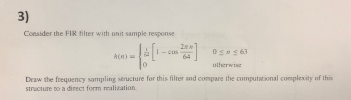 3) Consider the FIR filter with unit sample response 2t n 0<n< 63 otherwise Draw the frequency sampling structure for this filter and compare the computational complexity of this structure to a direct form realization.
3) Consider the FIR filter with unit sample response 2t n 0
3) Consider the FIR filter with unit sample response 2t n 0<n< 63 otherwise Draw the frequency sampling structure for this filter and compare the computational complexity of this structure to a direct form realization.
3) Consider the FIR filter with unit sample response 2t n 0
[1].(20 Write a MATLAB program to design an FIR filter with the ssba (6KH2-12kHz) and draw the frequency response....
 [1].(20 Write a MATLAB program to design an FIR filter with the ssba (6KH2-12kHz) and draw the frequency response. The sampling rate is 40kHz and the filter order is 10. Hint: b- firl(10, passband), freqz(b, 1, n (Display the horizontal axis in terms of analog frequency.) [2].(25}) In the following system f,800 samples/sec. yln]= 0.5y/n-1+ z{n]+ z{n_1] - c) Ideal D-to-A Cunverter LTI System Ideal A-to-D Converter -1/F T.-1/P (a) Determine the impulse response h nl/ (b) Determine the output...
DSP Lab Exercise 9 Given below are the Impulse Response h(n), of the four main types of FIR Digit...
 DSP Lab Exercise 9 Given below are the Impulse Response h(n), of the four main types of FIR Digital filters. Use appropriate MATLAB expressions to find: a) System Response (H(z) b) Pole-zero diagram c) Amplitude Response d) Phase Response 1. FIR Low-Pass Digital Filter ,n= 0.1 |[d(n) + δ(n-I))-1 h(n) 0, otherwise 2. FIR High-Pass Digital Filter 0, otherwise 3. FIR Band-Pass Digital Filter 0, otherwise 4. FIR Band-Stop Digital Filter , n = 0,2 0, otherwise Note: Your final...
2. H(z) is the system function for a stable LTI system and is given by: H(z)-...
 2. H(z) is the system function for a stable LTI system and is given by: H(z)- (1-2z-1)(1-0.75z1) z-1 (1-0.5z-1) H(z) can be represented as a cascade of a minimum phase system Hi(z) and a unity- gain all-pass system Hap(Z), i.e. Determine a choice for Hmin1 (z) and Hap(Z) and specify whether they are unique up to a scale factor
please reply asap. kindly, check the negative signs or any decimals too. please.... 2. Given a causal real LTI system with 1-4z system function H(z)- 1+2z Calculate Hmi and Hz) such that H (z) = H...
 please reply asap.
kindly, check the negative signs or any decimals too.
please....
2. Given a causal real LTI system with 1-4z system function H(z)- 1+2z Calculate Hmi and Hz) such that H (z) = H min(2)H AP(2) where Hmn Z)is a minimum phase system and HIP(2) is an allpass system Draw the SFG for the final cascaded system with the minimum multiplica tions. (30 Points)
2. Given a causal real LTI system with 1-4z system function H(z)- 1+2z Calculate...
please reply asap.
kindly, check the negative signs or any decimals too.
please....
2. Given a causal real LTI system with 1-4z system function H(z)- 1+2z Calculate Hmi and Hz) such that H (z) = H min(2)H AP(2) where Hmn Z)is a minimum phase system and HIP(2) is an allpass system Draw the SFG for the final cascaded system with the minimum multiplica tions. (30 Points)
2. Given a causal real LTI system with 1-4z system function H(z)- 1+2z Calculate...
Problem No. P3: Type 2 Linear Phase FIR fitler A Type 2 linear phase FIR filter is given by h[n]-[-4, 1,-1, -2, 5, 6, 6, 5, -2, -1, 1,-4) Determine the amplitude response Hr(w) and the location of...
 Problem No. P3: Type 2 Linear Phase FIR fitler A Type 2 linear phase FIR filter is given by h[n]-[-4, 1,-1, -2, 5, 6, 6, 5, -2, -1, 1,-4) Determine the amplitude response Hr(w) and the location of zeros of H(z) Use the code below: 2. Hr.type2: function [Hr,v,b.L) Hr_Type2(h); % Computes Amplitude response of a Type-2 LP FIR filter % Hr Amplitude Response % w- frequencies between [0 pi] over which Hr is computed % b = Type-2 LP...
1. A discrete-time LTI system has the system function H(z) given below: H(2)1 2 (e) Determine the impulse response hin] associated with the stable system defined by this system function. (f) Make a c...
 1. A discrete-time LTI system has the system function H(z) given below: H(2)1 2 (e) Determine the impulse response hin] associated with the stable system defined by this system function. (f) Make a careful sketch of the frequency response magnitude, i.е., IH(ew), of this system for lwl S T. Label your sketch!
1. A discrete-time LTI system has the system function H(z) given below: H(2)1 2 (e) Determine the impulse response hin] associated with the stable system defined by this...
1. A discrete-time LTI system has the system function H(z) given below: H(2)1 2 (e) Determine the impulse response hin] associated with the stable system defined by this system function. (f) Make a careful sketch of the frequency response magnitude, i.е., IH(ew), of this system for lwl S T. Label your sketch!
1. A discrete-time LTI system has the system function H(z) given below: H(2)1 2 (e) Determine the impulse response hin] associated with the stable system defined by this...
A discrete-time LTI system has the system function H(z) given below: 2 H(z (a) Sketch the...
 A discrete-time LTI system has the system function H(z) given below: 2 H(z (a) Sketch the pole-zero plot for this system. How many possible (ROCs) are there for H(z). List the possible ROCs and indicate what type of sequence (left-sided, right-sided, two-sided, finite-length) they correspond to (b) Which ROC (or ROCs) correspond to a stable system? Why? (c) Which ROC (or ROCs) correspond to a causal system? Why? (d) Write a difference equation that relates the input to the output...
 3) Given a filter with the following structure X(n); Hi(Z) y(n) H2(z) H(z) where Hi(2) 11+1+0.09z and H(z)--4z1+z1+0.09z2] Hi(Z)- 1/[1+z1+ Find the z-transform H(z) and the frequency response H(e2*) . Say if the filter is FIR or IIR, and if it is stable or not » Find the I/O equatio n and draw the block diagram
 Given the following FIR digital filter, H(z) = (1 – 2-1) (1+z-1) 3 1) Sketch the pole zero diagram of this filter. 2) Sketch magnitude and phase spectrum (not decibels) 3) Could you comment on the type of filter (LP, HP, BP or BS) and justify your answer?
 3) Consider the FIR filter with unit sample response 2t n 0<n< 63 otherwise Draw the frequency sampling structure for this filter and compare the computational complexity of this structure to a direct form realization.
3) Consider the FIR filter with unit sample response 2t n 0
3) Consider the FIR filter with unit sample response 2t n 0<n< 63 otherwise Draw the frequency sampling structure for this filter and compare the computational complexity of this structure to a direct form realization.
3) Consider the FIR filter with unit sample response 2t n 0
 [1].(20 Write a MATLAB program to design an FIR filter with the ssba (6KH2-12kHz) and draw the frequency response. The sampling rate is 40kHz and the filter order is 10. Hint: b- firl(10, passband), freqz(b, 1, n (Display the horizontal axis in terms of analog frequency.) [2].(25}) In the following system f,800 samples/sec. yln]= 0.5y/n-1+ z{n]+ z{n_1] - c) Ideal D-to-A Cunverter LTI System Ideal A-to-D Converter -1/F T.-1/P (a) Determine the impulse response h nl/ (b) Determine the output...
 DSP Lab Exercise 9 Given below are the Impulse Response h(n), of the four main types of FIR Digital filters. Use appropriate MATLAB expressions to find: a) System Response (H(z) b) Pole-zero diagram c) Amplitude Response d) Phase Response 1. FIR Low-Pass Digital Filter ,n= 0.1 |[d(n) + δ(n-I))-1 h(n) 0, otherwise 2. FIR High-Pass Digital Filter 0, otherwise 3. FIR Band-Pass Digital Filter 0, otherwise 4. FIR Band-Stop Digital Filter , n = 0,2 0, otherwise Note: Your final...
 2. H(z) is the system function for a stable LTI system and is given by: H(z)- (1-2z-1)(1-0.75z1) z-1 (1-0.5z-1) H(z) can be represented as a cascade of a minimum phase system Hi(z) and a unity- gain all-pass system Hap(Z), i.e. Determine a choice for Hmin1 (z) and Hap(Z) and specify whether they are unique up to a scale factor
 please reply asap.
kindly, check the negative signs or any decimals too.
please....
2. Given a causal real LTI system with 1-4z system function H(z)- 1+2z Calculate Hmi and Hz) such that H (z) = H min(2)H AP(2) where Hmn Z)is a minimum phase system and HIP(2) is an allpass system Draw the SFG for the final cascaded system with the minimum multiplica tions. (30 Points)
2. Given a causal real LTI system with 1-4z system function H(z)- 1+2z Calculate...
please reply asap.
kindly, check the negative signs or any decimals too.
please....
2. Given a causal real LTI system with 1-4z system function H(z)- 1+2z Calculate Hmi and Hz) such that H (z) = H min(2)H AP(2) where Hmn Z)is a minimum phase system and HIP(2) is an allpass system Draw the SFG for the final cascaded system with the minimum multiplica tions. (30 Points)
2. Given a causal real LTI system with 1-4z system function H(z)- 1+2z Calculate...
 Problem No. P3: Type 2 Linear Phase FIR fitler A Type 2 linear phase FIR filter is given by h[n]-[-4, 1,-1, -2, 5, 6, 6, 5, -2, -1, 1,-4) Determine the amplitude response Hr(w) and the location of zeros of H(z) Use the code below: 2. Hr.type2: function [Hr,v,b.L) Hr_Type2(h); % Computes Amplitude response of a Type-2 LP FIR filter % Hr Amplitude Response % w- frequencies between [0 pi] over which Hr is computed % b = Type-2 LP...
 1. A discrete-time LTI system has the system function H(z) given below: H(2)1 2 (e) Determine the impulse response hin] associated with the stable system defined by this system function. (f) Make a careful sketch of the frequency response magnitude, i.е., IH(ew), of this system for lwl S T. Label your sketch!
1. A discrete-time LTI system has the system function H(z) given below: H(2)1 2 (e) Determine the impulse response hin] associated with the stable system defined by this...
1. A discrete-time LTI system has the system function H(z) given below: H(2)1 2 (e) Determine the impulse response hin] associated with the stable system defined by this system function. (f) Make a careful sketch of the frequency response magnitude, i.е., IH(ew), of this system for lwl S T. Label your sketch!
1. A discrete-time LTI system has the system function H(z) given below: H(2)1 2 (e) Determine the impulse response hin] associated with the stable system defined by this...
 A discrete-time LTI system has the system function H(z) given below: 2 H(z (a) Sketch the pole-zero plot for this system. How many possible (ROCs) are there for H(z). List the possible ROCs and indicate what type of sequence (left-sided, right-sided, two-sided, finite-length) they correspond to (b) Which ROC (or ROCs) correspond to a stable system? Why? (c) Which ROC (or ROCs) correspond to a causal system? Why? (d) Write a difference equation that relates the input to the output...
Most questions answered within 3 hours.
-
Where is the error in this code sequence?
String s1 = "Hello";
String s2 = "ello";...
asked 11 months ago -
Financial data for Joel de Paris, Inc., for last year
follow:
Joel de Paris, Inc.
Balance...
asked 11 months ago -
Consider this reaction:
Al2(SO4)3 (aq)+ BaCl3
(aq) Al2Cl6 (aq)- +
3BaSO4(s) . What is the...
asked 11 months ago -
Suppose that Savneet is considering increasing her
recent random sample from 20 car rentals to 40...
asked 11 months ago -
Trucks arrive at an unloading terminal at an average rate of 120
per hour.
Trucks arrive...
asked 11 months ago -
Why are methanol and ethanol completely soluble in water while
octanol is not very little soluble....
asked 11 months ago -
A facilities manager at a university reads in a research report
that the mean amount of...
asked 11 months ago -
When the CuSO4 is rehydrated by adding water to the anhydrous
compound, is this an endothermic...
asked 11 months ago -
A ray of sunlight is passing from diamond into crown glass; the
angle of incidence is...
asked 11 months ago -
A block of mass 0.249 kg is placed on top of a light, vertical
spring of...
asked 11 months ago -
how do the kidneys compensate in the presences of acidosis
a) trigger hyperventilate
b) reserve acid...
asked 11 months ago -
Question 501 pts
The rental rate of capital to the firm increases. Which of the
following...
asked 11 months ago