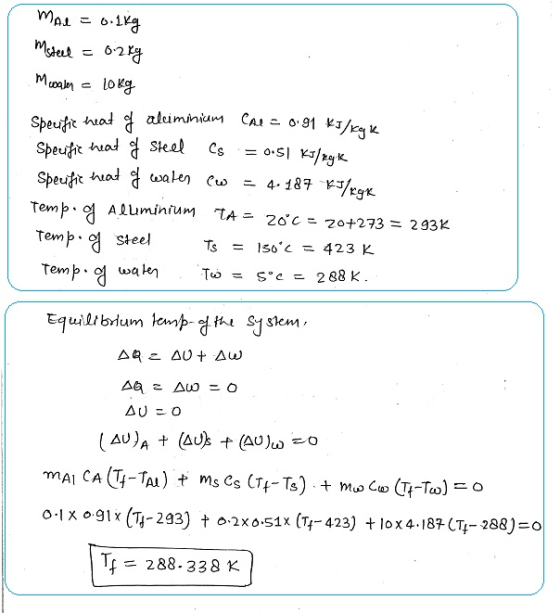
An isolated system consists of a closed aluminum vessel of mass .1 kg containing a .2...
Homework Answers
Please rate
if any mistake in this answer please comment i will clarify your
doubt . thank you
Add Answer to:
An
isolated system consists of a closed aluminum vessel of mass .1 kg
containing a .2...
A closed thermodynamic system consists of a stone with a mass of 5 kg and a...
A closed thermodynamic system consists of a stone with a mass of 5 kg and a bucket containing 10 m3 of water. The entire system is at the same temperature with the surroundings. The stone is initially at rest 25 m above the water. The stone falls into the water. No water is lost from the bucket. What is the change in a. Internal energy of the system b. Work done by the system c. Heat loss by the system
An aluminum cube of mass 44.25 g is immersed in liquid Nitrogen and comes to thermal...
An aluminum cube of mass 44.25 g is immersed in liquid Nitrogen and comes to thermal equilibrium with the liquid Nitrogen. This equilibrium temperature is that of liquid Nitrogen, -195.8° C. The cube is then immersed in 189.47 g of water at 22.3° C. The final, equilibrium temperature of the water-aluminum cube system is 14.0° C. Calculate the specific heat of the aluminum cube. Answer should be in units of calories, grams and °C. Show formulas and calculations.
An isolated system consists of two objects of the same mass. One object has an initial...
An isolated system consists of two objects of the same mass. One object has an initial temperature of 0 °C and its specific heat is c1. The other has an initial temperature of 100°C and its specific heat is c2=5 c1. What is the equilibrium temperature of the system, assuming that no phase changes take place for either object?
A 20 kg block of aluminum at 97.4 ∘C is dropped into a tank containing 10...
A 20 kg block of aluminum at 97.4 ∘C is dropped into a tank containing 10 kg of water at 3 ∘C. The final temperature after equilibrium is 30 ∘C. a) Determine ΔU for the combined system of aluminum and water after the process is complete. b) Determine ΔS for the combined system of aluminum and water after the process is complete.
A piece of iron of unknown mass has an initial temperature 210∘C. It is dropped into...
A piece of iron of unknown mass has an initial temperature 210∘C. It is dropped into an aluminum container of mass 0.2 kg containing 1 litre (1.0 kg) of water both of which are at a temperature of temperature 20 ∘C . The final equilibrium temperature of the system when energy transfer between the iron and the water finally stops is 28.5 ∘C. (Assume no thermal energy gets lost.) What is the mass of the iron piece? Express your answer...
We have a closed system with an aluminum cup, water and a cube of ice. The...
We have a closed system with an aluminum cup, water and a cube of ice. The glass has a mass of 100 grams. The temperature of the glass and water is 20 degrees C. We also have 200 grams of water in total. The cube of ice weighs 5 grams and is at 0 degrees C. Find the equilibrium temperature of the system.
A system consists of a sealed copper tank whose mass is 20kg, which contains 5 kg...
A system consists of a sealed copper tank whose mass is 20kg, which contains 5 kg of liquid water, and an electrical register (negligible mass). The system is insulated on its outer surface. Initially, the temperature of the copper is 27˚C and the temperature of the water is 50˚C. The electric resister transfers 100 kJ of energy to the system. Eventually the system comes to equilibrium. a) Sketch the system. Clearly label all components and include arrows indicating work or...
7. A thermally isolated system is made up of a hot piece of aluminum and a...
7. A thermally isolated system is made up of a hot piece of aluminum and a cold piece of copper, with the aluminum and the copper in thermal contact. If the specific heat capacity of aluminum is double that of copper, which object experiences the greater temperature change during the time the system takes to reach thermal equilibrium? a) the copper b) the aluminum c) both metals experience the same size temperature change d) it cannot be determined from the...
A 2.00 kg block of copper at 20.0◦C is dropped into a very large vessel of...
A 2.00 kg block of copper at 20.0◦C is dropped into a very large vessel of liquid nitrogen at 77.4K (this is the boiling temperature of liquid Nitrogen). How many kg of liquid nitrogen boils away before the system comes to equilibrium? (Assume the liquid and copper is an isolated system) Please show ALL steps
An aluminum block of mass 500 g is heated to a temperature of 150 C and...
An aluminum block of mass 500 g is heated to a temperature of 150 C and droped into a cup of water of mass 1500 g. The heat capacity of the cup is 100 cal/K. Assuming that the initial temperature of the cup and water is 20 C, find the final temperature of the system after it reaches thermal equilibrium.
Most questions answered within 3 hours.
-
Where is the error in this code sequence?
String s1 = "Hello";
String s2 = "ello";...
asked 11 months ago -
Financial data for Joel de Paris, Inc., for last year
follow:
Joel de Paris, Inc.
Balance...
asked 11 months ago -
Consider this reaction:
Al2(SO4)3 (aq)+ BaCl3
(aq) Al2Cl6 (aq)- +
3BaSO4(s) . What is the...
asked 11 months ago -
Suppose that Savneet is considering increasing her
recent random sample from 20 car rentals to 40...
asked 11 months ago -
Trucks arrive at an unloading terminal at an average rate of 120
per hour.
Trucks arrive...
asked 11 months ago -
Why are methanol and ethanol completely soluble in water while
octanol is not very little soluble....
asked 11 months ago -
A facilities manager at a university reads in a research report
that the mean amount of...
asked 11 months ago -
When the CuSO4 is rehydrated by adding water to the anhydrous
compound, is this an endothermic...
asked 11 months ago -
A ray of sunlight is passing from diamond into crown glass; the
angle of incidence is...
asked 11 months ago -
A block of mass 0.249 kg is placed on top of a light, vertical
spring of...
asked 11 months ago -
how do the kidneys compensate in the presences of acidosis
a) trigger hyperventilate
b) reserve acid...
asked 11 months ago -
Question 501 pts
The rental rate of capital to the firm increases. Which of the
following...
asked 11 months ago