Which of the following indexes are market value-weighted? I. The NYSE Composite II. The S&P 500...
Which of the following indexes are market value-weighted?
I. The NYSE Composite
II. The S&P 500
III.The Wilshire 5000
I, II, and III
I and III only
II and III only
I and II only
Homework Answers
ANSWER : I, II AND III (THUMBS UP PLEASE)
MARKET VALUE WEIGHTED INDEXES ARE THOSE WHICH ARE CALCULATED ON THE BASIS OF MARKET CAPITALIZATION OF STOCKS INCLUDED IN THE INDEX. MARKET CAPITALIZATION = NO OF SHARES TRADED X AVERAGE PRICE
SO ALL OF THE ABOVE INDEXES ARE OF SAME NATURE.
Add Answer to:
Which of the following indexes are market value-weighted?
I. The NYSE Composite
II. The S&P 500...
Which of the following stock price indexes is a price--weighted index? a) Dow Jones Industrial Average...
Which of the following stock price indexes is a price--weighted index? a) Dow Jones Industrial Average b) Standard & Poor's 500 Index c) Nasdaq d) Wilshire 5000
Which of the following is not a value-weighted series? A. NASDAQ Industrial Index B. Dow Jones...
Which of the following is not a value-weighted series? A. NASDAQ Industrial Index B. Dow Jones Industrial Average C. Wilshire 5000 Equity Index D. American Stock Exchange Series E. NASDAQ Composite Index
Which of the following will decrease if the coupon rate decreases? I. Market Value II. Face...
Which of the following will decrease if the coupon rate decreases? I. Market Value II. Face Value III. Current Yield IV. Yield-to-Maturity A) I, II and III only B) I, III and IV only C) I and II only D) I and IV only
The following are monthly rates of return for two market indexes. The XYZ Fund Index Monthly...
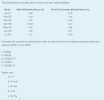 The following are monthly rates of return for two market indexes. The XYZ Fund Index Monthly Return (%) -0.30 1.72 -0.42 Month Jan-03 Feb-03 Mar-03 Apr-03 May-03 Jun-03 Jul-03 S&D 500 Monthly Return (%) -2.66 -1.52 1.03 10.424 5.33 1.28 1.79 -0.47 2.88 -0.61 -4.39 Compute the covariance between the rates of return for the two indexes using the data from January 2003 to July 2003. 1. 0.5206 II. 0.6074 III. 0.6074 %2 IV. 1.8381 V. 0.5206%2 Select one: O...
Which of the following will increase if the coupon rate for a bond increases? I. face value II. market value III. yield-...
Which of the following will increase if the coupon rate for a bond increases? I. face value II. market value III. yield-to-maturity IV. current yield Is it A. I and IV only, B. II, III, and IV only, C.II only, D. II and IV only?
The following are monthly percentage price changes for four market indexes. Month DJIA S&P 500 Russell...
The following are monthly percentage price changes for four market indexes. Month DJIA S&P 500 Russell 2000 Nikkei 1 0.04 0.01 0.04 0.04 2 0.07 0.06 0.10 -0.03 3 -0.02 -0.02 -0.03 0.08 4 0.02 0.02 0.02 0.01 5 0.05 0.05 0.11 0.01 6 -0.07 -0.04 -0.09 0.05 Compute the following. Average monthly rate of return for each index. Round your answers to five decimal places. DJIA: S&P 500: Russell 2000: Nikkei: Standard deviation for each index. Do not round...
14. In practice which market index would best be used as a proxy for the market...
14. In practice which market index would best be used as a proxy for the market portfolio in the CAPM? A. Wilshire 5000 B. Dow Jones Industrial Average C. U.S. Treasury Bill D. S&P 500
14. In practice which market index would best be used as a proxy for the market...
14. In practice which market index would best be used as a proxy for the market portfolio in the CAPM? A. Wilshire 5000 B. Dow Jones Industrial Average C. U.S. Treasury Bill D. S&P 500
Which of the following is not a weighting scheme commonly used in creating equity market indexes?...
Which of the following is not a weighting scheme commonly used in creating equity market indexes? A. industry-weighted. B. value-weighted. C. price-weighted.
Which of the following statements is true? I. If the p-value is 0.01, we reject H0...
Which of the following statements is true? I. If the p-value is 0.01, we reject H0 for any alpha level less than 0.01. II. If we use an alpha level of 0.05, then a p-value of 0.005 is not statistically significant. III. If we use an alpha level of 0.05, then we fail to reject the null hypothesis if the p-value is 0.1. Group of answer choices I only II only III only I and III II and III
 The following are monthly rates of return for two market indexes. The XYZ Fund Index Monthly Return (%) -0.30 1.72 -0.42 Month Jan-03 Feb-03 Mar-03 Apr-03 May-03 Jun-03 Jul-03 S&D 500 Monthly Return (%) -2.66 -1.52 1.03 10.424 5.33 1.28 1.79 -0.47 2.88 -0.61 -4.39 Compute the covariance between the rates of return for the two indexes using the data from January 2003 to July 2003. 1. 0.5206 II. 0.6074 III. 0.6074 %2 IV. 1.8381 V. 0.5206%2 Select one: O...
Most questions answered within 3 hours.
-
Where is the error in this code sequence?
String s1 = "Hello";
String s2 = "ello";...
asked 11 months ago -
Financial data for Joel de Paris, Inc., for last year
follow:
Joel de Paris, Inc.
Balance...
asked 11 months ago -
Consider this reaction:
Al2(SO4)3 (aq)+ BaCl3
(aq) Al2Cl6 (aq)- +
3BaSO4(s) . What is the...
asked 11 months ago -
Suppose that Savneet is considering increasing her
recent random sample from 20 car rentals to 40...
asked 11 months ago -
Trucks arrive at an unloading terminal at an average rate of 120
per hour.
Trucks arrive...
asked 11 months ago -
Why are methanol and ethanol completely soluble in water while
octanol is not very little soluble....
asked 11 months ago -
A facilities manager at a university reads in a research report
that the mean amount of...
asked 11 months ago -
When the CuSO4 is rehydrated by adding water to the anhydrous
compound, is this an endothermic...
asked 11 months ago -
A ray of sunlight is passing from diamond into crown glass; the
angle of incidence is...
asked 11 months ago -
A block of mass 0.249 kg is placed on top of a light, vertical
spring of...
asked 11 months ago -
how do the kidneys compensate in the presences of acidosis
a) trigger hyperventilate
b) reserve acid...
asked 11 months ago -
Question 501 pts
The rental rate of capital to the firm increases. Which of the
following...
asked 11 months ago