The energy store in a capacitor depends on the strength ε of the dielectric. True or...
The energy store in a capacitor depends on the strength ε of the dielectric.
True or False
Homework Answers
Capacitance is the ability to store energy in the form of an electric charge.

Add Answer to:
The energy store in a capacitor depends on the strength ε of the
dielectric.
True or...
2. (4 points) A spherical capacitor has outer radius R2 and inner radius R1 and is filled with a dielectric material in which ε--Ceo/r. A positive charge Q is placed in the inner radius and a negativ...
 2. (4 points) A spherical capacitor has outer radius R2 and inner radius R1 and is filled with a dielectric material in which ε--Ceo/r. A positive charge Q is placed in the inner radius and a negative charge-Q is placed on the outer radius. Remember that ε in this problem depends on the radial position r. (a) Calculate D, E and P within the capacitor, as a function of r for R R2 b) Calculate the potential V, from R1...
The dielectric to be used in a parallel-plate capacitor has a dielectric constant of 3.20 and...
The dielectric to be used in a parallel-plate capacitor has a dielectric constant of 3.20 and a dielectric strength of 1.25
Paper has a dielectric constant K = 3.7 and a dielectric strength of 15×106V/m. Suppose that...
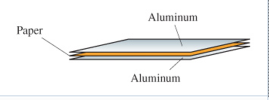 Paper has a dielectric constant K = 3.7 and a
dielectric strength of 15×106V/m. Suppose that a typical sheet of
paper has a thickness of 0.030 mm. You make a "homemade" capacitor
by placing a sheet of 21×14cm paper between two aluminum foil
sheets (see the figure).(Figure 1) The thickness of the aluminum
foil is 0.040 mm.
About how much charge could you store on your capacitor before
it would break down?
If you made 100 such capacitors, and connected...
Paper has a dielectric constant K = 3.7 and a
dielectric strength of 15×106V/m. Suppose that a typical sheet of
paper has a thickness of 0.030 mm. You make a "homemade" capacitor
by placing a sheet of 21×14cm paper between two aluminum foil
sheets (see the figure).(Figure 1) The thickness of the aluminum
foil is 0.040 mm.
About how much charge could you store on your capacitor before
it would break down?
If you made 100 such capacitors, and connected...
A certain substance has a dielectric constant of 2.8 and a dielectric strength of 18.0 MV/m....
A certain substance has a dielectric constant of 2.8 and a dielectric strength of 18.0 MV/m. If it is used as the dielectric material in a parallel-plate capacitor, what minimum area should the plates of the capacitor have to obtain a capacitance of 8.00×10⁻⁸ F and to ensure that the capacitor will be able to withstand a potential difference of 5.2 kV?
A certain substance has a dielectric constant of 2.8 and a dielectric strength of 18.0 MV/m....
A certain substance has a dielectric constant of 2.8 and a dielectric strength of 18.0 MV/m. If it is used as the dielectric material in a parallel-plate capacitor, what minimum area should the plates of the capacitor have to obtain a capacitance of 6.00×10⁻⁸ F and to ensure that the capacitor will be able to withstand a potential difference of 5.0 kV?
A certain substance has a dielectric constant of 3.9 and a dielectric strength of 22 MV/m....
A certain substance has a dielectric constant of 3.9 and a dielectric strength of 22 MV/m. If it is used as the dielectric material in a parallel-plate capacitor, what minimum area should the plates of the capacitor have to obtain a capacitance of 6.7 × 10⁻² µ F and to ensure that the capacitor will be able to withstand a potential difference of 3.7 kV?
A certain substance has a dielectric constant of 2.4 and a dielectric strength of 21 MV/m....
A certain substance has a dielectric constant of 2.4 and a dielectric strength of 21 MV/m. If it is used as the dielectric material in a parallel-plate capacitor, what minimum area should the plates of the capacitor have to obtain a capacitance of 10 × 10-2 µ F and to ensure that the capacitor will be able to withstand a potential difference of 4.3 kV?
A certain substance has a dielectric constant of 3.2 and a dielectric strength of 15 MV/m....
A certain substance has a dielectric constant of 3.2 and a dielectric strength of 15 MV/m. If it is used as the dielectric material in a parallel-plate capacitor, what minimum area should the plates of the capacitor have to obtain a capacitance of 10 × 10-2 µ F and to ensure that the capacitor will be able to withstand a potential difference of 4.7 kV?
BoNUs: Energy Storage Consider the capacitor as a device for storing energy. The practical limitation on...
 BoNUs: Energy Storage Consider the capacitor as a device for storing energy. The practical limitation on the potential difference between the plates of a capacitor is the "dielectric strength" of the dielectric material between the plates. This is the maximum field strength that can exist without causing a spark. It is typically on the order of 107 v/m for a good liquid dielectric with K ะ 2.3 and ะ 1 g/cm3 (a) Neglecting the weight of the electrodes and case,...
The dielectric to be used in a parallel-plate capacitor has a dielectric constant of 3.9 and...
The dielectric to be used in a parallel-plate capacitor has a dielectric constant of 3.9 and a dielectric strength of 1.9 × 10⁷ V/m. The capacitor is to have a capacitance of 1 × 10⁻⁹ F and must be able to withstand a maximum potential difference of 5,500 V. What is the minimum area the plates of the capacitor may have? (Give your answer in scientific notation using m2 (meter square) as unit)
 2. (4 points) A spherical capacitor has outer radius R2 and inner radius R1 and is filled with a dielectric material in which ε--Ceo/r. A positive charge Q is placed in the inner radius and a negative charge-Q is placed on the outer radius. Remember that ε in this problem depends on the radial position r. (a) Calculate D, E and P within the capacitor, as a function of r for R R2 b) Calculate the potential V, from R1...
 Paper has a dielectric constant K = 3.7 and a
dielectric strength of 15×106V/m. Suppose that a typical sheet of
paper has a thickness of 0.030 mm. You make a "homemade" capacitor
by placing a sheet of 21×14cm paper between two aluminum foil
sheets (see the figure).(Figure 1) The thickness of the aluminum
foil is 0.040 mm.
About how much charge could you store on your capacitor before
it would break down?
If you made 100 such capacitors, and connected...
Paper has a dielectric constant K = 3.7 and a
dielectric strength of 15×106V/m. Suppose that a typical sheet of
paper has a thickness of 0.030 mm. You make a "homemade" capacitor
by placing a sheet of 21×14cm paper between two aluminum foil
sheets (see the figure).(Figure 1) The thickness of the aluminum
foil is 0.040 mm.
About how much charge could you store on your capacitor before
it would break down?
If you made 100 such capacitors, and connected...
 BoNUs: Energy Storage Consider the capacitor as a device for storing energy. The practical limitation on the potential difference between the plates of a capacitor is the "dielectric strength" of the dielectric material between the plates. This is the maximum field strength that can exist without causing a spark. It is typically on the order of 107 v/m for a good liquid dielectric with K ะ 2.3 and ะ 1 g/cm3 (a) Neglecting the weight of the electrodes and case,...
Most questions answered within 3 hours.
-
Where is the error in this code sequence?
String s1 = "Hello";
String s2 = "ello";...
asked 10 months ago -
Financial data for Joel de Paris, Inc., for last year
follow:
Joel de Paris, Inc.
Balance...
asked 10 months ago -
Consider this reaction:
Al2(SO4)3 (aq)+ BaCl3
(aq) Al2Cl6 (aq)- +
3BaSO4(s) . What is the...
asked 10 months ago -
Suppose that Savneet is considering increasing her
recent random sample from 20 car rentals to 40...
asked 10 months ago -
Trucks arrive at an unloading terminal at an average rate of 120
per hour.
Trucks arrive...
asked 10 months ago -
Why are methanol and ethanol completely soluble in water while
octanol is not very little soluble....
asked 10 months ago -
A facilities manager at a university reads in a research report
that the mean amount of...
asked 10 months ago -
When the CuSO4 is rehydrated by adding water to the anhydrous
compound, is this an endothermic...
asked 10 months ago -
A ray of sunlight is passing from diamond into crown glass; the
angle of incidence is...
asked 10 months ago -
A block of mass 0.249 kg is placed on top of a light, vertical
spring of...
asked 10 months ago -
how do the kidneys compensate in the presences of acidosis
a) trigger hyperventilate
b) reserve acid...
asked 10 months ago -
Question 501 pts
The rental rate of capital to the firm increases. Which of the
following...
asked 10 months ago