The standard method for domestic laboratory identification of fire remnant evidence mainly refers to ASTM E1618...
The standard method for domestic laboratory identification of fire remnant evidence mainly refers to ASTM E1618 gas chromatography mass spectrometry. Please answer the questions related to the mass spectrometer:
(1) The five basic components and functions of the instrument.
(2) Total ion chromatogram.
(3) Mass-to-charge ratio (m/z) of the main two fragmentation ions of alkane (alkane).
Homework Answers
- The GC-MS (Gas chromatography- Mass spectrometry), as the name suggests, is made of two parts: the gas chromatograph and the mass spectrometer. The gas chromatograph has a gas stream (carrier gas, mobile phase), usually an inert gas, which mixes with the liquid stationary phase from the sample injector. The gas-phase then passes through the column, which is located in an oven where the temperature of the gas can be controlled.
The difference in the chemical properties between different molecules in the mixture and their relative affinity for the mobile phase will help in the separation of the sample as the sample passes through the column. The molecules are retained by the column at their retention times and are next passed up to the mass spectrometer where they are captured, ionized, accelerated, deflected and detected using the mass-to-charge ratio of the ionized fragments.
GC-MS is mostly used for:
- Tracking of organic pollutants in the environment.
- Detection of illegal narcotics.
- Detection of any explosives, chemical warfare agents, etc.
- Fire investigation.
- Identification of unknown substances from probe missions.
- Total ion chromatogram is obtained when all the mass peaks for a scan are added up to obtain a total ion current. When this total ion current is plotted against the scan number or time, we obtain a total ion chromatogram (TIC). TIC does not consider a particular set of peaks rather it considers the entire log.
- Ion fragmentation of alkanes can be considered for three sets of alkanes:
- Straight chain alkanes:
The largest peak is basically for an alkyl radical cation, CnH2n+1. The next peaks are separated by 14 amu (loss of CH2) and [M-15] peak for a loss of CH3 radical is mostly weak or absent.
e.g. CH3-CH2-CH3
CH3-CH2-CH3]·+ → 44 M+
CH3-CH2]+ + CH3]· → 29 M-15
CH3-CH2]· + CH3]+ → 15 M-29
- Branched alkanes:
Bond cleavage mostly takes place at the site of branching with the removal of the largest substituent as the radical. The radical achieves stability by delocalization of lone pair of electrons.
e.g.
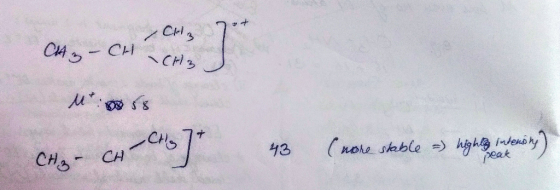
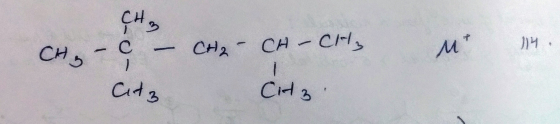
(CH3)3-C]+ + (CH3)2-CH-CH2]· → 57(most stable) [M-57]
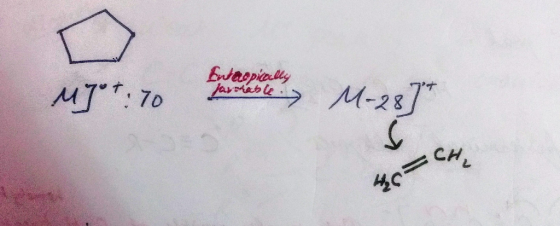
- Cycloalkanes:
A significant peak is observed at M-28 (often the base peak) due to loss of ethene (entropically favorable).
e.g.
Add Answer to:
The standard method for domestic laboratory identification of
fire remnant evidence mainly refers to ASTM E1618...
Most questions answered within 3 hours.
-
Where is the error in this code sequence?
String s1 = "Hello";
String s2 = "ello";...
asked 11 months ago -
Financial data for Joel de Paris, Inc., for last year
follow:
Joel de Paris, Inc.
Balance...
asked 11 months ago -
Consider this reaction:
Al2(SO4)3 (aq)+ BaCl3
(aq) Al2Cl6 (aq)- +
3BaSO4(s) . What is the...
asked 11 months ago -
Suppose that Savneet is considering increasing her
recent random sample from 20 car rentals to 40...
asked 11 months ago -
Trucks arrive at an unloading terminal at an average rate of 120
per hour.
Trucks arrive...
asked 11 months ago -
Why are methanol and ethanol completely soluble in water while
octanol is not very little soluble....
asked 11 months ago -
A facilities manager at a university reads in a research report
that the mean amount of...
asked 11 months ago -
When the CuSO4 is rehydrated by adding water to the anhydrous
compound, is this an endothermic...
asked 11 months ago -
A ray of sunlight is passing from diamond into crown glass; the
angle of incidence is...
asked 11 months ago -
A block of mass 0.249 kg is placed on top of a light, vertical
spring of...
asked 11 months ago -
how do the kidneys compensate in the presences of acidosis
a) trigger hyperventilate
b) reserve acid...
asked 11 months ago -
Question 501 pts
The rental rate of capital to the firm increases. Which of the
following...
asked 11 months ago