Help me please to answer on these questions. Thank you! 1. Is work required to move...
Help me please to answer on these questions. Thank you!
1. Is work required to move an electric charge along a line of equipotential? Explain. (Think about the strength of the force along these lines and which way it is pointing.)
2. Points P and Q are on the same equipotential lines in an electric field and points R and S are on a higher equipotential line. Compare the work done by the electric field when an electric particle with a positive charge moves from:
(a) P to R (b) S to Q (c) P to S (d) R to S
For example, in which case will the greatest amount of work be done? In which case will the work be the least? Defend your answer.
Homework Answers
1.
Equipotential line means all points on the line have same potential.
If we follow the equation of work, W = q dV ... dV represents difference in potential, which in this case is zero. Hence work also zero.
2.
Vp = Vq < Vr = Vs
Work done in moving the charge from P to R and in moving from P to S will be same ( as Vs = Vr) and will be highest because Vr-Vp will give max p.d in this case.
Similarly, work in S to Q will give least value. It will be equal to above work but -ve as charge is being moved from high to low, dV will be -ve.
*Work from R to S will be zero
Add Answer to:
Help me please to answer on these questions. Thank you!
1. Is work required to move...
Help, I’m confused. Need help with these questions 9. Without moving the ground probe, find another...
 Help, I’m confused. Need help with these questions
9. Without moving the ground probe, find another location where the reading is 0. Continue to find additional points (approximately 8-10) until you can determine the line that connects the points. This line is called an equipotentia of the points on the line. 10.Once you have finished your first line (and not before), move the ground probe to another location. Then repeat the process to create a second line. 11.Create additional lines...
Help, I’m confused. Need help with these questions
9. Without moving the ground probe, find another location where the reading is 0. Continue to find additional points (approximately 8-10) until you can determine the line that connects the points. This line is called an equipotentia of the points on the line. 10.Once you have finished your first line (and not before), move the ground probe to another location. Then repeat the process to create a second line. 11.Create additional lines...
Physics Prelab: Electric Field Explain what equipotential lines are? What is the work done when a...
Physics Prelab: Electric Field Explain what equipotential lines are? What is the work done when a charge moves along an equipotential line? How does one find the electric field when you know the voltage change between two points and the distance between those two points? Go to the website on cell phones and explain how your finger is able to interact with the phone using physics principles. What is the electric field of a 18 pC charge at a distance...
PART A What is the work done by the electric force to move a 1 C...
 PART A
What is the work done by the electric force to move a 1 C charge
from A to B?
Express your answer in joules.
PART B
What is the work done by the electric force to move a 1 C charge
from A to D?
Express your answer in joules.
Part C
The magnitude of the
electric field at point C is
greater than the magnitude of the electric field at point
B.
less than the magnitude of...
PART A
What is the work done by the electric force to move a 1 C charge
from A to B?
Express your answer in joules.
PART B
What is the work done by the electric force to move a 1 C charge
from A to D?
Express your answer in joules.
Part C
The magnitude of the
electric field at point C is
greater than the magnitude of the electric field at point
B.
less than the magnitude of...
1. Is it possible for two different equipotential lines to cross each other? Explain why or...
 1. Is it possible for two different equipotential lines to cross each other? Explain why or why not? 2. Is it possible for two different electric field lines to cross each other? Explain why or why 3. Where do the electric field lines begin and end? If they are equally spaced at their beginning, 4. If you wanted to push a charge along one of the electric field lines from one conductor to the 5. The potential is everywhere the...
Considering ; describe in symbolic form, the work required to move a charge "Q" across (a)...
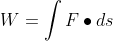 Considering ; describe in symbolic
form, the work required to move a charge "Q" across (a) an
equipotential line and (b) an electric field line. Explain your
results.
W = F.ds
Considering ; describe in symbolic
form, the work required to move a charge "Q" across (a) an
equipotential line and (b) an electric field line. Explain your
results.
W = F.ds
Question 3 (#859685) Equipotential Lines) Which of the following statements is NOT true about equipotential lines?...
 Question 3 (#859685) Equipotential Lines) Which of the following statements is NOT true about equipotential lines? Select the correct answer O All points on an equipotential line are at the same voltage. A positively charged particle loses potential energy as it moves from one equipotential line to another equipotential line of a lower voltage. Your Answer Equipotential lines run perpendicular to the electric field lines on a 2- dimensional surface. For a charged particle on an equipotential line, there is...
Work and exact values please! Thank you Sketch the electric field and equipotential contours for the...
 Work and exact values please! Thank you
Sketch the electric field and equipotential contours for the arrangement shown below. Use the PhET simulation if necessary. Consider the electric field lines drawn below for a configuration or two charges. Five points (A-E) are labeled on the diagram. Rank these locations in order of the electric field strength from smallest to largest. Calculate the net electric potential at point A in the diagram shown above. The net potential is the sum of...
Work and exact values please! Thank you
Sketch the electric field and equipotential contours for the arrangement shown below. Use the PhET simulation if necessary. Consider the electric field lines drawn below for a configuration or two charges. Five points (A-E) are labeled on the diagram. Rank these locations in order of the electric field strength from smallest to largest. Calculate the net electric potential at point A in the diagram shown above. The net potential is the sum of...
How to solve Part 4c? Sketches of electric field lines and equipotentials Sketch and answer 4...
 How to solve Part 4c?
Sketches of electric field lines and equipotentials Sketch and answer 4 - A through 4 - D in your answer book. Consider different charge configurations as shown: 4 - A : Suppose you are a test charge and you start at some distance from the charge q = +1 below, such as at the point X. Starting at point X, what path could you move along without doing any work? i.e. which Ē. ds is...
How to solve Part 4c?
Sketches of electric field lines and equipotentials Sketch and answer 4 - A through 4 - D in your answer book. Consider different charge configurations as shown: 4 - A : Suppose you are a test charge and you start at some distance from the charge q = +1 below, such as at the point X. Starting at point X, what path could you move along without doing any work? i.e. which Ē. ds is...
uestions for electric field experiment i) Info and draw on in it three more equipotential lines:...
 uestions for electric field experiment i) Info and draw on in it three more equipotential lines: one at the one slightly to the right of center and another slightly o 1. Use Fig. 5.6 center of the dipole, to the left of center sli Figure 5.6: The dashed lines are field lines for a dipole configuration. At each point it shows the direction that a positive probe-charge would follow if left alone there. The concentric lines around the poles are...
9. Suppose an external force moves the +0.4C charge at constant speed from A to B...
 9. Suppose an external force moves the +0.4C charge at constant speed from A to B following the path A to D to C to B. a. Along each segment of the path, find the work done by the electric force, FE, and compare to 3a above. Is the electric force conservative? Why? b.What is the change in electric potential energy, AU, along each segment of the path? What is the total ΔUE? c. What is the change in the...
 Help, I’m confused. Need help with these questions
9. Without moving the ground probe, find another location where the reading is 0. Continue to find additional points (approximately 8-10) until you can determine the line that connects the points. This line is called an equipotentia of the points on the line. 10.Once you have finished your first line (and not before), move the ground probe to another location. Then repeat the process to create a second line. 11.Create additional lines...
Help, I’m confused. Need help with these questions
9. Without moving the ground probe, find another location where the reading is 0. Continue to find additional points (approximately 8-10) until you can determine the line that connects the points. This line is called an equipotentia of the points on the line. 10.Once you have finished your first line (and not before), move the ground probe to another location. Then repeat the process to create a second line. 11.Create additional lines...
 PART A
What is the work done by the electric force to move a 1 C charge
from A to B?
Express your answer in joules.
PART B
What is the work done by the electric force to move a 1 C charge
from A to D?
Express your answer in joules.
Part C
The magnitude of the
electric field at point C is
greater than the magnitude of the electric field at point
B.
less than the magnitude of...
PART A
What is the work done by the electric force to move a 1 C charge
from A to B?
Express your answer in joules.
PART B
What is the work done by the electric force to move a 1 C charge
from A to D?
Express your answer in joules.
Part C
The magnitude of the
electric field at point C is
greater than the magnitude of the electric field at point
B.
less than the magnitude of...
 1. Is it possible for two different equipotential lines to cross each other? Explain why or why not? 2. Is it possible for two different electric field lines to cross each other? Explain why or why 3. Where do the electric field lines begin and end? If they are equally spaced at their beginning, 4. If you wanted to push a charge along one of the electric field lines from one conductor to the 5. The potential is everywhere the...
 Considering ; describe in symbolic
form, the work required to move a charge "Q" across (a) an
equipotential line and (b) an electric field line. Explain your
results.
W = F.ds
Considering ; describe in symbolic
form, the work required to move a charge "Q" across (a) an
equipotential line and (b) an electric field line. Explain your
results.
W = F.ds
 Question 3 (#859685) Equipotential Lines) Which of the following statements is NOT true about equipotential lines? Select the correct answer O All points on an equipotential line are at the same voltage. A positively charged particle loses potential energy as it moves from one equipotential line to another equipotential line of a lower voltage. Your Answer Equipotential lines run perpendicular to the electric field lines on a 2- dimensional surface. For a charged particle on an equipotential line, there is...
 Work and exact values please! Thank you
Sketch the electric field and equipotential contours for the arrangement shown below. Use the PhET simulation if necessary. Consider the electric field lines drawn below for a configuration or two charges. Five points (A-E) are labeled on the diagram. Rank these locations in order of the electric field strength from smallest to largest. Calculate the net electric potential at point A in the diagram shown above. The net potential is the sum of...
Work and exact values please! Thank you
Sketch the electric field and equipotential contours for the arrangement shown below. Use the PhET simulation if necessary. Consider the electric field lines drawn below for a configuration or two charges. Five points (A-E) are labeled on the diagram. Rank these locations in order of the electric field strength from smallest to largest. Calculate the net electric potential at point A in the diagram shown above. The net potential is the sum of...
 How to solve Part 4c?
Sketches of electric field lines and equipotentials Sketch and answer 4 - A through 4 - D in your answer book. Consider different charge configurations as shown: 4 - A : Suppose you are a test charge and you start at some distance from the charge q = +1 below, such as at the point X. Starting at point X, what path could you move along without doing any work? i.e. which Ē. ds is...
How to solve Part 4c?
Sketches of electric field lines and equipotentials Sketch and answer 4 - A through 4 - D in your answer book. Consider different charge configurations as shown: 4 - A : Suppose you are a test charge and you start at some distance from the charge q = +1 below, such as at the point X. Starting at point X, what path could you move along without doing any work? i.e. which Ē. ds is...
 uestions for electric field experiment i) Info and draw on in it three more equipotential lines: one at the one slightly to the right of center and another slightly o 1. Use Fig. 5.6 center of the dipole, to the left of center sli Figure 5.6: The dashed lines are field lines for a dipole configuration. At each point it shows the direction that a positive probe-charge would follow if left alone there. The concentric lines around the poles are...
 9. Suppose an external force moves the +0.4C charge at constant speed from A to B following the path A to D to C to B. a. Along each segment of the path, find the work done by the electric force, FE, and compare to 3a above. Is the electric force conservative? Why? b.What is the change in electric potential energy, AU, along each segment of the path? What is the total ΔUE? c. What is the change in the...
Most questions answered within 3 hours.
-
Where is the error in this code sequence?
String s1 = "Hello";
String s2 = "ello";...
asked 10 months ago -
Financial data for Joel de Paris, Inc., for last year
follow:
Joel de Paris, Inc.
Balance...
asked 10 months ago -
Consider this reaction:
Al2(SO4)3 (aq)+ BaCl3
(aq) Al2Cl6 (aq)- +
3BaSO4(s) . What is the...
asked 10 months ago -
Suppose that Savneet is considering increasing her
recent random sample from 20 car rentals to 40...
asked 10 months ago -
Trucks arrive at an unloading terminal at an average rate of 120
per hour.
Trucks arrive...
asked 10 months ago -
Why are methanol and ethanol completely soluble in water while
octanol is not very little soluble....
asked 10 months ago -
A facilities manager at a university reads in a research report
that the mean amount of...
asked 10 months ago -
When the CuSO4 is rehydrated by adding water to the anhydrous
compound, is this an endothermic...
asked 10 months ago -
A ray of sunlight is passing from diamond into crown glass; the
angle of incidence is...
asked 10 months ago -
A block of mass 0.249 kg is placed on top of a light, vertical
spring of...
asked 10 months ago -
how do the kidneys compensate in the presences of acidosis
a) trigger hyperventilate
b) reserve acid...
asked 10 months ago -
Question 501 pts
The rental rate of capital to the firm increases. Which of the
following...
asked 10 months ago