a) Doubly ionized Cesium ions are accelerated to 50 km/s in an ion rocket engine. What...
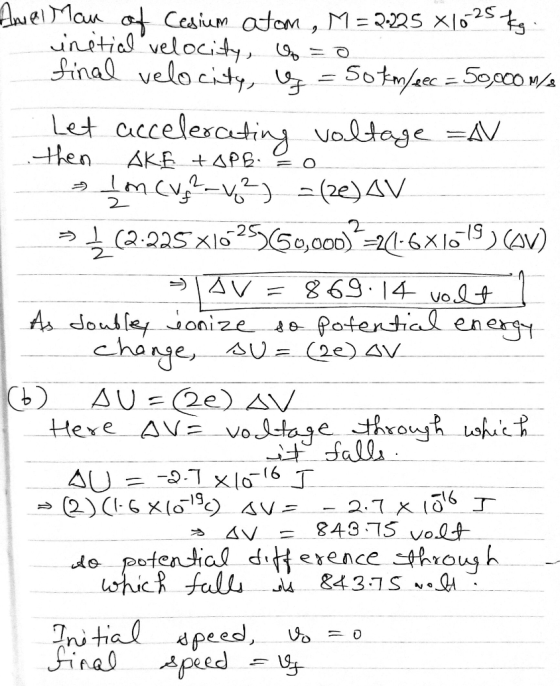
a) Doubly ionized Cesium ions are accelerated to 50 km/s in an ion rocket engine. What accelerating voltage is needed assuming they start from rest? Each ionization removes one electronic charge. **(Mass is 2.225x10⁻²⁵; Answer should be around 870V)
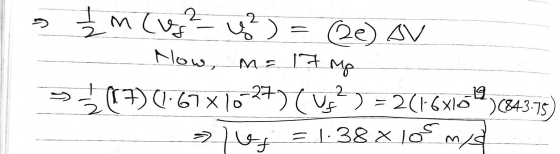
b) A doubly ionized atom (charge = + 2e, where e = 1.602 X 10⁻¹⁹ C) falls in a field that lowers its potential energy by 2.7 X 10⁻¹⁶ J. Through what voltage does it fall? If the ion has mass equal to 17 proton masses and falls from rest, what speed will it acquire?
Homework Answers
Here we apply definition of electric potential energy and kinetic energy as well as mechanical energy conservation.
Add Answer to:
a) Doubly ionized Cesium ions are accelerated to 50 km/s in an
ion rocket engine. What...
Suppose that an ion source in a mass spectrometer produces doubly ionized gold ions (Au2+), each...
Suppose that an ion source in a mass spectrometer produces doubly ionized gold ions (Au2+), each with a mass of 3.27 × 10⁻²⁵ kg. The ions are accelerated from rest through a potential difference of 2.20 kV. Then, a 0.530-T magnetic field causes the ions to follow a circular path. Determine the radius of the path.
Suppose that an ion source in a mass spectrometer produces doubly ionized gold ions (Au2+), each...
Suppose that an ion source in a mass spectrometer produces doubly ionized gold ions (Au2+), each with a mass of 3.27 × 10⁻²⁵ kg. The ions are accelerated from rest through a potential difference of 2.70 kV. Then, a 0.570-T magnetic field causes the ions to follow a circular path. Determine the radius of the path.
Suppose that an ion source in a mass spectrometer produces doubly ionized gold ions (Au^2+), each...
Suppose that an ion source in a mass spectrometer produces doubly ionized gold ions (Au^2+), each with a mass of 3.27*10^(-25) kg. The ions are accelerated from rest through a potential difference of 1.10 kV. Then, a 0.490 T magnetic field causes the ions to follow a circular path. Determine the radius of the path.
Suppose that an ion source in a mass spectrometer produces doubly ionized gold ions (Au^2+), each...
 Suppose that an ion source in a mass spectrometer produces doubly ionized gold ions (Au^2+), each with a mass of 3.27 times 10^-25 kg. The ions are accelerated from rest through a potential difference of 2.20 kV. Then, a 0.710-T magnetic field causes the ions to follow a circular path. Determine the radius of the path.
A doubly ionized atom (charge = +2e) whose mass is 8.30×10⁻²⁶ kg is accelerated by a...
A doubly ionized atom (charge = +2e) whose mass is 8.30×10⁻²⁶ kg is accelerated by a voltage of 2150.0 V and enters a region where a uniform magnetic field B = 0.100 T acts perpendicular to its motion. a) What is the radius of curvature of the path of the ion in the B-field? b) What is its period of revolution?
To five significant figures, what accelerating potential difference AV is required to detect the ion 0...
 To five significant figures, what accelerating potential difference AV is required to detect the ion 0 ? The masses of the atoms are shown in the table; the mass of the missing electron is less than 0.001 u and is not relevant at this level of precision. Use the following constants: 1 u = 1.6605 x 10⁻²⁷ kg, e = 1.6022 x 10⁻¹⁹ C. (Figure 1) shows a mass spectrometer, an analytical instrument used to identify the various molecules in...
 Suppose that an ion source in a mass spectrometer produces doubly ionized gold ions (Au^2+), each with a mass of 3.27 times 10^-25 kg. The ions are accelerated from rest through a potential difference of 2.20 kV. Then, a 0.710-T magnetic field causes the ions to follow a circular path. Determine the radius of the path.
 To five significant figures, what accelerating potential difference AV is required to detect the ion 0 ? The masses of the atoms are shown in the table; the mass of the missing electron is less than 0.001 u and is not relevant at this level of precision. Use the following constants: 1 u = 1.6605 x 10⁻²⁷ kg, e = 1.6022 x 10⁻¹⁹ C. (Figure 1) shows a mass spectrometer, an analytical instrument used to identify the various molecules in...
Most questions answered within 3 hours.
-
Where is the error in this code sequence?
String s1 = "Hello";
String s2 = "ello";...
asked 10 months ago -
Financial data for Joel de Paris, Inc., for last year
follow:
Joel de Paris, Inc.
Balance...
asked 10 months ago -
Consider this reaction:
Al2(SO4)3 (aq)+ BaCl3
(aq) Al2Cl6 (aq)- +
3BaSO4(s) . What is the...
asked 10 months ago -
Suppose that Savneet is considering increasing her
recent random sample from 20 car rentals to 40...
asked 10 months ago -
Trucks arrive at an unloading terminal at an average rate of 120
per hour.
Trucks arrive...
asked 10 months ago -
Why are methanol and ethanol completely soluble in water while
octanol is not very little soluble....
asked 10 months ago -
A facilities manager at a university reads in a research report
that the mean amount of...
asked 10 months ago -
When the CuSO4 is rehydrated by adding water to the anhydrous
compound, is this an endothermic...
asked 10 months ago -
A ray of sunlight is passing from diamond into crown glass; the
angle of incidence is...
asked 10 months ago -
A block of mass 0.249 kg is placed on top of a light, vertical
spring of...
asked 10 months ago -
how do the kidneys compensate in the presences of acidosis
a) trigger hyperventilate
b) reserve acid...
asked 10 months ago -
Question 501 pts
The rental rate of capital to the firm increases. Which of the
following...
asked 10 months ago