When water vapor condenses to a liquid, must heat be added or removed to maintain a...
When water vapor condenses to a liquid, must heat be added or removed to maintain a
constant temperature?
Homework Answers
Let us take the case of liquid water. If we want to convert liquid water to water vapour, then we need to provide heat to the system. As system is absorbing heat from the surrounding, it is an endothermic process.
The reverse process, that is, converting water vapour to liquid water (condensation) will be exothermic. The water vapour has to lose heat to the surrounding in order to become liquid water. As this is an exothermic process (the system is losing heat), in order to maintain constant temperature, we need to supply heat to the system.
Add Answer to:
When water vapor condenses to a liquid, must heat be added or
removed to maintain a...
6. (6 pts) As steam condenses from vapor into liquid water a) heat flows into the...
 6. (6 pts) As steam condenses from vapor into liquid water a) heat flows into the steanm b) heat flows out of the steam c) the temperature of the steam increases d) the temperature of the steam decreases e) both a & c f) both b & d
Calculate the change in heat when 12.50 g of water vapor (steam) at 100.0°C condenses to...
 Calculate the change in heat when 12.50 g of water vapor (steam)
at 100.0°C condenses to liquid water and then cools to 22.00
°C.
Calculate the change in heat when 12.50 g of water vapor (steam)
at 100.0°C condenses to liquid water and then cools to 22.00
°C.
Calculate the change in heat when 22.00 g of water vapor (steam) at 100.0°C condenses to...
Calculate the change in heat when 22.00 g of water vapor (steam) at 100.0°C condenses to liquid water and then cools to 28.00 °C.
If heat is added to ice and liquid water in a closed container and, after the...
If heat is added to ice and liquid water in a closed container and, after the addition of the heat, ice and liquid water remain, a. the vapor pressure of the water will decrease. b. the temperature will increase somewhat. c. the temperature will decrease somewhat. d. the vapor pressure of the water will rise. e. the vapor pressure of the water will remain constant.
(5) Freeze-drying occurs when vapor (and thus heat) is removed from a liquid. Assuming the vapor...
 (5) Freeze-drying occurs when vapor (and thus heat) is removed from a liquid. Assuming the vapor pressure of H20 remains constant as it cools, estimate the mass of ice that will form as H20 vapors are pulled off of 500.0 g of H20 () starting at 25.0°C.
See Periodic Table See Hint Calculate the change in heat when 16.50 g of water vapor (steam) at 100.0°C condenses t...
 See Periodic Table See Hint Calculate the change in heat when 16.50 g of water vapor (steam) at 100.0°C condenses to liquid water and then cools to 13.50 °C.
Calculate the heat that is absorbed/released when 9.00 g of steam condenses to liquid water at...
Calculate the heat that is absorbed/released when 9.00 g of steam condenses to liquid water at 100°C. DHvap(water) = 40.66 kJ/mol.
The vapor pressure of a liquid is the pressure exerted by its vapor when the liquid...
The vapor pressure of a liquid is the pressure exerted by its vapor when the liquid and vapor states are in equilibrium. The relationship between vapor pressure P and temperature T is expressed by the Clausius-Clapeyron equation. lnP2P1=ΔHvapR(1T1−1T2) where P1 and P2 are the vapor pressures at the absolute temperatures T1 and T2, respectively, ΔHvap is the heat of vaporization of the substance in joules per mole, and R is the ideal gas constant, which is equal to 8.3145 J/(mol⋅K)....
What amount of heat energy , in joules , must be removed to condensed 13.4g of...
What amount of heat energy , in joules , must be removed to condensed 13.4g of water vapor at 122.5C to liquid at 23.1C ?
4. (Latent Heat) Heat has to be removed to condense mercury vapor at a temperature of...
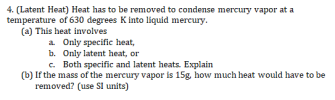 4. (Latent Heat) Heat has to be removed to condense mercury vapor at a temperature of 630 degrees Kinto liquid mercury. (a) This heat involves a. Only specific heat, b. Only latent heat, or c. Both specific and latent heats. Explain (b) If the mass of the mercury vapor is 15g, how much heat would have to be removed? (use SI units)
 6. (6 pts) As steam condenses from vapor into liquid water a) heat flows into the steanm b) heat flows out of the steam c) the temperature of the steam increases d) the temperature of the steam decreases e) both a & c f) both b & d
 Calculate the change in heat when 12.50 g of water vapor (steam)
at 100.0°C condenses to liquid water and then cools to 22.00
°C.
Calculate the change in heat when 12.50 g of water vapor (steam)
at 100.0°C condenses to liquid water and then cools to 22.00
°C.
 (5) Freeze-drying occurs when vapor (and thus heat) is removed from a liquid. Assuming the vapor pressure of H20 remains constant as it cools, estimate the mass of ice that will form as H20 vapors are pulled off of 500.0 g of H20 () starting at 25.0°C.
 See Periodic Table See Hint Calculate the change in heat when 16.50 g of water vapor (steam) at 100.0°C condenses to liquid water and then cools to 13.50 °C.
 4. (Latent Heat) Heat has to be removed to condense mercury vapor at a temperature of 630 degrees Kinto liquid mercury. (a) This heat involves a. Only specific heat, b. Only latent heat, or c. Both specific and latent heats. Explain (b) If the mass of the mercury vapor is 15g, how much heat would have to be removed? (use SI units)
Most questions answered within 3 hours.
-
Where is the error in this code sequence?
String s1 = "Hello";
String s2 = "ello";...
asked 11 months ago -
Financial data for Joel de Paris, Inc., for last year
follow:
Joel de Paris, Inc.
Balance...
asked 11 months ago -
Consider this reaction:
Al2(SO4)3 (aq)+ BaCl3
(aq) Al2Cl6 (aq)- +
3BaSO4(s) . What is the...
asked 11 months ago -
Suppose that Savneet is considering increasing her
recent random sample from 20 car rentals to 40...
asked 11 months ago -
Trucks arrive at an unloading terminal at an average rate of 120
per hour.
Trucks arrive...
asked 11 months ago -
Why are methanol and ethanol completely soluble in water while
octanol is not very little soluble....
asked 11 months ago -
A facilities manager at a university reads in a research report
that the mean amount of...
asked 11 months ago -
When the CuSO4 is rehydrated by adding water to the anhydrous
compound, is this an endothermic...
asked 11 months ago -
A ray of sunlight is passing from diamond into crown glass; the
angle of incidence is...
asked 11 months ago -
A block of mass 0.249 kg is placed on top of a light, vertical
spring of...
asked 11 months ago -
how do the kidneys compensate in the presences of acidosis
a) trigger hyperventilate
b) reserve acid...
asked 11 months ago -
Question 501 pts
The rental rate of capital to the firm increases. Which of the
following...
asked 11 months ago