why are benzene rings more stable than alkenes? use diagrams to explain your answer
Homework Answers
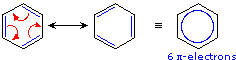
The six-membered ring in benzene is a perfect hexagon (all carbon-carbon bonds have an identical length of 1.40 Å). The cyclohexatriene contributors would be expected to show alternating bond lengths, the double bonds being shorter (1.34 Å) than the single bonds (1.54 Å). An alternative representation for benzene (circle within a hexagon) emphasizes the pi-electron delocalization in this molecule, and has the advantage of being a single diagram. In cases such as these, the electron delocalization described by resonance enhances the stability of the molecules, and compounds composed of such molecules often show exceptional stability and related properties.
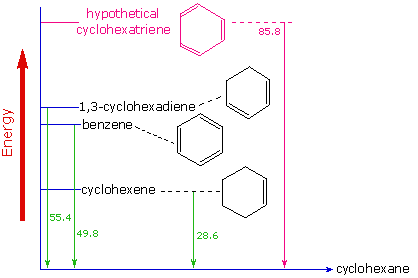
Evidence for the enhanced thermodynamic stability of benzene was obtained from measurements of the heat released when double bonds in a six-carbon ring are hydrogenated (hydrogen is added catalytically) to give cyclohexane as a common product. In the following diagram cyclohexane represents a low-energy reference point. Addition of hydrogen to cyclohexene produces cyclohexane and releases heat amounting to 28.6 kcal per mole. If we take this value to represent the energy cost of introducing one double bond into a six-carbon ring, we would expect a cyclohexadiene to release 57.2 kcal per mole on complete hydrogenation, and 1,3,5-cyclohexatriene to release 85.8 kcal per mole. These heats of hydrogenationwould reflect the relative thermodynamic stability of the compounds. In practice, 1,3-cyclohexadiene is slightly more stable than expected, by about 2 kcal, presumably due to conjugation of the double bonds. Benzene, however, is an extraordinary 36 kcal/mole more stable than expected. This sort of stability enhancement is now accepted as a characteristic of all aromatic compounds.
A molecular orbital description of benzene provides a more satisfying and more general treatment of "aromaticity". We know that benzene has a planar hexagonal structure in which all the carbon atoms are sp2 hybridized, and all the carbon-carbon bonds are equal in length. As shown below, the remaining cyclic array of six p-orbitals ( one on each carbon) overlap to generate six molecular orbitals, three bonding and three antibonding. The plus and minus signs shown in the diagram do not represent electrostatic charge, but refer to phase signs in the equations that describe these orbitals (in the diagram the phases are also color coded). When the phases correspond, the orbitals overlap to generate a common region of like phase, with those orbitals having the greatest overlap (e.g. π1) being lowest in energy. The remaining carbon valence electrons then occupy these molecular orbitals in pairs, resulting in a fully occupied (6 electrons) set of bonding molecular orbitals. It is this completely filled set of bonding orbitals, or closed shell, that gives the benzene ring its thermodynamic and chemical stability, just as a filled valence shell octet confers stability on the inert gases.
Add Answer to:
why
are benzene rings more stable than alkenes? use diagrams to explain
your answer
Which of the following substituted benzene rings is more activated towards electrophilic aromatic substitution than benzene?...
 Which of the following substituted benzene rings is more
activated towards electrophilic aromatic substitution than benzene?
Select all that apply
Which of the following substituted benzene rings is more activated towards electrophilic aromatic substitution than benzene? Select all that apply. CF3 Br NH2 OH A 00 D E F ОЕ OF D ОА OB Ос
Which of the following substituted benzene rings is more
activated towards electrophilic aromatic substitution than benzene?
Select all that apply
Which of the following substituted benzene rings is more activated towards electrophilic aromatic substitution than benzene? Select all that apply. CF3 Br NH2 OH A 00 D E F ОЕ OF D ОА OB Ос
3. 4 points Which of the following alkenes is more stable? Explain. 4. 2 points A...
 3. 4 points Which of the following alkenes is more stable? Explain. 4. 2 points A molecule has two rings, three double bonds, and two triple bonds. How many IHD units does this molecule have?
Which of the following substituted benzene rings is more activated towards electrophilic aromatic substitution than benzene?...
 Which of the following substituted benzene rings is more activated towards electrophilic aromatic substitution than benzene? Select all that apply. CF3 OH NH2 А B D E A D Ос B F ОЕ
Which of the following substituted benzene rings is more activated towards electrophilic aromatic substitution than benzene?...
 Which of the following substituted benzene rings is more activated towards electrophilic aromatic substitution than benzene? Select all that apply. ОН NH2 CF, Br E F A B OD B ОА OF Ос ОЕ
3. 4 points Which of the following alkenes is more stable? Explain.
 3. 4 points Which of the following alkenes is more stable? Explain.
please answer all parts, thanks! 1. More substituted alkenes are more stable than less substituted alkenes....
 please answer all parts, thanks!
1. More substituted alkenes are more stable than less substituted alkenes. Show the orbital overlap that helps to explain this observation. 2. Why is the heat of hydrogenation for an alkene exothermic? Analyze the bonds that are changing. AH = -30 kcal/mol Explain: + H2 3. Treating alkene "A" below with HBr can lead to a number of products. "A" SM + H-Br A bunch of products. For real, hella products. 3.A. Label the stereocenters...
please answer all parts, thanks!
1. More substituted alkenes are more stable than less substituted alkenes. Show the orbital overlap that helps to explain this observation. 2. Why is the heat of hydrogenation for an alkene exothermic? Analyze the bonds that are changing. AH = -30 kcal/mol Explain: + H2 3. Treating alkene "A" below with HBr can lead to a number of products. "A" SM + H-Br A bunch of products. For real, hella products. 3.A. Label the stereocenters...
xplain why chelating ligands give more stable complexes than monodentate ligands; use a balanced chemical equation...
 xplain why chelating ligands give more stable complexes than monodentate ligands; use a balanced chemical equation in your explanation. Explain why macrocyclic ligands give more stable complexes than chelating ligands.
Explain why alkenes react with Br2 and benzene does not yield any products when reacted with...
Explain why alkenes react with Br2 and benzene does not yield any products when reacted with Br2
Could anyone explain why the first compound is more stable than the one I circled? And...
 Could anyone explain why the first compound is more stable than
the one I circled? And also, why is resonance a stronger influence
and not induction? Thanks!
15. Circle one of the following charged compounds which is most stable. (3 Points) Which is the stronger influence for your choice? a) Resonance or b) Induction (hyperconjugation)? (2 Points)
Could anyone explain why the first compound is more stable than
the one I circled? And also, why is resonance a stronger influence
and not induction? Thanks!
15. Circle one of the following charged compounds which is most stable. (3 Points) Which is the stronger influence for your choice? a) Resonance or b) Induction (hyperconjugation)? (2 Points)
Briefly explain the two reasons why the radical anion on the RIGHT is more stable than...
 Briefly explain the two reasons why the radical anion on the RIGHT is more stable than the radical anion on the LEFT. Me Me Mе Me
 Which of the following substituted benzene rings is more
activated towards electrophilic aromatic substitution than benzene?
Select all that apply
Which of the following substituted benzene rings is more activated towards electrophilic aromatic substitution than benzene? Select all that apply. CF3 Br NH2 OH A 00 D E F ОЕ OF D ОА OB Ос
Which of the following substituted benzene rings is more
activated towards electrophilic aromatic substitution than benzene?
Select all that apply
Which of the following substituted benzene rings is more activated towards electrophilic aromatic substitution than benzene? Select all that apply. CF3 Br NH2 OH A 00 D E F ОЕ OF D ОА OB Ос
 3. 4 points Which of the following alkenes is more stable? Explain. 4. 2 points A molecule has two rings, three double bonds, and two triple bonds. How many IHD units does this molecule have?
 Which of the following substituted benzene rings is more activated towards electrophilic aromatic substitution than benzene? Select all that apply. CF3 OH NH2 А B D E A D Ос B F ОЕ
 Which of the following substituted benzene rings is more activated towards electrophilic aromatic substitution than benzene? Select all that apply. ОН NH2 CF, Br E F A B OD B ОА OF Ос ОЕ
 3. 4 points Which of the following alkenes is more stable? Explain.
 please answer all parts, thanks!
1. More substituted alkenes are more stable than less substituted alkenes. Show the orbital overlap that helps to explain this observation. 2. Why is the heat of hydrogenation for an alkene exothermic? Analyze the bonds that are changing. AH = -30 kcal/mol Explain: + H2 3. Treating alkene "A" below with HBr can lead to a number of products. "A" SM + H-Br A bunch of products. For real, hella products. 3.A. Label the stereocenters...
please answer all parts, thanks!
1. More substituted alkenes are more stable than less substituted alkenes. Show the orbital overlap that helps to explain this observation. 2. Why is the heat of hydrogenation for an alkene exothermic? Analyze the bonds that are changing. AH = -30 kcal/mol Explain: + H2 3. Treating alkene "A" below with HBr can lead to a number of products. "A" SM + H-Br A bunch of products. For real, hella products. 3.A. Label the stereocenters...
 xplain why chelating ligands give more stable complexes than monodentate ligands; use a balanced chemical equation in your explanation. Explain why macrocyclic ligands give more stable complexes than chelating ligands.
 Could anyone explain why the first compound is more stable than
the one I circled? And also, why is resonance a stronger influence
and not induction? Thanks!
15. Circle one of the following charged compounds which is most stable. (3 Points) Which is the stronger influence for your choice? a) Resonance or b) Induction (hyperconjugation)? (2 Points)
Could anyone explain why the first compound is more stable than
the one I circled? And also, why is resonance a stronger influence
and not induction? Thanks!
15. Circle one of the following charged compounds which is most stable. (3 Points) Which is the stronger influence for your choice? a) Resonance or b) Induction (hyperconjugation)? (2 Points)
 Briefly explain the two reasons why the radical anion on the RIGHT is more stable than the radical anion on the LEFT. Me Me Mе Me
Most questions answered within 3 hours.
-
Where is the error in this code sequence?
String s1 = "Hello";
String s2 = "ello";...
asked 11 months ago -
Financial data for Joel de Paris, Inc., for last year
follow:
Joel de Paris, Inc.
Balance...
asked 11 months ago -
Consider this reaction:
Al2(SO4)3 (aq)+ BaCl3
(aq) Al2Cl6 (aq)- +
3BaSO4(s) . What is the...
asked 11 months ago -
Suppose that Savneet is considering increasing her
recent random sample from 20 car rentals to 40...
asked 11 months ago -
Trucks arrive at an unloading terminal at an average rate of 120
per hour.
Trucks arrive...
asked 11 months ago -
Why are methanol and ethanol completely soluble in water while
octanol is not very little soluble....
asked 11 months ago -
A facilities manager at a university reads in a research report
that the mean amount of...
asked 11 months ago -
When the CuSO4 is rehydrated by adding water to the anhydrous
compound, is this an endothermic...
asked 11 months ago -
A ray of sunlight is passing from diamond into crown glass; the
angle of incidence is...
asked 11 months ago -
A block of mass 0.249 kg is placed on top of a light, vertical
spring of...
asked 11 months ago -
how do the kidneys compensate in the presences of acidosis
a) trigger hyperventilate
b) reserve acid...
asked 11 months ago -
Question 501 pts
The rental rate of capital to the firm increases. Which of the
following...
asked 11 months ago