Duality Theory : Consider the following LP problem: Maximize Z = 2x1 + x2 - x3...
Duality Theory :
Consider the following LP problem:
Maximize Z = 2x1 + x2 - x3
subject to
2x1 + x2+ x3 ≤ 8
4x1 +x2 - x3 ≤ 10
x1 ≥ 0, x2 ≥ 0, x3 ≥ 0.
(a) Find the dual for this LP
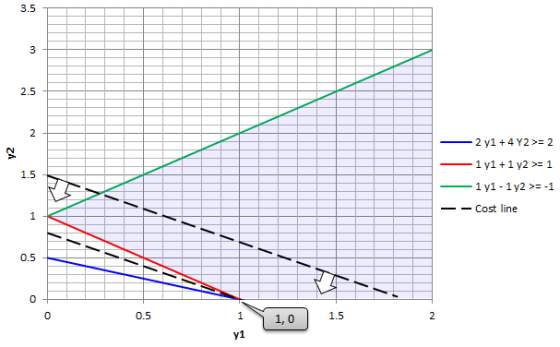
(b) Graphically solve the dual of this LP. And interpret the economic meaning of the optimal solution of the dual.
(c) Use complementary slackness property to solve the max problem (the primal problem).
Clearly answer each part of the question with Excel file thanks
Unfortunately it is excel is required. thanks for asking though!
unfortunately excel is required. thanks for asking though!
Homework Answers
Part (a) and (c) has nothing to do with Excel. Part (c) is just arithmetic. Part (a) is writing the dual. So, if the question asks for Excel for these two parts also, please simply paste the answers in the Excel file.
Only the part (b) (the graph) can be drawn in Excel.
(a)
Min W = 8 y1 + 10 y2
s.t.
2 y1 + 4 Y2 >= 2
1 y1 + 1 y2 >= 1
1 y1 - 1 y2 >= -1
y1, y2 >= 0
(b)
Steps to develop the graph is Excel:
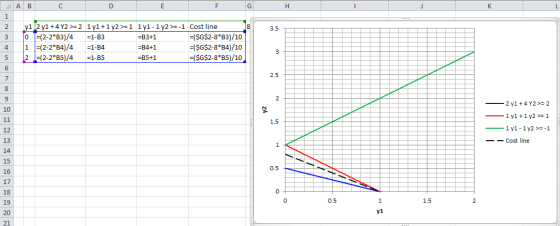
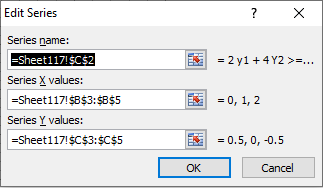
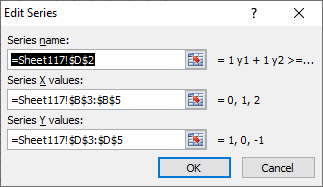
Develop the following table in Excel and use the scatter plot option to develop the chart as shown:
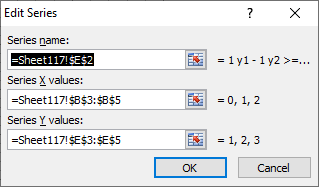
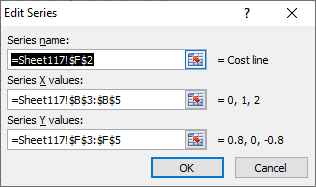
The cost line, moving in minimization direction (towards the origin), leaves the feasibility area at a point (1, 0). So, the optimal solution of the dual is as follows:
y1 = 1
y2 = 0
Min. W = 8*1 + 10*0 = 8
The optimal solution of the dual represents the dual prices of the corresponding primal constraints. So, if the RHS of the first primal constraint is increased by one unit, the corresponding increase in the 'Z' value is $1. Similarly, if the RHS of the second primal constraint is increased by one unit, the corresponding increase in the 'Z' value is $0.
(c)
The dual variable y1 = 1; using complementary slackness, the first, primal constraint is an equality
So,
2x1 + x2 + x3 = 8 --------(1)
The third dual constraint has a slack, using complementary slackness, x3 will be zero in primal
So,
x3 = 0
The second constraint of primal will have slack for y2 = 0 i.e. 4x1 + x2 - x3 < 10
Making x3 equal to zero,
2x1 + x2 = 8
4x1 + x2 < 10
Also, Min W = Max Z = 2x1 + x2 = 8
We can set x1 = 0 and x2 = 8 to satisfy them. So, the optimal solution is x1 = x3 = 0 and x2 = 8
and Max Z = Min W = 8
Add Answer to:
Duality Theory :
Consider the following LP problem:
Maximize Z = 2x1 +
x2 - x3...
QUESTION 3 Duality Theory : Consider the following LP problem: Maximize Z = 2x1 + x2...
QUESTION 3 Duality Theory : Consider the following LP problem: Maximize Z = 2x1 + x2 - x3 subject to 2x1 + x2+ x3 ≤ 8 4x1 +x2 - x3 ≤ 10 and x1 ≥ 0, x2 ≥ 0, x3 ≥ 0. (a) Find the dual for this LP (b) Graphically solve the dual of this LP. And interpret the economic meaning of the optimal solution of the dual. (c) Use complementary slackness property to solve the max problem (the...
Problem 3: Complentary slackness From Deterministic Operations Research, David J. Rader, Jr. Supp...
 Problem 3: Complentary slackness From Deterministic Operations Research, David J. Rader, Jr. Suppose that xı -2, r2 0, T3 -4 is an optimal solution to the linear program: max 4x1 + 2x2 + 3x3 s.t. 2x1+3x2 +x3 12 1 4r2 2x3 10 3zi 23 10 2x1 +3x2 +t3 12 21, 32,c3 20 (a) Using only the primal solution, complementary slackness, and the strong duality theorem, find an optimal solution to the dual problem. (b) Write the dual LP of this...
Problem 3: Complentary slackness From Deterministic Operations Research, David J. Rader, Jr. Suppose that xı -2,...
 Problem 3: Complentary slackness From Deterministic Operations Research, David J. Rader, Jr. Suppose that xı -2, r2 0, T3 -4 is an optimal solution to the linear program: max 4x1 + 2x2 + 3x3 s.t. 2x1+3x2 +x3 12 1 4r2 2x3 10 3zi 23 10 2x1 +3x2 +t3 12 21, 32,c3 20 (a) Using only the primal solution, complementary slackness, and the strong duality theorem, find an optimal solution to the dual problem. (b) Write the dual LP of this...
SOLVE STEP BY STEP! 4. Consider the following LP: Minimize z = x; +3x2 - X3...
 SOLVE STEP BY STEP!
4. Consider the following LP: Minimize z = x; +3x2 - X3 Subject to x + x2 + x2 > 3 -x + 2xz > 2 -x + 3x2 + x3 34 X1 X2,43 20 (a) Using the two-phase method, find the optimal solution to the primal problem above. (b) Write directly the dual of the primal problem, without using the method of transformation. (c) Determine the optimal values of the dual variables from the optimal...
SOLVE STEP BY STEP!
4. Consider the following LP: Minimize z = x; +3x2 - X3 Subject to x + x2 + x2 > 3 -x + 2xz > 2 -x + 3x2 + x3 34 X1 X2,43 20 (a) Using the two-phase method, find the optimal solution to the primal problem above. (b) Write directly the dual of the primal problem, without using the method of transformation. (c) Determine the optimal values of the dual variables from the optimal...
Solving an LP problem using complementary slackness
Solve the dual of the following L.P problem by simplex method. Hence find the solution of the primal using complimentary slackness conditions. Minimize Z = 4X1 - 5X2 - 2X3 Subject to 6X1 + X2 - X3 ≤ 5 2X1 + 2X2 - 3X3 ≥ 3 ...
Q3. (Dual Simplex Method) (2 marks) Use the dual Simplex method to solve the following LP model: max z= 2x1 +4x2 +9x3 x1 x2 x3 S 1 -x1+ X2 +2x3 S -4 x2+ X1,X2,X3 S 0 Q3. (Dual Simplex Method) (2...
 Q3. (Dual Simplex Method) (2 marks) Use the dual Simplex method to solve the following LP model: max z= 2x1 +4x2 +9x3 x1 x2 x3 S 1 -x1+ X2 +2x3 S -4 x2+ X1,X2,X3 S 0
Q3. (Dual Simplex Method) (2 marks) Use the dual Simplex method to solve the following LP model: max z= 2x1 +4x2 +9x3 x1 x2 x3 S 1 -x1+ X2 +2x3 S -4 x2+ X1,X2,X3 S 0
Q3. (Dual Simplex Method) (2 marks) Use the dual Simplex method to solve the following LP model: max z= 2x1 +4x2 +9x3 x1 x2 x3 S 1 -x1+ X2 +2x3 S -4 x2+ X1,X2,X3 S 0
5. Solve the linear program below as follows: First, solve the dual problem graphically. Then use...
 Operations Research
5. Solve the linear program below as follows: First, solve the dual problem graphically. Then use the solution to the dual problem to determine which variables in the primal problem are zero in the optimal primal solution. [Hint: Invoke complementary slackness.] Finally, solve for the optimal basic variables in the primal, using the primal equations. Primal Maximize-4x2 + 3x3 2x4-8xs, subject to: 3x1 + x2 + 2x3 +x4 = 3. x)2。 (j=1,2,3, 4.5).
5. Solve the linear program...
Operations Research
5. Solve the linear program below as follows: First, solve the dual problem graphically. Then use the solution to the dual problem to determine which variables in the primal problem are zero in the optimal primal solution. [Hint: Invoke complementary slackness.] Finally, solve for the optimal basic variables in the primal, using the primal equations. Primal Maximize-4x2 + 3x3 2x4-8xs, subject to: 3x1 + x2 + 2x3 +x4 = 3. x)2。 (j=1,2,3, 4.5).
5. Solve the linear program...
Solve the following LP problem GRAPHICALLY Maximize profit = 9x1 + 7x2 Subject to: 2x1 +...
Solve the following LP problem GRAPHICALLY Maximize profit = 9x1 + 7x2 Subject to: 2x1 + 1x2 ≤ 40 x1 + 3x2 ≤ 30 x1, x2 ≥ 0
Use the simplex algorithm to find all optimal solutions to the following LP. max z=2x1+x2 s.t....
Use the simplex algorithm to find all optimal solutions to the following LP. max z=2x1+x2 s.t. 4x1 + 2x2 ≤ 4 −2x1 + x2 ≤ 2 x1 ≥1 x1,x2 ≥0
4.3-7. Consider the following problem. Maximize Z = 5x1 + 3x2 + 4x3, subject to 2x1 + x2 + x3<...
4.3-7. Consider the following problem. Maximize Z = 5x1 + 3x2 + 4x3, subject to 2x1 + x2 + x3<= 20 3x1 + x2 + 2x3 <= 30 and x1 >= 0, x2 >= 0, x3 >= 0. You are given the information that the nonzero variables in the optimal solution are x2 and x3. (a) Describe how you can use this information to adapt the simplex method to solve this problem in the minimum possible number of iterations (when...
 Problem 3: Complentary slackness From Deterministic Operations Research, David J. Rader, Jr. Suppose that xı -2, r2 0, T3 -4 is an optimal solution to the linear program: max 4x1 + 2x2 + 3x3 s.t. 2x1+3x2 +x3 12 1 4r2 2x3 10 3zi 23 10 2x1 +3x2 +t3 12 21, 32,c3 20 (a) Using only the primal solution, complementary slackness, and the strong duality theorem, find an optimal solution to the dual problem. (b) Write the dual LP of this...
 Problem 3: Complentary slackness From Deterministic Operations Research, David J. Rader, Jr. Suppose that xı -2, r2 0, T3 -4 is an optimal solution to the linear program: max 4x1 + 2x2 + 3x3 s.t. 2x1+3x2 +x3 12 1 4r2 2x3 10 3zi 23 10 2x1 +3x2 +t3 12 21, 32,c3 20 (a) Using only the primal solution, complementary slackness, and the strong duality theorem, find an optimal solution to the dual problem. (b) Write the dual LP of this...
 SOLVE STEP BY STEP!
4. Consider the following LP: Minimize z = x; +3x2 - X3 Subject to x + x2 + x2 > 3 -x + 2xz > 2 -x + 3x2 + x3 34 X1 X2,43 20 (a) Using the two-phase method, find the optimal solution to the primal problem above. (b) Write directly the dual of the primal problem, without using the method of transformation. (c) Determine the optimal values of the dual variables from the optimal...
SOLVE STEP BY STEP!
4. Consider the following LP: Minimize z = x; +3x2 - X3 Subject to x + x2 + x2 > 3 -x + 2xz > 2 -x + 3x2 + x3 34 X1 X2,43 20 (a) Using the two-phase method, find the optimal solution to the primal problem above. (b) Write directly the dual of the primal problem, without using the method of transformation. (c) Determine the optimal values of the dual variables from the optimal...
 Q3. (Dual Simplex Method) (2 marks) Use the dual Simplex method to solve the following LP model: max z= 2x1 +4x2 +9x3 x1 x2 x3 S 1 -x1+ X2 +2x3 S -4 x2+ X1,X2,X3 S 0
Q3. (Dual Simplex Method) (2 marks) Use the dual Simplex method to solve the following LP model: max z= 2x1 +4x2 +9x3 x1 x2 x3 S 1 -x1+ X2 +2x3 S -4 x2+ X1,X2,X3 S 0
Q3. (Dual Simplex Method) (2 marks) Use the dual Simplex method to solve the following LP model: max z= 2x1 +4x2 +9x3 x1 x2 x3 S 1 -x1+ X2 +2x3 S -4 x2+ X1,X2,X3 S 0
 Operations Research
5. Solve the linear program below as follows: First, solve the dual problem graphically. Then use the solution to the dual problem to determine which variables in the primal problem are zero in the optimal primal solution. [Hint: Invoke complementary slackness.] Finally, solve for the optimal basic variables in the primal, using the primal equations. Primal Maximize-4x2 + 3x3 2x4-8xs, subject to: 3x1 + x2 + 2x3 +x4 = 3. x)2。 (j=1,2,3, 4.5).
5. Solve the linear program...
Operations Research
5. Solve the linear program below as follows: First, solve the dual problem graphically. Then use the solution to the dual problem to determine which variables in the primal problem are zero in the optimal primal solution. [Hint: Invoke complementary slackness.] Finally, solve for the optimal basic variables in the primal, using the primal equations. Primal Maximize-4x2 + 3x3 2x4-8xs, subject to: 3x1 + x2 + 2x3 +x4 = 3. x)2。 (j=1,2,3, 4.5).
5. Solve the linear program...
Most questions answered within 3 hours.
-
Where is the error in this code sequence?
String s1 = "Hello";
String s2 = "ello";...
asked 11 months ago -
Financial data for Joel de Paris, Inc., for last year
follow:
Joel de Paris, Inc.
Balance...
asked 11 months ago -
Consider this reaction:
Al2(SO4)3 (aq)+ BaCl3
(aq) Al2Cl6 (aq)- +
3BaSO4(s) . What is the...
asked 11 months ago -
Suppose that Savneet is considering increasing her
recent random sample from 20 car rentals to 40...
asked 11 months ago -
Trucks arrive at an unloading terminal at an average rate of 120
per hour.
Trucks arrive...
asked 11 months ago -
Why are methanol and ethanol completely soluble in water while
octanol is not very little soluble....
asked 11 months ago -
A facilities manager at a university reads in a research report
that the mean amount of...
asked 11 months ago -
When the CuSO4 is rehydrated by adding water to the anhydrous
compound, is this an endothermic...
asked 11 months ago -
A ray of sunlight is passing from diamond into crown glass; the
angle of incidence is...
asked 11 months ago -
A block of mass 0.249 kg is placed on top of a light, vertical
spring of...
asked 11 months ago -
how do the kidneys compensate in the presences of acidosis
a) trigger hyperventilate
b) reserve acid...
asked 11 months ago -
Question 501 pts
The rental rate of capital to the firm increases. Which of the
following...
asked 11 months ago