RADIOGRAPHIC DENSITY VS. ANATOMIC DENSITY ?
RADIOGRAPHIC DENSITY VS. ANATOMIC DENSITY ?
Homework Answers
Radiographic Density - the overall amount / degree of darkening
on a radiograph. In
routine radiography, the useful range of density varies from 0.3 to
2.0 density. The
density below 0.3 is due to the density produced by the base and by
some fog on the
film (base plus fog). Density is primarily determined by mA.
Atomic density means the number of atoms per unit volume. The atomic number of an element represents the number of protons in the nucleus and the number of electrons surrounding it.
Radiographic procedures are located in the CPT manual index under the term _____ with subterms for...
Radiographic procedures are located in the CPT manual index under the term _____ with subterms for the anatomic part. radiology x-ray angiography radiography
What anatomic entities are considered the passive and active stabilizer of a synovial joint? Compare their...
What anatomic entities are considered the passive and active stabilizer of a synovial joint? Compare their roles in providing joint stability to hip vs. shoulder joints.
radiographic pathology for technologists Chapter 5: ABDOMINAL & GASTROINTESTINAL SYSTEM Answer the following questions with a...
 radiographic pathology for technologists
Chapter 5: ABDOMINAL & GASTROINTESTINAL SYSTEM Answer the following questions with a short answer (2-3 sentences). • Please submit only the answer portion of this exercise to the instructor. • Make sure to number your answers. 1. Describe the differences, both clinical and radiographic, between a mechanical bowel obstruction and paralytic ileus. 2. Explain the connection between colonic polyps and the development of colorectal cancer. 3. Describe the role of CT in the staging of various...
radiographic pathology for technologists
Chapter 5: ABDOMINAL & GASTROINTESTINAL SYSTEM Answer the following questions with a short answer (2-3 sentences). • Please submit only the answer portion of this exercise to the instructor. • Make sure to number your answers. 1. Describe the differences, both clinical and radiographic, between a mechanical bowel obstruction and paralytic ileus. 2. Explain the connection between colonic polyps and the development of colorectal cancer. 3. Describe the role of CT in the staging of various...
What is the significance of the anatomic design of the autonomic nervous system?
What is the significance of the anatomic design of the autonomic nervous system?
(i) Plot the current density vs. overvoltage (j vs. h) relationship – the Butler-Volmer equation –...
(i) Plot the current density vs. overvoltage (j vs. h) relationship – the Butler-Volmer equation – for this reaction in the range h = -0.5 to 0.5 V. Assume a transfer coefficient a = 0.5 and vary the exchange current density: j0 = 10-3, 10-6, 10-9 A/cm2. Define the sign conventions for current and overvoltage. (ii) Plot the j vs. h relationship for j0 = 10-6 A/cm2 and a = 0.25, 0.5 and 0.75. (iii) Plot log½j½ vs. h curves...
Describe the mechanisms that confine cells and tissues to a specific anatomic site
Describe the mechanisms that confine cells and tissues to a specific anatomic site
After a normal exhalation, some air is left in the "anatomic dead spaces" of the lungs...
After a normal exhalation, some air is left in the "anatomic dead spaces" of the lungs and airways. This air cannot be used to oxygenate capillary blood, because it never comes in contact with the capillary network. Which of the following respiratory structures CANNOT be an "anatomic dead space"? Group of answer choices bronchus bronchiole trachea alveolus
12. Identify anatomic and physiologic barriers that defend the body against mi
 12. Identify anatomic and physiologic barriers that defend the body against mi
cheerleader is complaining of pain over the right anatomic snuffbox. You determine that the cheerleader fell...
cheerleader is complaining of pain over the right anatomic snuffbox. You determine that the cheerleader fell on an outstretched hand while performing a back flip at practice the previous day. Observation reveals minor swelling but no discoloration or deformity. Palpation reveals sharp pain in the anatomic snuffbox. What injury should you suspect? Explain what steps you would take in managing and treating her injury?
1. What is the ADA's standard for viewing and interpreting intraoral radiographic images? A. Labial mounting...
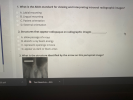 1. What is the ADA's standard for viewing and interpreting intraoral radiographic images? A. Labial mounting B. Lingual mounting C. Patient orientation D. External orientation O 2. Structures that appear radiopaque on radiographic images A. allow passage of x-rays B. absorb x-ray beam energy C. represent openings in bone D. appear as dark or black areas 3. What is the structure identified by the arrow on this periapical image? 20.pdf A b Test Result:ov....htm A
 radiographic pathology for technologists
Chapter 5: ABDOMINAL & GASTROINTESTINAL SYSTEM Answer the following questions with a short answer (2-3 sentences). • Please submit only the answer portion of this exercise to the instructor. • Make sure to number your answers. 1. Describe the differences, both clinical and radiographic, between a mechanical bowel obstruction and paralytic ileus. 2. Explain the connection between colonic polyps and the development of colorectal cancer. 3. Describe the role of CT in the staging of various...
radiographic pathology for technologists
Chapter 5: ABDOMINAL & GASTROINTESTINAL SYSTEM Answer the following questions with a short answer (2-3 sentences). • Please submit only the answer portion of this exercise to the instructor. • Make sure to number your answers. 1. Describe the differences, both clinical and radiographic, between a mechanical bowel obstruction and paralytic ileus. 2. Explain the connection between colonic polyps and the development of colorectal cancer. 3. Describe the role of CT in the staging of various...
 12. Identify anatomic and physiologic barriers that defend the body against mi
 1. What is the ADA's standard for viewing and interpreting intraoral radiographic images? A. Labial mounting B. Lingual mounting C. Patient orientation D. External orientation O 2. Structures that appear radiopaque on radiographic images A. allow passage of x-rays B. absorb x-ray beam energy C. represent openings in bone D. appear as dark or black areas 3. What is the structure identified by the arrow on this periapical image? 20.pdf A b Test Result:ov....htm A
Most questions answered within 3 hours.
-
Where is the error in this code sequence?
String s1 = "Hello";
String s2 = "ello";...
asked 10 months ago -
Financial data for Joel de Paris, Inc., for last year
follow:
Joel de Paris, Inc.
Balance...
asked 10 months ago -
Consider this reaction:
Al2(SO4)3 (aq)+ BaCl3
(aq) Al2Cl6 (aq)- +
3BaSO4(s) . What is the...
asked 10 months ago -
Suppose that Savneet is considering increasing her
recent random sample from 20 car rentals to 40...
asked 10 months ago -
Trucks arrive at an unloading terminal at an average rate of 120
per hour.
Trucks arrive...
asked 10 months ago -
Why are methanol and ethanol completely soluble in water while
octanol is not very little soluble....
asked 10 months ago -
A facilities manager at a university reads in a research report
that the mean amount of...
asked 10 months ago -
When the CuSO4 is rehydrated by adding water to the anhydrous
compound, is this an endothermic...
asked 10 months ago -
A ray of sunlight is passing from diamond into crown glass; the
angle of incidence is...
asked 10 months ago -
A block of mass 0.249 kg is placed on top of a light, vertical
spring of...
asked 10 months ago -
how do the kidneys compensate in the presences of acidosis
a) trigger hyperventilate
b) reserve acid...
asked 10 months ago -
Question 501 pts
The rental rate of capital to the firm increases. Which of the
following...
asked 10 months ago