consider a consol/perpetuity that pays $100 every period forever. If current yield on the consol was...
consider a consol/perpetuity that pays $100 every period forever. If current yield on the consol was 4% in period t and increased to 5% in period t+1. During this period, the inflation rate was 2%. Then what is the real rate of return for someone who bought it in period t and sold it in period t+1?
(In word format preferred)
Homework Answers
current yield = annual income / current price
in year t, current price = annual income/current yield
current price = 100/0.04 = 2500
in year t+1, current price = annual income/current yield
current price = 100/0.05 = 2000
buying cost = 2500
selling price = 2000
interest income = 100
real rate of return = (2000+100 - 2500*(1.02))/2500 = -18%
Add Answer to:
consider a consol/perpetuity that pays $100 every period
forever. If current yield on the consol was...
8) The British government has consol bonds (perpetuities) outstanding that pay £100 per year forever....

8) The British government has consol bonds (perpetuities) outstanding that pay £100 per year forever. Assume that the current discount rate is 4% a) What is the value of the bond today in £? b) If this consol trades in the market today at £2,480, what rate of return will an investor earn from this investment? 9) The Elysian Trust has set up a program that provides free school education for underprivileged children in India and Nepal. The Elysian...
8) The British government has consol bonds (perpetuities) outstanding that pay £100 per year forever. Assume that the current discount rate is 4% a) What is the value of the bond today in £? b) If this consol trades in the market today at £2,480, what rate of return will an investor earn from this investment? 9) The Elysian Trust has set up a program that provides free school education for underprivileged children in India and Nepal. The Elysian...
14) b) The British government has consol bonds (perpetuities) outstanding that pay £100 per year, forever....
 14) b) The British government has consol bonds (perpetuities) outstanding that pay £100 per year, forever. Assume that the current discount rate is 4%. What is the value of the bond today in £, if the last payment was made yesterday? What is the value of the bond today in £, if you will receive the first payment today? Assume an ordinary perpetuity. If this consol trades in the market today at £2,480, what rate of return will an investor...
Consider a long term government bond, specifically a "consol" that pays a fixed coupon payment C...
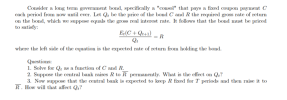 Consider a long term government bond, specifically a "consol" that pays a fixed coupon payment C each period from now until ever. Let Qt be the price of the bond C and R the required gross rate of return on the bond, which we suppose equals the gross real interest rate. It follows that the bond must be priced to satisfy: where the left side of the equation is the expected rate of return from holding the bond. Questions 1....
Consider an investment that pays $17.17 every year forever. This firm does not intend to grow...
Consider an investment that pays $17.17 every year forever. This firm does not intend to grow and has an interest rate (required rate of return) of 8%. What is the present value of this investment opportunity? Give answers to two decimals.
Consider an investment that pays $47.32 in year 1, and then stabilizes and pays $6.69 every...
Consider an investment that pays $47.32 in year 1, and then stabilizes and pays $6.69 every year forever after that (the first cash flow is in year 2) This firm does not intend to grow and has an interest rate (required rate of return) of 7%. What is the present value of this investment opportunity? Give your answer to two decimals
Consider an investment that pays $41.49 in year 1, and then stabilizes and pays $4.81 every...
Consider an investment that pays $41.49 in year 1, and then stabilizes and pays $4.81 every year forever after that (the first cash flow is in year 2) This firm does not intend to grow and has an interest rate (required rate of return) of 5%. What is the present value of this investment opportunity? Give your answer to two decimals
The current price of stock XYZ is $100. Stock pays dividends at the continuously compounded yield...
The current price of stock XYZ is $100. Stock pays dividends at the continuously compounded yield rate of 4%. The continuously compounded risk-free rate is 5% annually. In one year, the stock price may be 115 or 90. The expected continuously compounded rate of return on the stock is 10%. Consider a 105-strike 1-year European call option. Find the continuously compounded expected rate of discount γ for the call option.
The current price of a preferred stock is $100. The preferred stock just paid a dividend...
The current price of a preferred stock is $100. The preferred stock just paid a dividend of $1,2. The preferred stock pays dividends every quarter and the growth rate of dividends is 3% per quarter. a) What is the quarterly discount rate to price this preferred stock? b) What is the annual percentage rate to price this preferred stock? c) What is the real annual percentage discount rate if the expected rate of inflation is 2,3%? d) What is the...
roblem Consider a one period (discount) bond that pays $100 at the end of the year....
 roblem Consider a one period (discount) bond that pays $100 at the end of the year. 1. Ifthe current interest rate is 5 percent per-annum, what is the current price ofthe bond? Answer: Suppose the current interest rate was to fall to 2 percent, what is the effect on the price of the bond? 2. Answer: Problem 2
Companies that have preferred stock outstanding promise to pay a stated dividend for an infinite period....
 Companies that have preferred stock outstanding promise to pay a stated dividend for an infinite period. Preferred stock is treated like a perpetuity if the payments last forever. Preferred stocks are considered to be a hybrid of a common stock and a bond. For example, one of the major differences between preferred shares and bonds is that the issuing companies can suspend the payment of their preferred dividends without throwing the company into bankruptcy. However, similar to bonds, preferred stockholders...

8) The British government has consol bonds (perpetuities) outstanding that pay £100 per year forever. Assume that the current discount rate is 4% a) What is the value of the bond today in £? b) If this consol trades in the market today at £2,480, what rate of return will an investor earn from this investment? 9) The Elysian Trust has set up a program that provides free school education for underprivileged children in India and Nepal. The Elysian...
8) The British government has consol bonds (perpetuities) outstanding that pay £100 per year forever. Assume that the current discount rate is 4% a) What is the value of the bond today in £? b) If this consol trades in the market today at £2,480, what rate of return will an investor earn from this investment? 9) The Elysian Trust has set up a program that provides free school education for underprivileged children in India and Nepal. The Elysian...
 14) b) The British government has consol bonds (perpetuities) outstanding that pay £100 per year, forever. Assume that the current discount rate is 4%. What is the value of the bond today in £, if the last payment was made yesterday? What is the value of the bond today in £, if you will receive the first payment today? Assume an ordinary perpetuity. If this consol trades in the market today at £2,480, what rate of return will an investor...
 Consider a long term government bond, specifically a "consol" that pays a fixed coupon payment C each period from now until ever. Let Qt be the price of the bond C and R the required gross rate of return on the bond, which we suppose equals the gross real interest rate. It follows that the bond must be priced to satisfy: where the left side of the equation is the expected rate of return from holding the bond. Questions 1....
 roblem Consider a one period (discount) bond that pays $100 at the end of the year. 1. Ifthe current interest rate is 5 percent per-annum, what is the current price ofthe bond? Answer: Suppose the current interest rate was to fall to 2 percent, what is the effect on the price of the bond? 2. Answer: Problem 2
 Companies that have preferred stock outstanding promise to pay a stated dividend for an infinite period. Preferred stock is treated like a perpetuity if the payments last forever. Preferred stocks are considered to be a hybrid of a common stock and a bond. For example, one of the major differences between preferred shares and bonds is that the issuing companies can suspend the payment of their preferred dividends without throwing the company into bankruptcy. However, similar to bonds, preferred stockholders...
Most questions answered within 3 hours.
-
Where is the error in this code sequence?
String s1 = "Hello";
String s2 = "ello";...
asked 10 months ago -
Financial data for Joel de Paris, Inc., for last year
follow:
Joel de Paris, Inc.
Balance...
asked 10 months ago -
Consider this reaction:
Al2(SO4)3 (aq)+ BaCl3
(aq) Al2Cl6 (aq)- +
3BaSO4(s) . What is the...
asked 10 months ago -
Suppose that Savneet is considering increasing her
recent random sample from 20 car rentals to 40...
asked 10 months ago -
Trucks arrive at an unloading terminal at an average rate of 120
per hour.
Trucks arrive...
asked 10 months ago -
Why are methanol and ethanol completely soluble in water while
octanol is not very little soluble....
asked 10 months ago -
A facilities manager at a university reads in a research report
that the mean amount of...
asked 10 months ago -
When the CuSO4 is rehydrated by adding water to the anhydrous
compound, is this an endothermic...
asked 10 months ago -
A ray of sunlight is passing from diamond into crown glass; the
angle of incidence is...
asked 10 months ago -
A block of mass 0.249 kg is placed on top of a light, vertical
spring of...
asked 10 months ago -
how do the kidneys compensate in the presences of acidosis
a) trigger hyperventilate
b) reserve acid...
asked 10 months ago -
Question 501 pts
The rental rate of capital to the firm increases. Which of the
following...
asked 10 months ago