1- Consider the following SQL query and related relations SELECT P.Name FROM Players P, Games G...
1- Consider the following SQL query and related relations
SELECT P.Name
FROM Players P, Games G
WHERE P.Id = G.PlayerId
AND P.Game = 'Football' AND G.Season ='2019'
where:
Players (Id, Name, Game)
Games (PlayerId, GameCode, Season)
A- Translate the above SQL query to a relational algebra expression.
B- Draw the Query tree for above relational algebra expression in part (a).
Note: Please no screenshot
Homework Answers
SELECT P.Name
FROM Players P, Games G
WHERE P.Id = G.PlayerId
AND P.Game = 'Football' AND G.Season ='2019'
Let us see first symbol which will be used in translating the query in relational algebra:
- As Select P.name is to extract a particular column from the table, Projection(π) symbol will be used.
πP.name
- Select σ symbol is used to extract tuples from table according to where clause condition
σ Id(Player)= PlayerId(Games)
So the relational algebra expression for the following part of Sql Query :
SELECT P.Name
FROM Players P, Games G
WHERE P.Id = G.PlayerId
is
πP.name (σ Id(Player)= PlayerId(Games))
- Now we create relational algebra expression using AND for the full query as
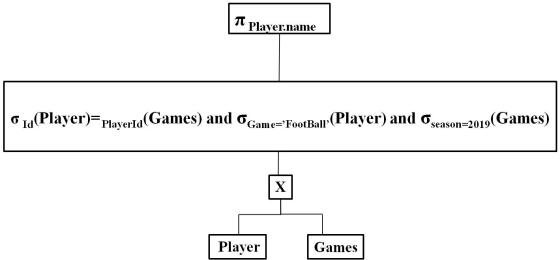
π Player.name (σ Id(Player)= PlayerId(Games) and σGame=’FootBall’(Player) and σseason=2019(Games))( Player X Games)
Where Player X Games shows Cartesian product to merge two relations Player and Games.
Query Tree
Add Answer to:
1- Consider the following SQL
query and related
relations
SELECT P.Name
FROM Players P, Games
G...
Please clear and direct answer Consider the following SQL query and related relations SELECT P.Name FROM...
Please clear and direct answer Consider the following SQL query and related relations SELECT P.Name FROM Players P, Games G WHERE P.Id = G.PlayerId AND P.Game = 'Football' AND G.Season ='2019' where: Players (Id, Name, Game) Games (PlayerId, GameCode, Season) Translate the above SQL query to a relational algebra expression. Draw the Query tree for above relational algebra expression in part (a).
**************PLEASE COMPLETE PART F) ONLY************** Consider the following relational database schema (primary keys are underlined) and...
**************PLEASE COMPLETE PART F) ONLY************** Consider the following relational database schema (primary keys are underlined) and SQL query: Hotel (hotelNo, hotelName, city) Room (roomNo, hotelNo, type, price) Booking (hotelNo, guestNo, dateFrom, dateTo, roomNo) Guest (guestNo, guestName, guestAddress) SELECT g.guestNo, g.guestName FROM Room r, Booking b, Hotel h, Guest g WHERE h.hotelNo = b.hotelNo AND g.guestNo = b.guestNo AND h.hotelNo = r.hotelNo AND h.hotelName = "Ritz" AND dateFrom >= "Jan 01, 2001" AND dateTo <= "Dec 31, 2001"; (A) state what...
**************PLEASE COMPLETE PART E) ONLY************** Consider the following relational database schema (primary keys are underlined) and...
**************PLEASE COMPLETE PART E) ONLY************** Consider the following relational database schema (primary keys are underlined) and SQL query: Hotel (hotelNo, hotelName, city) Room (roomNo, hotelNo, type, price) Booking (hotelNo, guestNo, dateFrom, dateTo, roomNo) Guest (guestNo, guestName, guestAddress) SELECT g.guestNo, g.guestName FROM Room r, Booking b, Hotel h, Guest g WHERE h.hotelNo = b.hotelNo AND g.guestNo = b.guestNo AND h.hotelNo = r.hotelNo AND h.hotelName = "Ritz" AND dateFrom >= "Jan 01, 2001" AND dateTo <= "Dec 31, 2001"; (A) state what...
Question 1.Write a SQL statement for each of the following questions based on the above tables...
 Question 1.Write a SQL statement for each of the following
questions based on the above tables (50 Points).
1) Create “Enrollment” table.
2) Change the credits of “Database” course from 2 to 3.
3) List the course titles (not Course_No) and grades John Doe
had taken.
4) Calculate average of Café Balance, and name new field as
Average Balance.
5) Create a roster for “Database” course (list student ID, last
name, first name, major, and status for each student enrolled...
Question 1.Write a SQL statement for each of the following
questions based on the above tables (50 Points).
1) Create “Enrollment” table.
2) Change the credits of “Database” course from 2 to 3.
3) List the course titles (not Course_No) and grades John Doe
had taken.
4) Calculate average of Café Balance, and name new field as
Average Balance.
5) Create a roster for “Database” course (list student ID, last
name, first name, major, and status for each student enrolled...
ChangeRequest(CRID, CRType, CRTitle, CROriginDate, CRPriority, CRNeedEvent, CRStatus) NeedByEvent(Event) CRPrevState(CRID, CRState, StartDate, EndDate) CRAssigned(CRID, EmpID, StartDate, EndDate)...
ChangeRequest(CRID, CRType, CRTitle, CROriginDate, CRPriority, CRNeedEvent, CRStatus) NeedByEvent(Event) CRPrevState(CRID, CRState, StartDate, EndDate) CRAssigned(CRID, EmpID, StartDate, EndDate) Employees(EmpID, FirstName, LastName, JobTitle) ChangeRequest(CRID, CRType, CRTitle, CROriginDate, CRPriority, CRNeedEvent, CRStatus) The CRID is the primary key, it is unique, and it is an positive integer The CRType may be one of two values: "Deficiency" or "Enhancement" CRTitle is a variable length string that may be up to 2048 characters CROriginDate is a date CRPriority is an integer that may assume a value of...
 Question 1.Write a SQL statement for each of the following
questions based on the above tables (50 Points).
1) Create “Enrollment” table.
2) Change the credits of “Database” course from 2 to 3.
3) List the course titles (not Course_No) and grades John Doe
had taken.
4) Calculate average of Café Balance, and name new field as
Average Balance.
5) Create a roster for “Database” course (list student ID, last
name, first name, major, and status for each student enrolled...
Question 1.Write a SQL statement for each of the following
questions based on the above tables (50 Points).
1) Create “Enrollment” table.
2) Change the credits of “Database” course from 2 to 3.
3) List the course titles (not Course_No) and grades John Doe
had taken.
4) Calculate average of Café Balance, and name new field as
Average Balance.
5) Create a roster for “Database” course (list student ID, last
name, first name, major, and status for each student enrolled...
Most questions answered within 3 hours.
-
Where is the error in this code sequence?
String s1 = "Hello";
String s2 = "ello";...
asked 10 months ago -
Financial data for Joel de Paris, Inc., for last year
follow:
Joel de Paris, Inc.
Balance...
asked 10 months ago -
Consider this reaction:
Al2(SO4)3 (aq)+ BaCl3
(aq) Al2Cl6 (aq)- +
3BaSO4(s) . What is the...
asked 10 months ago -
Suppose that Savneet is considering increasing her
recent random sample from 20 car rentals to 40...
asked 10 months ago -
Trucks arrive at an unloading terminal at an average rate of 120
per hour.
Trucks arrive...
asked 10 months ago -
Why are methanol and ethanol completely soluble in water while
octanol is not very little soluble....
asked 10 months ago -
A facilities manager at a university reads in a research report
that the mean amount of...
asked 10 months ago -
When the CuSO4 is rehydrated by adding water to the anhydrous
compound, is this an endothermic...
asked 10 months ago -
A ray of sunlight is passing from diamond into crown glass; the
angle of incidence is...
asked 10 months ago -
A block of mass 0.249 kg is placed on top of a light, vertical
spring of...
asked 10 months ago -
how do the kidneys compensate in the presences of acidosis
a) trigger hyperventilate
b) reserve acid...
asked 10 months ago -
Question 501 pts
The rental rate of capital to the firm increases. Which of the
following...
asked 10 months ago