11. A figure skater is spinning at 4.85 rad/s when his moment of inertia is 1.60...
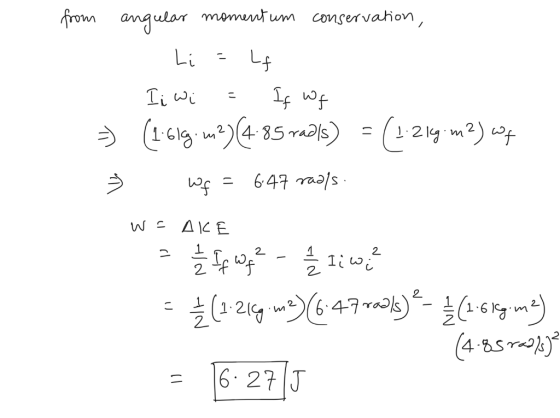
11. A figure skater is spinning at 4.85 rad/s when his moment of inertia is 1.60 kg·m2. How much work does he do in decreasing his moment of inertia to 1.20 kg·m2? a) 6.27 J b) 5.27 J c) 5.76 J d) 4.34 J e) 3.48 J
Homework Answers
Concept - first use conservation of angular momentum to find the final angular speed and then use work energy theorem to find the work done as shown below,
***********************************************************************************************
This concludes the answers. If there is any mistake or
omission, let me know immediately and I will fix
it....
Add Answer to:
11. A figure skater is spinning at 4.85 rad/s when his moment of
inertia is 1.60...
An ice skater is spinning at 6.8 rev/s and has a moment of inertia of 0.24...
An ice skater is spinning at 6.8 rev/s and has a moment of inertia of 0.24 kg ⋅ m2. Calculate the angular momentum, in kilogram meters squared per second, of the ice skater spinning at 6.8 rev/s. He reduces his rate of rotation by extending his arms and increasing his moment of inertia. Find the value of his moment of inertia (in kilogram meters squared) if his rate of rotation decreases to 1.25 rev/s. Suppose instead he keeps his arms...
A figure skater spins at 5.6 rad/sec with a moment of inertia of 67.3 kg?m2. How...
A figure skater spins at 5.6 rad/sec with a moment of inertia of 67.3 kg?m2. How fast are they spinning after they change their moment of inertia to 46.2 kg?m2 by pulling their hands in closer to their body?
An ice skater is spinning at 5.2 rev/s and has a moment of inertia of 0.56...
 An ice skater is spinning at
5.2 rev/s and has a moment of inertia of 0.56 kg ⋅
m2.
(9%) Problem 9: An ice skater is spinning at 5.2 rev/s and has a moment of inertia of 0.56 kg. m². > A 33% Part (a) Calculate the angular momentum, in kilogram meters squared per second, of the ice skater spinning at 5.2 rev/s. Grade Summary Deductions 0% Potential 100% L = 1 E sin() cos() tan() cotano asino acos atan...
An ice skater is spinning at
5.2 rev/s and has a moment of inertia of 0.56 kg ⋅
m2.
(9%) Problem 9: An ice skater is spinning at 5.2 rev/s and has a moment of inertia of 0.56 kg. m². > A 33% Part (a) Calculate the angular momentum, in kilogram meters squared per second, of the ice skater spinning at 5.2 rev/s. Grade Summary Deductions 0% Potential 100% L = 1 E sin() cos() tan() cotano asino acos atan...
Afigure skater rotating at 5.00 rad/s with arms extended had amoment of inertia of...
A figure skater rotating at 5.00 rad/s with arms extended had a moment of inertia of 2.25 kg·m^2. If he pulls in his arms so his moment of inertia decreases to 1.80 kg·m^2, what will be his new angular speed?A) 2.25 rad/sB) 6.25 rad /sC) 0.81 rad/sD) 4.60 rad/s
A figure skater rotating at 1,8 rad/s with arms extended has a moment of inertia of...
A figure skater rotating at 1,8 rad/s with arms extended has a moment of inertia of 1,35 kg∙m2. If the arms are pulled in so the moment of inertia decreases to 1,94 kg∙m2, what is the final angular speed? Answer in two decimal places.
(a) Calculate the angular momentum of an ice skater spinning at 6.00 rev/s given his moment...
(a) Calculate the angular momentum of an ice skater spinning at 6.00 rev/s given his moment of inertia is 0.400kg⋅m20.400kg⋅m2 (b) He reduces his rate of spin (his angular velocity) by extending his arms and increasing his moment of inertia. Find the value of his moment of inertia if his angular velocity decreases to 1.25 rev/s. (c) Suppose instead he keeps his arms in and allows friction of the ice to slow him to 3.00 rev/s. What average torque was exerted...
a figure skater is spinning at 10.7 rad/s with her arm extended . She does 79J...
a figure skater is spinning at 10.7 rad/s with her arm extended . She does 79J of workto pull her arm in close to her body; as she does this, her anguler speed in creases to 16.4 rad/s. what is her final totational inertia
(a) Calculate the angular momentum of an ice skater spinning at 6.00 rev/s given his moment...
(a) Calculate the angular momentum of an ice skater spinning at 6.00 rev/s given his moment of inertia is 0.300 kg · m2. _____kg · m2/s (b) He reduces his rate of spin (his angular velocity) by extending his arms and increasing his moment of inertia. Find the value of his moment of inertia if his angular velocity drops to 1.75 rev/s. ______kg · m2 (c) Suppose instead he keeps his arms in and allows friction with the ice to...
3. A figure skater with an angular velocity of 30 rad/s decreases her moment of inertia...
3. A figure skater with an angular velocity of 30 rad/s decreases her moment of inertia by a factor of 3. What is her new angular velocity assuming a frictionless surface? (2 pts)
Problem 19: sig.gif?tid=2N74-D1-D6-44-AC90-13475 An ice skater is spinning at 6.2 rev/s and has a moment of inertia of 0.36 kg ⋅ m2.
 Problem 19: An ice skater is spinning at 6.2 rev/s and has a moment of inertia of 0.36 kg ⋅ m2.Part (a) Calculate the angular momentum, in kilogram meters squared per second, of the ice skater spinning at 6.2 rev/s. Part (b) He reduces his rate of rotation by extending his arms and increasing his moment of inertia. Find the value of his moment of inertia (in kilogram meters squared) if his rate of rotation decreases to 0.75 rev/s. Part (c) Suppose instead he keeps his...
 An ice skater is spinning at
5.2 rev/s and has a moment of inertia of 0.56 kg ⋅
m2.
(9%) Problem 9: An ice skater is spinning at 5.2 rev/s and has a moment of inertia of 0.56 kg. m². > A 33% Part (a) Calculate the angular momentum, in kilogram meters squared per second, of the ice skater spinning at 5.2 rev/s. Grade Summary Deductions 0% Potential 100% L = 1 E sin() cos() tan() cotano asino acos atan...
An ice skater is spinning at
5.2 rev/s and has a moment of inertia of 0.56 kg ⋅
m2.
(9%) Problem 9: An ice skater is spinning at 5.2 rev/s and has a moment of inertia of 0.56 kg. m². > A 33% Part (a) Calculate the angular momentum, in kilogram meters squared per second, of the ice skater spinning at 5.2 rev/s. Grade Summary Deductions 0% Potential 100% L = 1 E sin() cos() tan() cotano asino acos atan...
 Problem 19: An ice skater is spinning at 6.2 rev/s and has a moment of inertia of 0.36 kg ⋅ m2.Part (a) Calculate the angular momentum, in kilogram meters squared per second, of the ice skater spinning at 6.2 rev/s. Part (b) He reduces his rate of rotation by extending his arms and increasing his moment of inertia. Find the value of his moment of inertia (in kilogram meters squared) if his rate of rotation decreases to 0.75 rev/s. Part (c) Suppose instead he keeps his...
Most questions answered within 3 hours.
-
Where is the error in this code sequence?
String s1 = "Hello";
String s2 = "ello";...
asked 11 months ago -
Financial data for Joel de Paris, Inc., for last year
follow:
Joel de Paris, Inc.
Balance...
asked 11 months ago -
Consider this reaction:
Al2(SO4)3 (aq)+ BaCl3
(aq) Al2Cl6 (aq)- +
3BaSO4(s) . What is the...
asked 11 months ago -
Suppose that Savneet is considering increasing her
recent random sample from 20 car rentals to 40...
asked 11 months ago -
Trucks arrive at an unloading terminal at an average rate of 120
per hour.
Trucks arrive...
asked 11 months ago -
Why are methanol and ethanol completely soluble in water while
octanol is not very little soluble....
asked 11 months ago -
A facilities manager at a university reads in a research report
that the mean amount of...
asked 11 months ago -
When the CuSO4 is rehydrated by adding water to the anhydrous
compound, is this an endothermic...
asked 11 months ago -
A ray of sunlight is passing from diamond into crown glass; the
angle of incidence is...
asked 11 months ago -
A block of mass 0.249 kg is placed on top of a light, vertical
spring of...
asked 11 months ago -
how do the kidneys compensate in the presences of acidosis
a) trigger hyperventilate
b) reserve acid...
asked 11 months ago -
Question 501 pts
The rental rate of capital to the firm increases. Which of the
following...
asked 11 months ago