Below are the reduction half reactions for chemolithoautotrophic nitrification, where ammonia is a source of electrons...
Below are the reduction half reactions for chemolithoautotrophic nitrification, where ammonia is a source of electrons and energy and oxygen is the terminal electron acceptor.
NO2- + 6e- -> NH4+ (-0.41 volts)
O2 + 4e- -> 2H2O (+0.82 volts)
If you balance and combine the reactions so that 82 molecules of NH4+ are oxidized to NO2-, how many molecules of O2 will be reduced to H2O?
Homework Answers
You need to first balance the oxidation half and the reduction half to get a completely balanced redox reaction in this case.
The balance require the steps in each side
a. balance the atoms is getting oxidized or reduced
b. balance electrons
c. balance number of O atoms
d. balance number of H atoms
e. after balancing both halves, you multiply them by a factor so that the electrons get canceled out.
See attachement for details.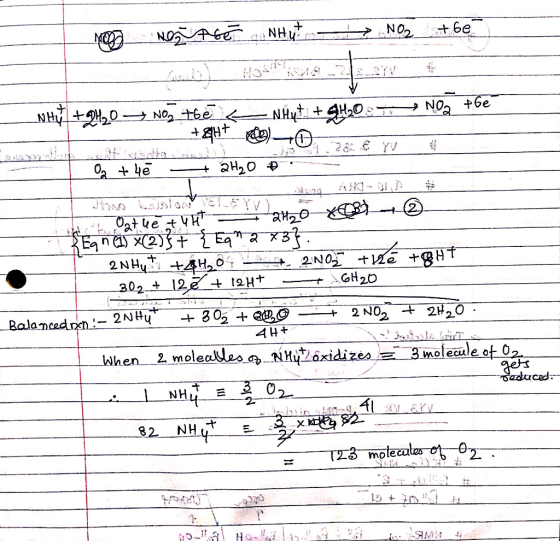
Add Answer to:
Below are the reduction half reactions for chemolithoautotrophic
nitrification, where ammonia is a source of electrons...
Below are the reduction half reactions for chemolithoautotrophic nitrification, where ammonia is a source of electrons...
Below are the reduction half reactions for chemolithoautotrophic nitrification, where ammonia is a source of electrons and energy and oxygen is the terminal electron acceptor. NO2- + 6e- -> NH4+ (-0.41 volts) O2 + 4e- -> 2H2O (+0.82 volts) Using the information given, calculate the ΔE for this reaction, balance the full reaction to determine the n, the number of electrons transfered when 3 molecules of NH4+ are oxidized. Finally, use the simplified Nernst Equation ΔG = -nFΔE, where F...
Below are the reduction half reactions for chemolithoautotrophic denitrification, where hydrogen is a source of electrons...
Below are the reduction half reactions for chemolithoautotrophic denitrification, where hydrogen is a source of electrons and energy and nitrate is the terminal electron acceptor. NO3- + 10e- -> N2 (E0 = +0.74 V) H+ + 2e- -> H2 (E0 = -0.42 V) If you balance and combine the reactions so that 155 molecules of H2 gas are oxidized to H+, how many molecules of NO3- will be reduced to dinitrogen gas?
Below are the reduction half reactions for chemolithoautotrophic denitrification, where hydrogen is a source of electrons...
Below are the reduction half reactions for chemolithoautotrophic denitrification, where hydrogen is a source of electrons and energy and nitrate is the terminal electron acceptor. NO3- + 10e- -> N2 (E0 = +0.74 V) H+ + 2e- -> H2 (E0 = -0.42 V) If you balance and combine the reactions so that 220 molecules of H2 gas are oxidized to H+, how many molecules of NO3- will be reduced to dinitrogen gas?
1. What is the redox state of Oxygen in a molecule of diatomic hydrogen gas (H2)?...
1. What is the redox state of Oxygen in a molecule of diatomic hydrogen gas (H2)? 2. NO2- + 6e- -> NH4+ (-0.41 volts) & O2 + 4e- -> 2H2O (+0.82 volts) If you balance and combine the reactions so that 52 molecules of NH4+ are oxidized to NO2-, how many molecules of O2 will be reduced to H2O? 3. NO3- + 10e- -> N2 (E0 = +0.74 V) & H+ + 2e- -> H2 (E0 = -0.42 V) If...
Below are the half reactions for sulfate reduction using acetate as a source of electrons, energy,...
Below are the half reactions for sulfate reduction using acetate as a source of electrons, energy, and carbon. CO2 + 8e- -> CH3COO-(-0.29 volts) SO42-+ 8e- -> H2S (-0.22 volts) If you balance and combine the reactions so that 41 molecules of CH3COO- are oxidized to CO2, how many molecules of H2S will be produced?
Below are the half reactions for sulfate reduction using acetate as a source of electrons, energy,...
Below are the half reactions for sulfate reduction using acetate as a source of electrons, energy, and carbon. CO2 + 8e- -> CH3COO-(-0.29 volts) SO42-+ 8e- -> H2S (-0.22 volts) If you balance and combine the reactions so that 15 molecules of CH3COO- are oxidized to CO2, how many electrons are transferred from carbon to sulfur?
Below are the half reactions for sulfate reduction using acetate as a source of electrons, energy,...
Below are the half reactions for sulfate reduction using acetate as a source of electrons, energy, and carbon. CO2 + 8e- -> CH3COO-(-0.29 volts) SO42-+ 8e- -> H2S (-0.22 volts) If you balance and combine the reactions so that 90 molecules of CH3COO- are oxidized to CO2, how many electrons are transferred from carbon to sulfur?
In redox reactions Protons are transferred from one molecule to another One substance loses electrons and...
In redox reactions Protons are transferred from one molecule to another One substance loses electrons and the other gains electrons A substance that loses electrons is reduced, while a substance e that gains electrons are oxidized B and c are both correct Which process in eukaryotic cells will proceed normally whether oxygen (O2) is present of not? Electron transport Glycolysis The citric acid cycle Oxidative phosphorylation Chemiosmosis How many carbon atoms are fed into the cirtic acid cycle as a...
Below are the paired reduction reactions for chemolithotrophic denitrification: these organisms are using nitrate as an...
Below are the paired reduction reactions for chemolithotrophic denitrification: these organisms are using nitrate as an electron accepter and are using hydrogen gas as a source of energy and electrons. 2NO3- + 10e- -> N2 (+0.74 volts) 2H+ + 2e- -> H2 (-0.42 volts) Using the information given, calculate the ΔE for this reaction, balance the full reaction to determine n, the number of electrons transfered when 97 molecules of H2 are oxidized. Finally, use the simplified Nernst Equation ΔG...
Below are the paired reduction reactions for chemolithotrophic denitrification: theseorganisms are using nitrate as an electron...
Below are the paired reduction reactions for chemolithotrophic denitrification: theseorganisms are using nitrate as an electron accepter and are using hydrogen gas as a source of energy and electrons. 2NO3- + 10e- -> N2 (+0.74 volts) 2H+ + 2e- -> H2 (-0.42 volts) Using the information given, calculate the ΔE for this reaction, balance the full reaction to determine n, the number of electrons transfered when 53 molecules of H2 are oxidized. Finally, use the simplified Nernst Equation ΔG =...
Most questions answered within 3 hours.
-
Where is the error in this code sequence?
String s1 = "Hello";
String s2 = "ello";...
asked 10 months ago -
Financial data for Joel de Paris, Inc., for last year
follow:
Joel de Paris, Inc.
Balance...
asked 10 months ago -
Consider this reaction:
Al2(SO4)3 (aq)+ BaCl3
(aq) Al2Cl6 (aq)- +
3BaSO4(s) . What is the...
asked 10 months ago -
Suppose that Savneet is considering increasing her
recent random sample from 20 car rentals to 40...
asked 10 months ago -
Trucks arrive at an unloading terminal at an average rate of 120
per hour.
Trucks arrive...
asked 10 months ago -
Why are methanol and ethanol completely soluble in water while
octanol is not very little soluble....
asked 10 months ago -
A facilities manager at a university reads in a research report
that the mean amount of...
asked 10 months ago -
When the CuSO4 is rehydrated by adding water to the anhydrous
compound, is this an endothermic...
asked 10 months ago -
A ray of sunlight is passing from diamond into crown glass; the
angle of incidence is...
asked 10 months ago -
A block of mass 0.249 kg is placed on top of a light, vertical
spring of...
asked 10 months ago -
how do the kidneys compensate in the presences of acidosis
a) trigger hyperventilate
b) reserve acid...
asked 10 months ago -
Question 501 pts
The rental rate of capital to the firm increases. Which of the
following...
asked 10 months ago