When we discussed the particle in a box model, we defined our box to be from...
When we discussed the particle in a box model, we defined our
box to be from x=0 to x=a. Re-
examine this problem, defining the box to be from -a to +a. Recall
that the general solution for a
particle in a region of V=0 is ψ = A sin kx + B cos kx. Apply
the appropriate boundary conditions,
figure out what k is (in terms of a), and normalize your solution
(i.e. evaluate A and B).
.
Homework Answers


Add Answer to:
When we discussed the particle in a box model, we defined our
box to be from...
6. The Particle in a Box problem refers to a potential energy function called the infinite square...
 6. The Particle in a Box problem refers to a potential energy function called the infinite square well, aka the box: ; x < 0 (Region I) V(x) = 0 : 0 L (Region II) x x >L (Region III) Let's investigate a quantum particle with mass m and energy E in this potential well of length L We were unable to transcribe this image6d (continued) write down an equation relating ψ, (x = 0) to ψ"(x I and II....
The following information pertains to a particle in a 2-D box. Both dimensions of the box...
The following information pertains to a particle in a 2-D box. Both dimensions of the box are equal (Lx=Ly=L) Normalized Eigen functions: 1. Ψ(x,y)= 2/L sin (nπx/L)sin( kπy/L) 2. H= h2/2m( d2/dx2+ d2/dy2)+ V (x,y) Boundary Conditions: V( x,y > 0; x,y < L) =0 V(x,y > L; x,y < 0 ) = Infinity a. Draw the 2-D potential energy surface ("box") that confines the particle. b. Use equations 2 and 3 to produce the general solution ( a formula in...
In solving the particle in a one dimensional infinite depth box problem (0k x < a)...
 In solving the particle in a one dimensional infinite depth box problem (0k x < a) we started with the function following is a true statement? (a) The value of k is found by requiring that the solution be normalized. (b) The function wx) is not an eigenfunciton of the operator d2/dx2 (c) It is necessary that this function equals a when x=0 (ie, Ψ(0) = a). (d) The boundary condition at x = 0 is used to show that...
In class, we considered a box with walls at x = 0 and x = L. Now consider a box with width L but centered at x = 0, so that it extends from x = L/2 to x = L/2 as shown in the figure.
 In class, we considered a box with walls at \(x=0\) and \(x=L\). Now consider a box with width \(L\) but centered at \(x=0\), so that it extends from \(x=-L / 2\) to \(x=L / 2\) as shown in the figure. Note that this box is symmetric about \(x=0 .\) (a) Consider possible wave functions of the form \(\psi(x)=A \sin k x\). Apply the boundary conditions at the wall to obtain the allowed energy levels.(b) Another set of possible wave functions...
21. For a particle of mass, m, moving along a circular path in the xy plane...
 21. For a particle of mass, m, moving along a circular path in the xy plane at a fixed distance, r, from the center and with no forces acting on it (V(x)-0), answer the following. Note the similarity to the hydrogen atom. We have an electron moving in the plane of a circle around a nucleus. Note the similarity between the Laplacian below and the azimuthal term in the hydrogen system Write the Schrödinger equation for this system. The Laplacian...
2. Derivation of the Kronig-Penney result: Write the solution for the wave function in the region...
 2. Derivation of the Kronig-Penney result: Write the solution for the wave function in the region 0 < r < a as a linear combi nation of sin and cos functions and in the region-b< 0 as a linear combination of the hvperbolic sin and cos functions: ψ(z) Asin Kr +Bcos Kx (0<x <a) = By invoking the continuity and differentiability conditions at a- 0, show that B D and AK - CQ, so essentially two constants, say A and...
(1 point) In this problem we find the eigenfunctions and eigenvalues of the differential equation B+...
 (1 point) In this problem we find the eigenfunctions and eigenvalues of the differential equation B+ iy=0 with boundary conditions (0) + (0) = 0 W2) = 0 For the general solution of the differential equation in the following cases use A and B for your constants, for example y = A cos(x) + B sin(x)For the variable i type the word lambda, otherwise treat it as you would any other variable. Case 1: 1 = 0 (1a.) Ignoring the...
4. Answer the following short answer questions. a. For the particle in a square well, when...
 4. Answer the following short answer questions. a. For the particle in a square well, when solving Schrödinger equation in all regions, one gets the following wavefunctions (where A,B,C,D,F, and G are constants): 4.(x) = Ce** + De-*** (x) = A cos Bx + B sin Bx m(x) = Fe*:* + Ge-*** where Region 1/2 [2m(V. - E) (2mE ki and B = Since there are six unknown constants, one needs six boundary conditions/constraints to complete the problem. State the...
1. This problem is all about the variational method, as applied to the particle in a...
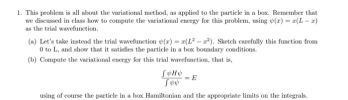 1. This problem is all about the variational method, as applied to the particle in a box. Remember that we discussed in class how to compute the variational energy for this problem, using (2) = x(L - 2) as the trial wavefunction. (a) Let's take instead the trial wavefunction (x) = x(L2 - 22). Sketch carefully this function from 0 to L, and show that it satisfies the particle in a box boundary conditions. (b) Compute the variational energy for...
Consider the Kronig-Penney model discussed in the lectures, where the periodic potential corresponds to an array of del...
 Consider the Kronig-Penney model discussed in the lectures, where the periodic potential corresponds to an array of delta functions: However, unlike the usual model, we will take α < 0, so that we have potential wells rather than barriers. In the following, we aim to solve the time-independent Schrödinger equation 2m r (a) First consider the case where the energy E 0. Write down the general solution for ψ(z) within the interval 0 < r < a, and use the...
 6. The Particle in a Box problem refers to a potential energy function called the infinite square well, aka the box: ; x < 0 (Region I) V(x) = 0 : 0 L (Region II) x x >L (Region III) Let's investigate a quantum particle with mass m and energy E in this potential well of length L We were unable to transcribe this image6d (continued) write down an equation relating ψ, (x = 0) to ψ"(x I and II....
 In solving the particle in a one dimensional infinite depth box problem (0k x < a) we started with the function following is a true statement? (a) The value of k is found by requiring that the solution be normalized. (b) The function wx) is not an eigenfunciton of the operator d2/dx2 (c) It is necessary that this function equals a when x=0 (ie, Ψ(0) = a). (d) The boundary condition at x = 0 is used to show that...
 21. For a particle of mass, m, moving along a circular path in the xy plane at a fixed distance, r, from the center and with no forces acting on it (V(x)-0), answer the following. Note the similarity to the hydrogen atom. We have an electron moving in the plane of a circle around a nucleus. Note the similarity between the Laplacian below and the azimuthal term in the hydrogen system Write the Schrödinger equation for this system. The Laplacian...
 2. Derivation of the Kronig-Penney result: Write the solution for the wave function in the region 0 < r < a as a linear combi nation of sin and cos functions and in the region-b< 0 as a linear combination of the hvperbolic sin and cos functions: ψ(z) Asin Kr +Bcos Kx (0<x <a) = By invoking the continuity and differentiability conditions at a- 0, show that B D and AK - CQ, so essentially two constants, say A and...
 (1 point) In this problem we find the eigenfunctions and eigenvalues of the differential equation B+ iy=0 with boundary conditions (0) + (0) = 0 W2) = 0 For the general solution of the differential equation in the following cases use A and B for your constants, for example y = A cos(x) + B sin(x)For the variable i type the word lambda, otherwise treat it as you would any other variable. Case 1: 1 = 0 (1a.) Ignoring the...
 4. Answer the following short answer questions. a. For the particle in a square well, when solving Schrödinger equation in all regions, one gets the following wavefunctions (where A,B,C,D,F, and G are constants): 4.(x) = Ce** + De-*** (x) = A cos Bx + B sin Bx m(x) = Fe*:* + Ge-*** where Region 1/2 [2m(V. - E) (2mE ki and B = Since there are six unknown constants, one needs six boundary conditions/constraints to complete the problem. State the...
 1. This problem is all about the variational method, as applied to the particle in a box. Remember that we discussed in class how to compute the variational energy for this problem, using (2) = x(L - 2) as the trial wavefunction. (a) Let's take instead the trial wavefunction (x) = x(L2 - 22). Sketch carefully this function from 0 to L, and show that it satisfies the particle in a box boundary conditions. (b) Compute the variational energy for...
 Consider the Kronig-Penney model discussed in the lectures, where the periodic potential corresponds to an array of delta functions: However, unlike the usual model, we will take α < 0, so that we have potential wells rather than barriers. In the following, we aim to solve the time-independent Schrödinger equation 2m r (a) First consider the case where the energy E 0. Write down the general solution for ψ(z) within the interval 0 < r < a, and use the...
Most questions answered within 3 hours.
-
Where is the error in this code sequence?
String s1 = "Hello";
String s2 = "ello";...
asked 10 months ago -
Financial data for Joel de Paris, Inc., for last year
follow:
Joel de Paris, Inc.
Balance...
asked 10 months ago -
Consider this reaction:
Al2(SO4)3 (aq)+ BaCl3
(aq) Al2Cl6 (aq)- +
3BaSO4(s) . What is the...
asked 10 months ago -
Suppose that Savneet is considering increasing her
recent random sample from 20 car rentals to 40...
asked 10 months ago -
Trucks arrive at an unloading terminal at an average rate of 120
per hour.
Trucks arrive...
asked 10 months ago -
Why are methanol and ethanol completely soluble in water while
octanol is not very little soluble....
asked 10 months ago -
A facilities manager at a university reads in a research report
that the mean amount of...
asked 10 months ago -
When the CuSO4 is rehydrated by adding water to the anhydrous
compound, is this an endothermic...
asked 10 months ago -
A ray of sunlight is passing from diamond into crown glass; the
angle of incidence is...
asked 10 months ago -
A block of mass 0.249 kg is placed on top of a light, vertical
spring of...
asked 10 months ago -
how do the kidneys compensate in the presences of acidosis
a) trigger hyperventilate
b) reserve acid...
asked 10 months ago -
Question 501 pts
The rental rate of capital to the firm increases. Which of the
following...
asked 10 months ago