Using the C Language - Calculate and print the first 20 elements of the Fibonacci series....
Using the C Language -
Calculate and print the first 20 elements of the Fibonacci series. You must use the recursive function call method to calculate the elements.
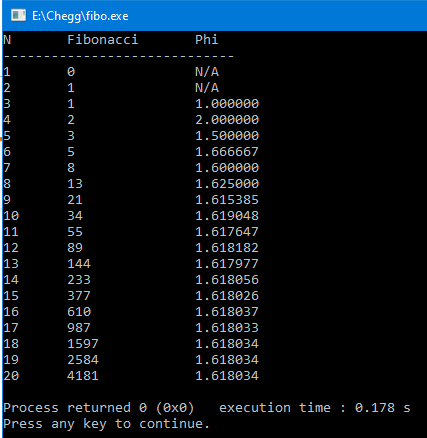
Output the elements of the series in a fixed column width table format and calculate Phi for each step.
Output how many iterations it would take to approach the theoretical value of Phi within 0.1%.
For example:
N Fibonacci Phi
--------------------------------------------------
1 0 N/A
2 1 N/A
3 1 1.0
4 2 2.0
5 3 1.5
….
Homework Answers
Program
#include<stdio.h>
//recursive function to calculate the Fibonacci series.
int fibo(int n)
{
if(n==0 || n==1)
return n;
return fibo(n-1) + fibo(n-2);
}
//function to calculate Phi
float getPhi(int i)
{
return (float)fibo(i)/fibo(i-1);
}
//main function
int main()
{
int i = 0;
printf("N\tFibonacci\tPhi\n");
printf("--------------------------------------\n");
printf("%d\t%d\t\tN/A\n", ++i, fibo(i));
printf("%d\t%d\t\tN/A\n", ++i, fibo(i));
for(i=2; i<20; i++)
{
printf("%d\t%d\t\t%f\n", i+1, fibo(i), getPhi(i));
}
return 0;
}
Output
Add Answer to:
Using the C Language -
Calculate and print the first 20 elements of the Fibonacci
series....
Write an ARM assembly language subroutine (named nfibo) to calculate and return the n-th Fibonacci number....
 Write an ARM assembly language subroutine (named nfibo) to calculate and return the n-th Fibonacci number. Fibonacci numbers (or a Fibonacci sequence) are a series of numbers with a property that the next number in the series is a sum of previous two numbers. Starting the series from 0, 1 as the first two numbers we have 0, 1, (0 + 1) = 1, (1 + 1) = 2, (1 + 2) = 3, (2 + 3) = 5, (3...
in C++ 6. (20)The Fibonacci sequence is the series of integers 0, 1, 1,2, 3, 5,...
 in C++
6. (20)The Fibonacci sequence is the series of integers 0, 1, 1,2, 3, 5, 8, 13, 21, 34, 55, 89.. 1 See the pattern? Each element in the series is the sum of the preceding two items. There is a recursive formula for calculating the nth number of the sequence (the oth number if Fib(0)-0): 8 Fib(N)-/N, if N 0 or 1 ifN> 1 Fib(N-2) Fib(N-1), a. b. c. Write a recursive version of the function Fibonacci. Write...
in C++
6. (20)The Fibonacci sequence is the series of integers 0, 1, 1,2, 3, 5, 8, 13, 21, 34, 55, 89.. 1 See the pattern? Each element in the series is the sum of the preceding two items. There is a recursive formula for calculating the nth number of the sequence (the oth number if Fib(0)-0): 8 Fib(N)-/N, if N 0 or 1 ifN> 1 Fib(N-2) Fib(N-1), a. b. c. Write a recursive version of the function Fibonacci. Write...
Fibonacci Sequence The Fibonacci Sequence is the series of numbers: 0, 1, 1, 2, 3, 5,...
Fibonacci Sequence The Fibonacci Sequence is the series of numbers: 0, 1, 1, 2, 3, 5, 8, 13, 21, 34, ... The next number is found by adding up the two numbers before it. The 2 is found by adding the two numbers before it (1+1) The 3 is found by adding the two numbers before it (1+2), And the 5 is (2+3), and so on! Example: the next number in the sequence above is 21+34 = 55 Source:...
c++ fibonacci code using loops Here are 8 Fibonacci numbers: 1, 1, 2, 3, 5, 8,...
 c++ fibonacci code using loops
Here are 8 Fibonacci numbers: 1, 1, 2, 3, 5, 8, 13, 21 Note that the first Fibonacci number is 1, F(1) = 1 The second Fibonacci number is 1, i.e. F(2) = 1 Other Fibonacci numbers in the sequence is the sum of two previous Fibonacci numbers. For example F(3) = F(2) + F(1). In general F(n) = F(n-1) + F(n-2) Write a program to do the following tasks. User entries are shown in...
c++ fibonacci code using loops
Here are 8 Fibonacci numbers: 1, 1, 2, 3, 5, 8, 13, 21 Note that the first Fibonacci number is 1, F(1) = 1 The second Fibonacci number is 1, i.e. F(2) = 1 Other Fibonacci numbers in the sequence is the sum of two previous Fibonacci numbers. For example F(3) = F(2) + F(1). In general F(n) = F(n-1) + F(n-2) Write a program to do the following tasks. User entries are shown in...
Solve using C language The mathematician Euler proved that: tan-(x) = x -. Write a C...
 Solve using C language
The mathematician Euler proved that: tan-(x) = x -. Write a C program to do the following: -Ask user to enter the value of (x) radians, -0.5<=x<=0.5. -Calculate and print the actual value atan (x)in degrees. - Use loops to calculate and print the series sum in degrees. -loop should stop when absolute difference between actual and series sum become <=10-3. -Print out number of iterations needed to get the result. - The program should run...
Solve using C language
The mathematician Euler proved that: tan-(x) = x -. Write a C program to do the following: -Ask user to enter the value of (x) radians, -0.5<=x<=0.5. -Calculate and print the actual value atan (x)in degrees. - Use loops to calculate and print the series sum in degrees. -loop should stop when absolute difference between actual and series sum become <=10-3. -Print out number of iterations needed to get the result. - The program should run...
I need help with this code. Im using C++ coding. Non Recursive (iterative) Fibonacci Write a...
I need help with this code. Im using C++ coding. Non Recursive (iterative) Fibonacci Write a program that uses a for loop to calculate a Fibonacci sequence (NOT RECURSIVE!!!) up to a given position, starting with position 0. This function defines a Fibonacci sequence: If the number is 0, the function returns a 0 If the number is 1, the function returns a 1 If the number is higher than 1, it returns the sum of the previous two numbers...
using C language Create an array of doubles with 5 elements. In the array prompt the...
 using C language
Create an array of doubles with 5 elements. In the array prompt the user to enter 5 temperature values (in degree Fahrenheit). Do this within main. Create a user defined function called convert2Cels. This function will not return any values to main with a return statement. It should have parameters that include the temperature array and the number of elements. The function should convert the values for Fahrenheit to Celsius and save them back into the same...
using C language
Create an array of doubles with 5 elements. In the array prompt the user to enter 5 temperature values (in degree Fahrenheit). Do this within main. Create a user defined function called convert2Cels. This function will not return any values to main with a return statement. It should have parameters that include the temperature array and the number of elements. The function should convert the values for Fahrenheit to Celsius and save them back into the same...
Write common assembly language (RISC) programs to a) sum the first n elements of an array...
Write common assembly language (RISC) programs to a) sum the first n elements of an array A, and b) compute r = ab for unsigned integers a and b. Each program will consist of a driver and a subprogram. The drivers will 1) read one or more values from the keyboard, 2) call the subprogram, and 3) print a result. The subprograms must not: ● store into memory, ● use registers $1 – $9, or ● make system calls
CMPS 290 Programming Assignment Arrays and Recursion – Fibonacci Numbers In this programming assignment you will...
CMPS 290 Programming Assignment Arrays and Recursion – Fibonacci Numbers In this programming assignment you will be working with arrays and multiple function calls, including a recursive function call. The goal of the assignment will be to, using a pre-set array of sequence numbers, calculate the Fibonacci sequence number for each value in the array (see the example at the bottom if this isn’t clear). Instructions and Requirements: • Create a program that assembles and runs to find the correct...
Write a recursive function that finds the n-th integer of the Fibonacci sequence(in C++ using a...
Write a recursive function that finds the n-th integer of the Fibonacci sequence(in C++ using a function). Then build a minimal program to test it. For reference see Fibonacci number. To check for recursion, please have the Fibonacci function print out its input as shown in the examples below: INPUT: 5 OUTPUT: fib(5) fib(4) fib(3) fib(2) fib(1) fib(0) fib(1) fib(2) fib(1) fib(0) fib(3) fib(2) fib(1) fib(0) fib(1) 5 INPUT: 7 OUTPUT: fib(7) fib(6) fib(5) fib(4) fib(3) fib(2) fib(1) fib(0) fib(1)...
 Write an ARM assembly language subroutine (named nfibo) to calculate and return the n-th Fibonacci number. Fibonacci numbers (or a Fibonacci sequence) are a series of numbers with a property that the next number in the series is a sum of previous two numbers. Starting the series from 0, 1 as the first two numbers we have 0, 1, (0 + 1) = 1, (1 + 1) = 2, (1 + 2) = 3, (2 + 3) = 5, (3...
 in C++
6. (20)The Fibonacci sequence is the series of integers 0, 1, 1,2, 3, 5, 8, 13, 21, 34, 55, 89.. 1 See the pattern? Each element in the series is the sum of the preceding two items. There is a recursive formula for calculating the nth number of the sequence (the oth number if Fib(0)-0): 8 Fib(N)-/N, if N 0 or 1 ifN> 1 Fib(N-2) Fib(N-1), a. b. c. Write a recursive version of the function Fibonacci. Write...
in C++
6. (20)The Fibonacci sequence is the series of integers 0, 1, 1,2, 3, 5, 8, 13, 21, 34, 55, 89.. 1 See the pattern? Each element in the series is the sum of the preceding two items. There is a recursive formula for calculating the nth number of the sequence (the oth number if Fib(0)-0): 8 Fib(N)-/N, if N 0 or 1 ifN> 1 Fib(N-2) Fib(N-1), a. b. c. Write a recursive version of the function Fibonacci. Write...
 c++ fibonacci code using loops
Here are 8 Fibonacci numbers: 1, 1, 2, 3, 5, 8, 13, 21 Note that the first Fibonacci number is 1, F(1) = 1 The second Fibonacci number is 1, i.e. F(2) = 1 Other Fibonacci numbers in the sequence is the sum of two previous Fibonacci numbers. For example F(3) = F(2) + F(1). In general F(n) = F(n-1) + F(n-2) Write a program to do the following tasks. User entries are shown in...
c++ fibonacci code using loops
Here are 8 Fibonacci numbers: 1, 1, 2, 3, 5, 8, 13, 21 Note that the first Fibonacci number is 1, F(1) = 1 The second Fibonacci number is 1, i.e. F(2) = 1 Other Fibonacci numbers in the sequence is the sum of two previous Fibonacci numbers. For example F(3) = F(2) + F(1). In general F(n) = F(n-1) + F(n-2) Write a program to do the following tasks. User entries are shown in...
 Solve using C language
The mathematician Euler proved that: tan-(x) = x -. Write a C program to do the following: -Ask user to enter the value of (x) radians, -0.5<=x<=0.5. -Calculate and print the actual value atan (x)in degrees. - Use loops to calculate and print the series sum in degrees. -loop should stop when absolute difference between actual and series sum become <=10-3. -Print out number of iterations needed to get the result. - The program should run...
Solve using C language
The mathematician Euler proved that: tan-(x) = x -. Write a C program to do the following: -Ask user to enter the value of (x) radians, -0.5<=x<=0.5. -Calculate and print the actual value atan (x)in degrees. - Use loops to calculate and print the series sum in degrees. -loop should stop when absolute difference between actual and series sum become <=10-3. -Print out number of iterations needed to get the result. - The program should run...
 using C language
Create an array of doubles with 5 elements. In the array prompt the user to enter 5 temperature values (in degree Fahrenheit). Do this within main. Create a user defined function called convert2Cels. This function will not return any values to main with a return statement. It should have parameters that include the temperature array and the number of elements. The function should convert the values for Fahrenheit to Celsius and save them back into the same...
using C language
Create an array of doubles with 5 elements. In the array prompt the user to enter 5 temperature values (in degree Fahrenheit). Do this within main. Create a user defined function called convert2Cels. This function will not return any values to main with a return statement. It should have parameters that include the temperature array and the number of elements. The function should convert the values for Fahrenheit to Celsius and save them back into the same...
Most questions answered within 3 hours.
-
Where is the error in this code sequence?
String s1 = "Hello";
String s2 = "ello";...
asked 10 months ago -
Financial data for Joel de Paris, Inc., for last year
follow:
Joel de Paris, Inc.
Balance...
asked 10 months ago -
Consider this reaction:
Al2(SO4)3 (aq)+ BaCl3
(aq) Al2Cl6 (aq)- +
3BaSO4(s) . What is the...
asked 10 months ago -
Suppose that Savneet is considering increasing her
recent random sample from 20 car rentals to 40...
asked 10 months ago -
Trucks arrive at an unloading terminal at an average rate of 120
per hour.
Trucks arrive...
asked 10 months ago -
Why are methanol and ethanol completely soluble in water while
octanol is not very little soluble....
asked 10 months ago -
A facilities manager at a university reads in a research report
that the mean amount of...
asked 10 months ago -
When the CuSO4 is rehydrated by adding water to the anhydrous
compound, is this an endothermic...
asked 10 months ago -
A ray of sunlight is passing from diamond into crown glass; the
angle of incidence is...
asked 10 months ago -
A block of mass 0.249 kg is placed on top of a light, vertical
spring of...
asked 10 months ago -
how do the kidneys compensate in the presences of acidosis
a) trigger hyperventilate
b) reserve acid...
asked 10 months ago -
Question 501 pts
The rental rate of capital to the firm increases. Which of the
following...
asked 10 months ago