Give a mechanism and a set of reagents that can be used to synthesize each of...
Give a mechanism and a set of reagents that can be used to synthesize each of the following:
a) synthesize 1-pentyne through the elimination of a dihalide
b) synthesize cis-2-pentene from an addition reaction
c) synthesize trans-2-pentene from an addition reaction
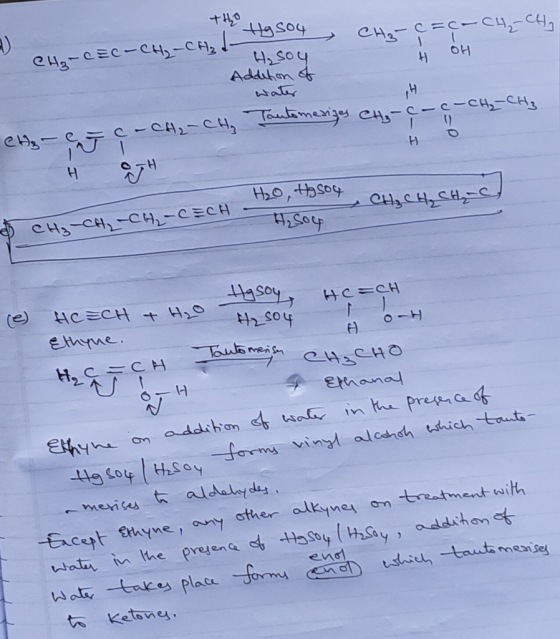
d) synthesize a ketone from an addition reaction
e) synthesize and aldehyde from an addition reaction
Homework Answers
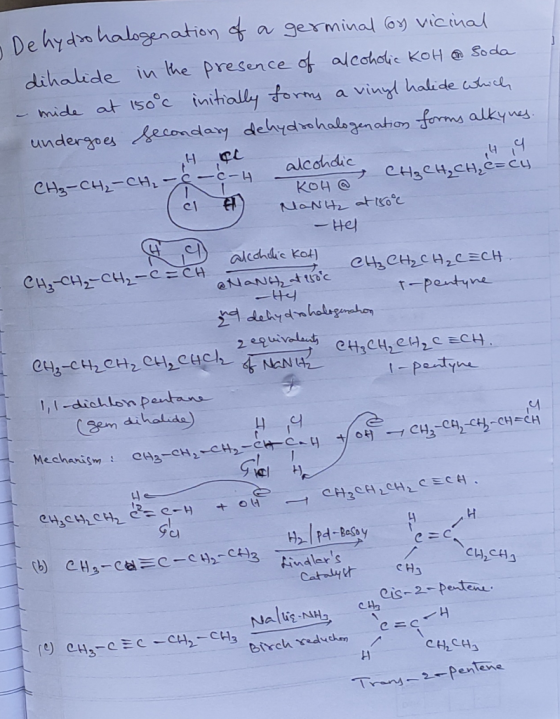
b)
Generally alkynes on hydrogenation in the presence of Ni or Platinum catalysts initially forms alkenes which further undergoes addition reaction and forms alkynes.
Lindlar's catalyst is a poisioned palladium catalyst composed of powdered barium sulphate coated with palladium poisoned with quinoline.
c)
Sodium dissolves in liquid Ammonia to give up electrons. These solvated electrons reduce the alkyne. Non-teminal alkynes only reduced to trans alkenes.
Add Answer to:
Give a mechanism and a set of reagents that can be
used to synthesize each of...
_________________________________________________________________________________________________________________________________ d. Prepare octane from 1-pentyne, indicate each needed reagents. e. Synthesize cis-2-hexene from 1-pentyne and...
 _________________________________________________________________________________________________________________________________
d. Prepare octane from 1-pentyne, indicate each needed
reagents.
e. Synthesize cis-2-hexene from 1-pentyne and an alkyl
halide.
f. Synthesize trans-2-hexene from 1-pentyne and an alkyl
halide.
Synthesize each compound from acetylene. You may use any other organic or inorganic reagents. a.
_________________________________________________________________________________________________________________________________
d. Prepare octane from 1-pentyne, indicate each needed
reagents.
e. Synthesize cis-2-hexene from 1-pentyne and an alkyl
halide.
f. Synthesize trans-2-hexene from 1-pentyne and an alkyl
halide.
Synthesize each compound from acetylene. You may use any other organic or inorganic reagents. a.
7.40 Suggest reagents that could be used to synthesize each of the following from an aldehyde...
 7.40 Suggest reagents that could be used to synthesize each of the following from an aldehyde or ketone. a) ОН (3 methods) Groups ОН b) (2 methods) ОН
WMK Mechanism Project You are expected to provide a mechanism from beginning to end with a...
 WMK Mechanism Project You are expected to provide a mechanism from beginning to end with a detailed explanation of type of chemical reaction, mechanism, and labeling relevant reagent classes. Use the reaction steps to guide your mechanistic detail; note not all reagents, catalysts, and solvents are shown. For each mechanistic step, a. Label the Nucleophile/Base/Electrophile/Acid (if possible) b. Label each step according the mechanism: A. acid/base, B. bimolecular nucleophilic substitution, C. heterolysis, D. coordination, E. bimolecular elimination, F. electrophilic elimination,...
answer needed in ficher projection PROBLEM 32 What stereoisomers are obtained from the reaction of each of the follo...
 answer needed in ficher projection
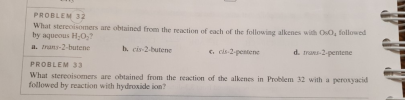
PROBLEM 32 What stereoisomers are obtained from the reaction of each of the following alkenes with OsO4 followed by aqueous H02? a. trans-2-butene b. cis-2-butene c. cis-2-pentene d. trans-2-pentene PROBLEM 33 What stereoisomers are obtained from the reaction of the alkenes in Problem 32 with a peroxyacid followed by reaction with hydroxide ion?
PROBLEM 32 What stereoisomers are obtained from the reaction of each of the following alkenes with OsO4 followed by aqueous H02? a....
answer needed in ficher projection
PROBLEM 32 What stereoisomers are obtained from the reaction of each of the following alkenes with OsO4 followed by aqueous H02? a. trans-2-butene b. cis-2-butene c. cis-2-pentene d. trans-2-pentene PROBLEM 33 What stereoisomers are obtained from the reaction of the alkenes in Problem 32 with a peroxyacid followed by reaction with hydroxide ion?
PROBLEM 32 What stereoisomers are obtained from the reaction of each of the following alkenes with OsO4 followed by aqueous H02? a....
9. (5 points) Elimination reactions of els NaOCHCH in ethanol can give the same or di...
 9. (5 points) Elimination reactions of els NaOCHCH in ethanol can give the same or di or 3-methyleyelohexene (2). Which of (a)-(d) indicates the main products nation reactions of a 2-methylcyclohexanes with Ho in ethanol can give the same or different main product, 1-methylcyclohexene Br NaOCH, NaOCH CH,OH CH,OH trans cis a) 1 from both the cis and trans substrates b) 2 from both the cis and trans substrates c) from the cis, and 2 from the trans substrate d)...
4. List two different sets of reagents (each set consisting of a carbonyl compound and a...
 4. List two different sets of reagents (each set consisting of a carbonyl compound and a Grignard reagent) that could be used to synthesize each of the following secondary alcohols. [4 points each] 3H 5. Reaction of cyclohexanone with ethylene glycol in the presence of an acid catalyst gives the cyclic acetal shown. Propose a mechanism for this reaction. [8 points]
Choroalkane 30. Which reactant would give reduction of 2 Pentyne? H2gas with Pt metal H2 gas...
 Choroalkane 30. Which reactant would give reduction of 2 Pentyne? H2gas with Pt metal H2 gas with Lindlar Catalyst Sodium metal in liquid ammonia Ozone with dimethylsulfide 31. Which reaction would give an aldehyde as its product? Hydroboration of 3-Heyne b) Acid-Catalyzed hydration of 1-Hexyne Hydroboration of 1-Hexyne d) Acid-Catalyzed hydration of 3 Hexyne 32. Which functional group cannot be found in the molecule below Alcohol Ketone Alkyne Alkene 33. What is the name of the following reaction? 3-Methylhex-3-yne +...
2) Starting from benzene, use the reagents below to synthesize acetophenone (methyl phenyl ketone). There are...
 2) Starting from benzene, use the reagents below to synthesize acetophenone (methyl phenyl ketone). There are two possible ways to accomplish this; give both. You may draw the intermediates in any format. Starting from benzene you have to figure out how to make the appropriate Grignard reagent 2 in two steps... 3) A, B, C, D, E? Route A: Choose one СН3 Na2Cr207 H.S04. H2O H30® workup Now convert Intermediate 2 to acetophenone... 2- acetophenone Route B: Choose one 3)...
Give the correct IUPAC name for the following compound, CH3 CEC CH3-CH, CH, CH3 O a....
 Give the correct IUPAC name for the following compound, CH3 CEC CH3-CH, CH, CH3 O a. 3-methyl-3-hexene Ob. 3-methyl-trans-3-hexene Oc. 2-ethyl-trans-2-pentene O d. 3-methyl-cis-3-hexene Oe. 2-ethyl-2-pentene QUESTION 6 The systematic name for the following is CH3CH2-C-CH-CH3 CH3 a. 2-methyl-3-pentanal b.2-methyl-3-pentanone c. ethyl isopropyl ketone d. 2-methyl-3-propanol e. 2-methyl-3-propanone
Section 4. Total points 26 1. Give one example of each of the following name reactions....
 Section 4. Total points 26 1. Give one example of each of the following name reactions. For each reaction, you MUST INCLUDE: i) IUPAC Name of the reactant ii) IUPAC Name of the product iii) Reagents and reaction conditions (4points X 4 = 16 points) a. H.V.Z reaction b. Crossed aldol reaction between an aldehyde and a ketone 2-Propanone Benzaldehple c. Michael reaction between an a.ß unsaturated aldehyde and a B-diketone. d. Dieckman Condensation to have a cyclic product with...
 _________________________________________________________________________________________________________________________________
d. Prepare octane from 1-pentyne, indicate each needed
reagents.
e. Synthesize cis-2-hexene from 1-pentyne and an alkyl
halide.
f. Synthesize trans-2-hexene from 1-pentyne and an alkyl
halide.
Synthesize each compound from acetylene. You may use any other organic or inorganic reagents. a.
_________________________________________________________________________________________________________________________________
d. Prepare octane from 1-pentyne, indicate each needed
reagents.
e. Synthesize cis-2-hexene from 1-pentyne and an alkyl
halide.
f. Synthesize trans-2-hexene from 1-pentyne and an alkyl
halide.
Synthesize each compound from acetylene. You may use any other organic or inorganic reagents. a.
 7.40 Suggest reagents that could be used to synthesize each of the following from an aldehyde or ketone. a) ОН (3 methods) Groups ОН b) (2 methods) ОН
 WMK Mechanism Project You are expected to provide a mechanism from beginning to end with a detailed explanation of type of chemical reaction, mechanism, and labeling relevant reagent classes. Use the reaction steps to guide your mechanistic detail; note not all reagents, catalysts, and solvents are shown. For each mechanistic step, a. Label the Nucleophile/Base/Electrophile/Acid (if possible) b. Label each step according the mechanism: A. acid/base, B. bimolecular nucleophilic substitution, C. heterolysis, D. coordination, E. bimolecular elimination, F. electrophilic elimination,...
 answer needed in ficher projection
PROBLEM 32 What stereoisomers are obtained from the reaction of each of the following alkenes with OsO4 followed by aqueous H02? a. trans-2-butene b. cis-2-butene c. cis-2-pentene d. trans-2-pentene PROBLEM 33 What stereoisomers are obtained from the reaction of the alkenes in Problem 32 with a peroxyacid followed by reaction with hydroxide ion?
PROBLEM 32 What stereoisomers are obtained from the reaction of each of the following alkenes with OsO4 followed by aqueous H02? a....
answer needed in ficher projection
PROBLEM 32 What stereoisomers are obtained from the reaction of each of the following alkenes with OsO4 followed by aqueous H02? a. trans-2-butene b. cis-2-butene c. cis-2-pentene d. trans-2-pentene PROBLEM 33 What stereoisomers are obtained from the reaction of the alkenes in Problem 32 with a peroxyacid followed by reaction with hydroxide ion?
PROBLEM 32 What stereoisomers are obtained from the reaction of each of the following alkenes with OsO4 followed by aqueous H02? a....
 9. (5 points) Elimination reactions of els NaOCHCH in ethanol can give the same or di or 3-methyleyelohexene (2). Which of (a)-(d) indicates the main products nation reactions of a 2-methylcyclohexanes with Ho in ethanol can give the same or different main product, 1-methylcyclohexene Br NaOCH, NaOCH CH,OH CH,OH trans cis a) 1 from both the cis and trans substrates b) 2 from both the cis and trans substrates c) from the cis, and 2 from the trans substrate d)...
 4. List two different sets of reagents (each set consisting of a carbonyl compound and a Grignard reagent) that could be used to synthesize each of the following secondary alcohols. [4 points each] 3H 5. Reaction of cyclohexanone with ethylene glycol in the presence of an acid catalyst gives the cyclic acetal shown. Propose a mechanism for this reaction. [8 points]
 Choroalkane 30. Which reactant would give reduction of 2 Pentyne? H2gas with Pt metal H2 gas with Lindlar Catalyst Sodium metal in liquid ammonia Ozone with dimethylsulfide 31. Which reaction would give an aldehyde as its product? Hydroboration of 3-Heyne b) Acid-Catalyzed hydration of 1-Hexyne Hydroboration of 1-Hexyne d) Acid-Catalyzed hydration of 3 Hexyne 32. Which functional group cannot be found in the molecule below Alcohol Ketone Alkyne Alkene 33. What is the name of the following reaction? 3-Methylhex-3-yne +...
 2) Starting from benzene, use the reagents below to synthesize acetophenone (methyl phenyl ketone). There are two possible ways to accomplish this; give both. You may draw the intermediates in any format. Starting from benzene you have to figure out how to make the appropriate Grignard reagent 2 in two steps... 3) A, B, C, D, E? Route A: Choose one СН3 Na2Cr207 H.S04. H2O H30® workup Now convert Intermediate 2 to acetophenone... 2- acetophenone Route B: Choose one 3)...
 Give the correct IUPAC name for the following compound, CH3 CEC CH3-CH, CH, CH3 O a. 3-methyl-3-hexene Ob. 3-methyl-trans-3-hexene Oc. 2-ethyl-trans-2-pentene O d. 3-methyl-cis-3-hexene Oe. 2-ethyl-2-pentene QUESTION 6 The systematic name for the following is CH3CH2-C-CH-CH3 CH3 a. 2-methyl-3-pentanal b.2-methyl-3-pentanone c. ethyl isopropyl ketone d. 2-methyl-3-propanol e. 2-methyl-3-propanone
 Section 4. Total points 26 1. Give one example of each of the following name reactions. For each reaction, you MUST INCLUDE: i) IUPAC Name of the reactant ii) IUPAC Name of the product iii) Reagents and reaction conditions (4points X 4 = 16 points) a. H.V.Z reaction b. Crossed aldol reaction between an aldehyde and a ketone 2-Propanone Benzaldehple c. Michael reaction between an a.ß unsaturated aldehyde and a B-diketone. d. Dieckman Condensation to have a cyclic product with...
Most questions answered within 3 hours.
-
Where is the error in this code sequence?
String s1 = "Hello";
String s2 = "ello";...
asked 11 months ago -
Financial data for Joel de Paris, Inc., for last year
follow:
Joel de Paris, Inc.
Balance...
asked 11 months ago -
Consider this reaction:
Al2(SO4)3 (aq)+ BaCl3
(aq) Al2Cl6 (aq)- +
3BaSO4(s) . What is the...
asked 11 months ago -
Suppose that Savneet is considering increasing her
recent random sample from 20 car rentals to 40...
asked 11 months ago -
Trucks arrive at an unloading terminal at an average rate of 120
per hour.
Trucks arrive...
asked 11 months ago -
Why are methanol and ethanol completely soluble in water while
octanol is not very little soluble....
asked 11 months ago -
A facilities manager at a university reads in a research report
that the mean amount of...
asked 11 months ago -
When the CuSO4 is rehydrated by adding water to the anhydrous
compound, is this an endothermic...
asked 11 months ago -
A ray of sunlight is passing from diamond into crown glass; the
angle of incidence is...
asked 11 months ago -
A block of mass 0.249 kg is placed on top of a light, vertical
spring of...
asked 11 months ago -
how do the kidneys compensate in the presences of acidosis
a) trigger hyperventilate
b) reserve acid...
asked 11 months ago -
Question 501 pts
The rental rate of capital to the firm increases. Which of the
following...
asked 11 months ago