Consider a star at a distance of 27.4 x 10¹⁷ m from Earth. If this star...
Consider a star at a distance of 27.4 x 10¹⁷ m from Earth. If this star were to burn out today, how many years would it take to see it disappear?
Homework Answers

Add Answer to:
Consider a star at a distance of 27.4 x 10¹⁷ m from
Earth. If this star...
Q-21.14 Homework Unanswered Due in 5 hours The distance to a star is approximately 8.30 X...
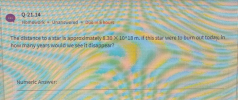 Q-21.14 Homework Unanswered Due in 5 hours The distance to a star is approximately 8.30 X 10418 m. If this star were to burn out today, in how many years would we see it disappear? Numeric Answer:
Consider a bright star in our night sky. Assume its distance from Earth is 31.7 light-years...
 Consider a bright star in our night sky. Assume its distance from Earth is 31.7 light-years (ly) and its power output is 4.00 x 1028 W, about 100 times that of the Sun. (a) Find the intensity of the starlight at the Earth. 3.54e-8 Your response differs significantly from the correct answer. Rework your solution from the beginning and check each step carefully. nW/m² (b) Find the power of the starlight the Earth intercepts. One light-year is the distance traveled...
Consider a bright star in our night sky. Assume its distance from Earth is 64.5 light-years...
Consider a bright star in our night sky. Assume its distance from Earth is 64.5 light-years (ly) and its power output is 4.00 1028 W, about 100 times that of the Sun. (a) Find the intensity of the starlight at the Earth. (b) Find the power of the starlight the Earth intercepts. One light-year is the distance traveled by the light through a vacuum in one year. (The radius of Earth is 6.37 106 m.)
Part A If you were to travel to a star 155 light-years from Earth at a...
 Part A If you were to travel to a star 155 light-years from Earth at a speed of 2.70 x 10 m/s, what would you measure this distance to be? 180 AS - OO ? Submit Request Answer
Consider a bright star in our night sky. Assume its distance from Earth is 89.1 light-years...
Consider a bright star in our night sky. Assume its distance from Earth is 89.1 light-years (ly) and its power output is 4.00 ✕ 1028 W, about 100 times that of the Sun. One light-year is the distance traveled by light through a vacuum in one year. (a) Find the intensity of the starlight at the Earth. Your response differs significantly from the correct answer. Rework your solution from the beginning and check each step carefully. W/m2 (b) Find the...
The nearest star to Earth besides the Sun is Proxima Centauri, which is a distance of...
 The nearest star to Earth besides the Sun is Proxima Centauri, which is a distance of approximately 4 light years away. A planet that may be able to sustain liquid water on its surface was discovered in 2016 orbiting Proxima Centauri. According to observers on Earth, a spaceship that travels at 0.9c should be able to reach the planet in 3.6 years. How long would the trip take according to astronauts on board the spaceship?
Recently a star with several possibly earth-like planets was discovered. It is 3.0 x 10¹⁸ m...
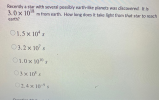 Recently a star with several possibly earth-like planets was discovered. It is 3.0 x 10¹⁸ m from earth. How long does it take light from that star to reach earth? 01.5 x 10⁴ s O 3.2 107 s O 1.0 x 10¹⁰ s 03x 108 s 2.4 x 10⁻⁹ s nunti
Need help with this problem. Thanks. Binary Stars Q1) A binary star system has a distance...
 Need help with this problem. Thanks.
Binary Stars Q1) A binary star system has a distance from Earth of 42.2 light years. The distance between the stars is 1.08 x 101 m and the rotation period is 104 days. Assume equal masses of the stars, and circular orbits (centre of mass of the system is at rest relative to the Earth). a) Calculate the speed of the stars relative to the centre of mass of the system. Further assume the...
Need help with this problem. Thanks.
Binary Stars Q1) A binary star system has a distance from Earth of 42.2 light years. The distance between the stars is 1.08 x 101 m and the rotation period is 104 days. Assume equal masses of the stars, and circular orbits (centre of mass of the system is at rest relative to the Earth). a) Calculate the speed of the stars relative to the centre of mass of the system. Further assume the...
A spaceship travels from earth to a star 95 light years away at a speed of...
A spaceship travels from earth to a star 95 light years away at a speed of 2.2 x 10^8 m/s. how long does it take to get there (a) as measured on the earth and b) as measured by a passenger on the spaceship?
A star is 17.2 ly (light-years) from Earth. (a) At what constant speed (in m/s) must...
A star is 17.2 ly (light-years) from Earth. (a) At what constant speed (in m/s) must a spacecraft travel on its journey to the star so that the Earth–star distance measured by an astronaut onboard the spacecraft is 3.86 ly? m/s (b) What is the journey's travel time in years as measured by a person on Earth? yr (c) What is the journey's travel time in years as measured by the astronaut? yr
 Q-21.14 Homework Unanswered Due in 5 hours The distance to a star is approximately 8.30 X 10418 m. If this star were to burn out today, in how many years would we see it disappear? Numeric Answer:
 Consider a bright star in our night sky. Assume its distance from Earth is 31.7 light-years (ly) and its power output is 4.00 x 1028 W, about 100 times that of the Sun. (a) Find the intensity of the starlight at the Earth. 3.54e-8 Your response differs significantly from the correct answer. Rework your solution from the beginning and check each step carefully. nW/m² (b) Find the power of the starlight the Earth intercepts. One light-year is the distance traveled...
 Part A If you were to travel to a star 155 light-years from Earth at a speed of 2.70 x 10 m/s, what would you measure this distance to be? 180 AS - OO ? Submit Request Answer
 The nearest star to Earth besides the Sun is Proxima Centauri, which is a distance of approximately 4 light years away. A planet that may be able to sustain liquid water on its surface was discovered in 2016 orbiting Proxima Centauri. According to observers on Earth, a spaceship that travels at 0.9c should be able to reach the planet in 3.6 years. How long would the trip take according to astronauts on board the spaceship?
 Recently a star with several possibly earth-like planets was discovered. It is 3.0 x 10¹⁸ m from earth. How long does it take light from that star to reach earth? 01.5 x 10⁴ s O 3.2 107 s O 1.0 x 10¹⁰ s 03x 108 s 2.4 x 10⁻⁹ s nunti
 Need help with this problem. Thanks.
Binary Stars Q1) A binary star system has a distance from Earth of 42.2 light years. The distance between the stars is 1.08 x 101 m and the rotation period is 104 days. Assume equal masses of the stars, and circular orbits (centre of mass of the system is at rest relative to the Earth). a) Calculate the speed of the stars relative to the centre of mass of the system. Further assume the...
Need help with this problem. Thanks.
Binary Stars Q1) A binary star system has a distance from Earth of 42.2 light years. The distance between the stars is 1.08 x 101 m and the rotation period is 104 days. Assume equal masses of the stars, and circular orbits (centre of mass of the system is at rest relative to the Earth). a) Calculate the speed of the stars relative to the centre of mass of the system. Further assume the...
Most questions answered within 3 hours.
-
Where is the error in this code sequence?
String s1 = "Hello";
String s2 = "ello";...
asked 11 months ago -
Financial data for Joel de Paris, Inc., for last year
follow:
Joel de Paris, Inc.
Balance...
asked 11 months ago -
Consider this reaction:
Al2(SO4)3 (aq)+ BaCl3
(aq) Al2Cl6 (aq)- +
3BaSO4(s) . What is the...
asked 11 months ago -
Suppose that Savneet is considering increasing her
recent random sample from 20 car rentals to 40...
asked 11 months ago -
Trucks arrive at an unloading terminal at an average rate of 120
per hour.
Trucks arrive...
asked 11 months ago -
Why are methanol and ethanol completely soluble in water while
octanol is not very little soluble....
asked 11 months ago -
A facilities manager at a university reads in a research report
that the mean amount of...
asked 11 months ago -
When the CuSO4 is rehydrated by adding water to the anhydrous
compound, is this an endothermic...
asked 11 months ago -
A ray of sunlight is passing from diamond into crown glass; the
angle of incidence is...
asked 11 months ago -
A block of mass 0.249 kg is placed on top of a light, vertical
spring of...
asked 11 months ago -
how do the kidneys compensate in the presences of acidosis
a) trigger hyperventilate
b) reserve acid...
asked 11 months ago -
Question 501 pts
The rental rate of capital to the firm increases. Which of the
following...
asked 11 months ago