USING SCHEME PROGRAMMING LANGUAGE define a function addSubList that processes a list of lists of numbers...
USING SCHEME PROGRAMMING LANGUAGE
define a function addSubList that processes a list of lists of numbers and adds up all sub-lists. The output of your function is a flat list of numbers. (You can assume that your function only receives valid input).
Example:
  (define Q '(1 2 (3 4) 1 5 (7 8)))
;;;;;;;;;;;;;;;;;;;;;
; (addSubList Q)
; => '(1 2 7 1 5 15)
;;;;;;;;;;;;;;;;;;;
Homework Answers
******************************************************************************************
Please Upvote the answer as it matters to me a lot :)
*****************************************************************************************
As per HomeworkLib expert answering guidelines,Experts are supposed to
answer only certain number of questions/sub-parts in a post.Please
raise the remaining as a new question as per HomeworkLib
guidelines.
******************************************************************************************
; (define (sum a b)
; (display "x + y = ")
; (display (+ a b)))
; (sum 10 25)
; (newline)
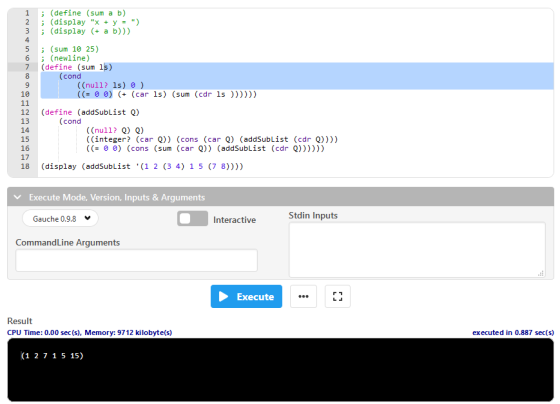
(define (sum ls)
(cond
((null? ls) 0 )
((= 0 0) (+ (car ls) (sum (cdr ls ))))))
(define (addSubList Q)
(cond
((null? Q) Q)
((integer? (car Q)) (cons (car Q) (addSubList (cdr Q))))
((= 0 0) (cons (sum (car Q)) (addSubList (cdr Q))))))
(display (addSubList '(1 2 (3 4) 1 5 (7 8))))
Add Answer to:
USING SCHEME PROGRAMMING LANGUAGE
define a function addSubList that processes a list of lists of
numbers...
Scheme Language: Define a function nondecreastream, which takes in a stream of numbers and outputs a...
Scheme Language: Define a function nondecreastream, which takes in a stream of numbers and outputs a stream of lists, which overall has the same numbers in the same order, but grouped into segments that are non-decreasing. For example, if the input is a stream containing elements 1 2 3 4 1 2 3 4 1 1 1 2 1 1 0 4 3 2 1 ... the output should contain elements (1 2 3 4) (1 2 3 4) (1...
Write a program in scheme using eopl language. Define a function "symbol-count" which takes a flat...
Write a program in scheme using eopl language. Define a function "symbol-count" which takes a flat list of symbols and returns a list of lists in which each symbol is paired with the count of how many times it occurs in the original input. > (symbol-count '(b a)) '((b 1) (a 1))
Write the function below in scheme/lisp programming language. Drracket Exercise: It is well known that n^2...
Write the function below in scheme/lisp programming language. Drracket Exercise: It is well known that n^2 is equal to the sum of the first n odd numbers. For example, 16 = 4^2 = 7 + 5 + 3 + 1. Write a function that takes as input a natural number, n, and that returns the square of its input by adding the first n odd numbers. Your code may not contain delayed operations and must use accumulative recursion.
c++ programming please. thx. Define a function template named "merge" to merge two lists of items...
 c++
programming please. thx.
Define a function template named "merge" to merge two lists of items into one list including all the items of the first list followed by the items of the second list. Even though, the data type of the items of the lists is a generic type, both input lists include items of the same type. To merge the two lists, the function first dynamically allocates enough memory to accommodate the items of both lists. The allocated...
c++
programming please. thx.
Define a function template named "merge" to merge two lists of items into one list including all the items of the first list followed by the items of the second list. Even though, the data type of the items of the lists is a generic type, both input lists include items of the same type. To merge the two lists, the function first dynamically allocates enough memory to accommodate the items of both lists. The allocated...
PYTHON 3 LANGUAGE , LINKED LISTS , define function ITERATIVELY Define an iterative function named alternate_i;...
PYTHON 3 LANGUAGE , LINKED LISTS , define function ITERATIVELY Define an iterative function named alternate_i; it is passed two linked lists (ll1 and ll2) as arguments. It returns a reference to the front of a linked list that alternates the LNs from ll1 and ll2, starting with ll1; if either linked list becomes empty, the rest of the LNs come from the other linked list. So, all LNs in ll1 and ll2 appear in the returned result (in the...
a) 7% Define a function (the function definition only) named combine_lists that receives two lists of...
a) 7% Define a function (the function definition only) named combine_lists that receives two lists of integers (the function has 2 parameters). You can assume that each list is the same length and each list is not empty. The function will create a new list which is composed of the addition of each element of the two lists. The function returns the new list. For example, if the function is sent this list: [2,4,6,8,10] and this list: [5,6,7,8,9] then the...
In scheme coding language Write a function filterN that returns only the numbers n through m...
In scheme coding language Write a function filterN that returns only the numbers n through m from a lat. For example: (filterN 4 6 (1 turkey 5 9 4 bacon 6 cheese)) returns (5 4 6). Use only functions add1, sub1, and, or, <, >, null?, number?, zero?, define, lambda, cond, and else in the code. Assume n < m
Haskell Define function-divisors that receives a number and returns a list of all divisors of that...
Haskell Define function-divisors that receives a number and returns a list of all divisors of that number.For example, if the input is 20, then the output would be[1,2,4,5,10,20]. You may use list comprehension, list ranges, and function mod for this purpose.Hint:Given numbern, consider all numbers from 1 ton, and then keep only the ones that dividen.
Define a function called collapse() which takes a list as input. Each element of the list...
Define a function called collapse() which takes a list as input. Each element of the list will either be an integer, or a list of integers. The function should modify the input list by replacing all of the elements which themselves are lists with the sum of their elements. For example: Test Result vals = [1, 2, 3, 4, 5] collapse(vals) print(vals) [1, 2, 3, 4, 5] vals = [1, [2, 3], 4, 5] collapse(vals) print(vals) [1, 5, 4, 5]...
Define a function add_nums_x_pos_given_list_nums (..) which receives a list that is guaranteed to only have numbers...
Define a function add_nums_x_pos_given_list_nums (..) which receives a list that is guaranteed to only have numbers (or the empty list) and returns the sum of each number multiplied by the position where the number is. (In the case of the empty list the function it will return 0) For example add_nums_x_pos_given_list_nums ([10,20,30]) will return the value 80 which is the result of adding: 0 * 10 (10 is in position 0 in the list) + 1 * 20 + 2...
 c++
programming please. thx.
Define a function template named "merge" to merge two lists of items into one list including all the items of the first list followed by the items of the second list. Even though, the data type of the items of the lists is a generic type, both input lists include items of the same type. To merge the two lists, the function first dynamically allocates enough memory to accommodate the items of both lists. The allocated...
c++
programming please. thx.
Define a function template named "merge" to merge two lists of items into one list including all the items of the first list followed by the items of the second list. Even though, the data type of the items of the lists is a generic type, both input lists include items of the same type. To merge the two lists, the function first dynamically allocates enough memory to accommodate the items of both lists. The allocated...
Most questions answered within 3 hours.
-
Where is the error in this code sequence?
String s1 = "Hello";
String s2 = "ello";...
asked 11 months ago -
Financial data for Joel de Paris, Inc., for last year
follow:
Joel de Paris, Inc.
Balance...
asked 11 months ago -
Consider this reaction:
Al2(SO4)3 (aq)+ BaCl3
(aq) Al2Cl6 (aq)- +
3BaSO4(s) . What is the...
asked 11 months ago -
Suppose that Savneet is considering increasing her
recent random sample from 20 car rentals to 40...
asked 11 months ago -
Trucks arrive at an unloading terminal at an average rate of 120
per hour.
Trucks arrive...
asked 11 months ago -
Why are methanol and ethanol completely soluble in water while
octanol is not very little soluble....
asked 11 months ago -
A facilities manager at a university reads in a research report
that the mean amount of...
asked 11 months ago -
When the CuSO4 is rehydrated by adding water to the anhydrous
compound, is this an endothermic...
asked 11 months ago -
A ray of sunlight is passing from diamond into crown glass; the
angle of incidence is...
asked 11 months ago -
A block of mass 0.249 kg is placed on top of a light, vertical
spring of...
asked 11 months ago -
how do the kidneys compensate in the presences of acidosis
a) trigger hyperventilate
b) reserve acid...
asked 11 months ago -
Question 501 pts
The rental rate of capital to the firm increases. Which of the
following...
asked 11 months ago