explain the mechanism that causes the sodium citrate concentration to control the size of gold nanoparticles?
Homework Answers
Request Answer!
We need at least 10 more requests to produce the answer.
0 / 10 have requested this problem solution
The more requests, the faster the answer.
Add Answer to:
explain the mechanism that causes the sodium citrate concentration
to control the size of gold nanoparticles?
explain why the concentration of sodium citrate can be used to control the size of gold nanoparticles.
explain why the concentration of sodium citrate can be used to control the size of gold nanoparticles.
Using chemical equations, describe the reaction(s) that leads to the production of the citrate-stabilized gold nanoparticles....
Using chemical equations, describe the reaction(s) that leads to the production of the citrate-stabilized gold nanoparticles. What are the products of the reaction, including the products of citrate oxidation? Note that you should indicate a disproportionation reaction somewhere. (What is a disproportionation?)
Question 3 5 pts Gold nanoparticles are typically prepared by the reduction of aurochloric acid (HAUCla)...
 Question 3 5 pts Gold nanoparticles are typically prepared by the reduction of aurochloric acid (HAUCla) with boiling sodium citrate. The sodium citrate is used in excess and it is assumed that 100% of the Au atoms end up as part of the nanoparticles. If you start with a 1.00% (w/w) aqueous solution of HAC14:3H20 (aurochloric acid is typically available as the trihydrate) and the average particle diameter is 20.0 nm, what is the concentration of Au nanoparticles in the...
Gold nanoparticles research psdt. Part C is data collected in the second picture 1. Based on...
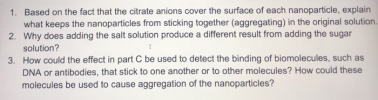 Gold nanoparticles research
psdt. Part C is data collected in the second picture
1. Based on the fact that the citrate anions cover the surface of each nanoparticle, explain what keeps the nanoparticles from sticking together (aggregating) in the original solution. 2. Why does adding the salt solution produce a different result from adding the sugar solution? 3. How could the effect in part C be used to detect the binding of biomolecules, such as DNA or antibodies, that stick...
Gold nanoparticles research
psdt. Part C is data collected in the second picture
1. Based on the fact that the citrate anions cover the surface of each nanoparticle, explain what keeps the nanoparticles from sticking together (aggregating) in the original solution. 2. Why does adding the salt solution produce a different result from adding the sugar solution? 3. How could the effect in part C be used to detect the binding of biomolecules, such as DNA or antibodies, that stick...
Q1: Write the chemical reaction for the following experiment below involving the synthesis of gold nanoparticles....
Q1: Write the chemical reaction for the following experiment below involving the synthesis of gold nanoparticles. Procedure: STEP 1: Solution A,B,C,D Solution A: Take 0.1g of tannic acid and add 10 ml of dI water in a sample vial. Solution B: Take 0.1g of tri-sodium citrate and add 10 ml of dI water in a sample vial. Solution C: Take 0.552g of potassium carbonate and add 20 ml of dI water in a beaker to obtain 0.2 M stock solution....
Question: Write the chemical reaction for the following experiment involving the synthesis of gold nanoparticles. Procedure:...
Question: Write the chemical reaction for the following experiment involving the synthesis of gold nanoparticles. Procedure: STEP 1: Solution A,B,C,D Solution A: Take 0.1g of tannic acid and add 10 ml of dI water in a sample vial. Solution B: Take 0.1g of tri-sodium citrate and add 10 ml of dI water in a sample vial. Solution C: Take 0.552g of potassium carbonate and add 20 ml of dI water in a beaker to obtain 0.2 M stock solution. Take...
A solution of sodium citrate (monobasic) is prepared to a formal concentration of 0.2 M. If...
A solution of sodium citrate (monobasic) is prepared to a formal concentration of 0.2 M. If the pKa's for the triprotic citric acid molecule are 3.13, 4.76, 6.40 what is the approximate pH of this solution?
A solution of sodium citrate (monobasic) is prepared to a formal concentration of 0.2 M. If...
A solution of sodium citrate (monobasic) is prepared to a formal concentration of 0.2 M. If the pKa's for the triprotic citric acid molecule are 3.13, 4.76, 6.40 what is the approximate pH of this solution
Explain the mechanism of how substrate concentration affects enzyme activity and how this mechanism yields the...
Explain the mechanism of how substrate concentration affects enzyme activity and how this mechanism yields the expected summary curve
List 5 pathological conditions that patient needs to control the sodium, water, or protein, and explain...
List 5 pathological conditions that patient needs to control the sodium, water, or protein, and explain the reasons to control diet for each condition.
 Question 3 5 pts Gold nanoparticles are typically prepared by the reduction of aurochloric acid (HAUCla) with boiling sodium citrate. The sodium citrate is used in excess and it is assumed that 100% of the Au atoms end up as part of the nanoparticles. If you start with a 1.00% (w/w) aqueous solution of HAC14:3H20 (aurochloric acid is typically available as the trihydrate) and the average particle diameter is 20.0 nm, what is the concentration of Au nanoparticles in the...
 Gold nanoparticles research
psdt. Part C is data collected in the second picture
1. Based on the fact that the citrate anions cover the surface of each nanoparticle, explain what keeps the nanoparticles from sticking together (aggregating) in the original solution. 2. Why does adding the salt solution produce a different result from adding the sugar solution? 3. How could the effect in part C be used to detect the binding of biomolecules, such as DNA or antibodies, that stick...
Gold nanoparticles research
psdt. Part C is data collected in the second picture
1. Based on the fact that the citrate anions cover the surface of each nanoparticle, explain what keeps the nanoparticles from sticking together (aggregating) in the original solution. 2. Why does adding the salt solution produce a different result from adding the sugar solution? 3. How could the effect in part C be used to detect the binding of biomolecules, such as DNA or antibodies, that stick...
Most questions answered within 3 hours.
-
Where is the error in this code sequence?
String s1 = "Hello";
String s2 = "ello";...
asked 10 months ago -
Financial data for Joel de Paris, Inc., for last year
follow:
Joel de Paris, Inc.
Balance...
asked 10 months ago -
Consider this reaction:
Al2(SO4)3 (aq)+ BaCl3
(aq) Al2Cl6 (aq)- +
3BaSO4(s) . What is the...
asked 10 months ago -
Suppose that Savneet is considering increasing her
recent random sample from 20 car rentals to 40...
asked 10 months ago -
Trucks arrive at an unloading terminal at an average rate of 120
per hour.
Trucks arrive...
asked 10 months ago -
Why are methanol and ethanol completely soluble in water while
octanol is not very little soluble....
asked 10 months ago -
A facilities manager at a university reads in a research report
that the mean amount of...
asked 10 months ago -
When the CuSO4 is rehydrated by adding water to the anhydrous
compound, is this an endothermic...
asked 10 months ago -
A ray of sunlight is passing from diamond into crown glass; the
angle of incidence is...
asked 10 months ago -
A block of mass 0.249 kg is placed on top of a light, vertical
spring of...
asked 10 months ago -
how do the kidneys compensate in the presences of acidosis
a) trigger hyperventilate
b) reserve acid...
asked 10 months ago -
Question 501 pts
The rental rate of capital to the firm increases. Which of the
following...
asked 10 months ago