True or False? 1. If an LP has multiple optimal solutions, then all solutions have the...
True or False?
1. If an LP has multiple optimal solutions, then all solutions have the same objective function value (such as total profit or cost).
2. As long as all prices (objective coefficients) change within their respective ranges, the optimal solution of a linear program does not change.
3. When a dual price changes within its range, the optimal solution does not change.
4. The solution of a linear program always consists of whole numbers (integers). That is why the linear program is so popular in practice.
5. If a constraint is not tight then its dual price has to be zero. This conclusion is true for both >= and <= constraints.
6. If the reduced cost of a product (decision variable) is positive, then the objective function will decrease by the amount of the reduced cost if an additional such product is produced.
Homework Answers
answer..
1.
True.
This is true because if the inverse was true and there were two optimal values, then only one of them can be optimal and therefore only one can be an optimal solution. Suppose for a maximization problem, you have two solutions one with objective function = 5 units and one with objective function 10 units, then automatically the optimal solution referring to objective function equal to 10 units becomes the optimal solution and one with 5 units cannot be optimal by definition.
2.
True – That is the essential meaning of the change of objective coefficient in respective ranges. While the objective function value at optimal can still change.
5.
True – The dual price is the improvement in objective function (reduction in minimization problem and increase in maximization problem by relaxing one unit of a constraint RHS.
Add Answer to:
True or False?
1. If an LP has multiple optimal solutions, then all solutions
have the...
Interpreting an LP output after solving the problem using the software. The following linear programming problem has been solved using the software. Use the output to answer the questi...
Interpreting an LP output after solving the problem using the software. The following linear programming problem has been solved using the software. Use the output to answer the questions below. LINEAR PROGRAMMING PROBLEM: MAX 25X1+30X2+15X3 S.T. 1) 4X1+5X2+8X3<1200 2) 9X1+15X2+3X3<1500 OPTIMAL SOLUTION: Objective Function Value = 4700.000 Variable Value Reduced Costs X1 140.000 0.000 X2 0.000 10.000 X3 80.000 0.000 Constraint Slack/Surplus Dual Prices 1 0.000 1.000 2 0.000 2.333 OBJECTIVE COEFFICIENT RANGES: Variable Lower Limit Current Value Upper Limit...
3. 1-10 are True/False questions, Please write True (T) or False (F) next to each question...
 3. 1-10 are True/False questions, Please write True (T) or False (F) next to each question 11-20 are multiple choice questions, Please circle the correct answer for each question.(20) 1. The linear programming approach to media selection problems is typically to either maxim The use of LP in solving assignment problems yields solutions of either O or 1 for each An infeasible solution may sometimes be the optimal found by the corner point method the number of ads placed per...
Given a linear programming optimal solution, if the value of the coefficient of a decision variable...
Given a linear programming optimal solution, if the value of the coefficient of a decision variable is changed but remains within its sensitivity range then a linear programming optimal solution, if the value of the coefficient of a decision The value of the objective function will not change The value of that decision variable will not change The value of slack or surplus variables for all constraints will be zero The dual value (shadow price) for every constraint will be...
I post this question but C, G, and H was not answered...can I have an answer for them please as soon as possible. Interpreting an LP output after solving the problem using the software. The follow...
 I post this question but C, G, and H was not
answered...can I have an answer for them please as soon as
possible.
Interpreting an LP output after solving the problem using the software. The following linear programming problem has been solved using the software. Use the output to answer the questions below LINEAR PROGRAMMING PROBLEM: MAX 25X1+30X2+15X3 1) 4X1+5X2+8X3<1200 2) 9x1+15X2+3X3<1500 OPTIMAL SOLUTION: Objective Function Value- 4700.000 ariabl X1 x2 X3 0s 0.000 10.000 0.000 140.000 0.000 80.000 Less...
I post this question but C, G, and H was not
answered...can I have an answer for them please as soon as
possible.
Interpreting an LP output after solving the problem using the software. The following linear programming problem has been solved using the software. Use the output to answer the questions below LINEAR PROGRAMMING PROBLEM: MAX 25X1+30X2+15X3 1) 4X1+5X2+8X3<1200 2) 9x1+15X2+3X3<1500 OPTIMAL SOLUTION: Objective Function Value- 4700.000 ariabl X1 x2 X3 0s 0.000 10.000 0.000 140.000 0.000 80.000 Less...
Use this output to answer these questions please, I need to understand. Interpreting an LP output after solving the problem using the software. The following linear programming problem has been so...
 Use this output to answer these questions please, I
need to understand.
Interpreting an LP output after solving the problem using the software. The following linear programming problem has been solved using the software. Use the output to answer the questions below LINEAR PROGRAMMING PROBLEM MAX 25x1+30x2+15x3 ST. 1) 4X1+5X2+8X3<1200 2) 9x1+15X2+3X3c1500 OPTIMAL SOLUTION: Objective Function Value- 4700.000 Variable Value 140.000 duced Costs 0.000 10.000 0.000 x1 x2 X3 0.000 80.000 Slack/Surplus 0.000 0.000 1.000 2.333 2 OBJECTIVE COEFFICIENT RANGES:...
Use this output to answer these questions please, I
need to understand.
Interpreting an LP output after solving the problem using the software. The following linear programming problem has been solved using the software. Use the output to answer the questions below LINEAR PROGRAMMING PROBLEM MAX 25x1+30x2+15x3 ST. 1) 4X1+5X2+8X3<1200 2) 9x1+15X2+3X3c1500 OPTIMAL SOLUTION: Objective Function Value- 4700.000 Variable Value 140.000 duced Costs 0.000 10.000 0.000 x1 x2 X3 0.000 80.000 Slack/Surplus 0.000 0.000 1.000 2.333 2 OBJECTIVE COEFFICIENT RANGES:...
for last thing, these are 2 methods that we learned in class Theorem 1 (Sufficient Optimality...
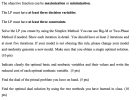 for last thing, these are 2 methods that we learned in class
Theorem 1 (Sufficient Optimality Criterion): If x0 and y0 are
feasible solutions to the primal and dual problems such that z =
cx0 = y0b = w, then x0 and y0 are optimal solutions to their
respective problems.
Theorem 2 (Strong Duality): In a primal-dual pair of LPs, if
either the primal or the dual problem has an optimal feasible
solution, then the other problem does also have...
for last thing, these are 2 methods that we learned in class
Theorem 1 (Sufficient Optimality Criterion): If x0 and y0 are
feasible solutions to the primal and dual problems such that z =
cx0 = y0b = w, then x0 and y0 are optimal solutions to their
respective problems.
Theorem 2 (Strong Duality): In a primal-dual pair of LPs, if
either the primal or the dual problem has an optimal feasible
solution, then the other problem does also have...
1. Consider the following linear program: min 85 + 3M s. t. | 505 + 100M...
 1. Consider the following linear program: min 85 + 3M s. t. | 505 + 100M < 1,200,000 5S + 4M > 60,000 M > 3,000 SM 20 a. Find the optimal solution. b. Specify the objective function coefficient ranges, and interpret the ranges. c. Suppose one OFC increases from 8 to 12 and another OFC increases from 3 to 3.5. Would the optimal solution change? d. Identify each of the right-hand-side ranges, and interpret these ranges. e. What is...
a. What is the optimal solution in lay terms? What is the optimal value of the...
 a. What is the optimal solution
in lay terms? What is the optimal value of the objective
function?
b. Which constraints are binding? Explain.
c. What are the shadow prices of demand for B constraint and
assembly time constraints? Interpret each.
d. If you could change the right-hand side of one constraint by
one unit (either increase or decrease), which one would you choose?
Why? Show all calculations.
e. State and interpret the ranges of optimality for any one of...
a. What is the optimal solution
in lay terms? What is the optimal value of the objective
function?
b. Which constraints are binding? Explain.
c. What are the shadow prices of demand for B constraint and
assembly time constraints? Interpret each.
d. If you could change the right-hand side of one constraint by
one unit (either increase or decrease), which one would you choose?
Why? Show all calculations.
e. State and interpret the ranges of optimality for any one of...
LP PROBLEM PLEASE EXPLAIN thanks Search 3:30 Str1+2 + 23 + 4 2 + 35 (A) Calculate the optimal solution. Write the basis change in the optimal solution . (B) Find Inverse matrix B-1 of the optimal...
 LP
PROBLEM PLEASE EXPLAIN
thanks
Search 3:30 Str1+2 + 23 + 4 2 + 35 (A) Calculate the optimal solution. Write the basis change in the optimal solution . (B) Find Inverse matrix B-1 of the optimal basis matrix C.) Consider increasing the constant on the right side of one constraint by 1. At that time, the smallest value of the objective function decreases most when the constant of the constraint is increased? D.) Find the range of t such...
LP
PROBLEM PLEASE EXPLAIN
thanks
Search 3:30 Str1+2 + 23 + 4 2 + 35 (A) Calculate the optimal solution. Write the basis change in the optimal solution . (B) Find Inverse matrix B-1 of the optimal basis matrix C.) Consider increasing the constant on the right side of one constraint by 1. At that time, the smallest value of the objective function decreases most when the constant of the constraint is increased? D.) Find the range of t such...
The LP problem whose output follows determines how many necklaces, bracelets, rings, and earrings a jewelry...
The LP problem whose output follows determines how many necklaces, bracelets, rings, and earrings a jewelry store should stock. The objective function measures profit; it is assumed that every piece stocked will be sold.Constraint 1 measures display space in units, constraint 2 measures time to set up the display in minutes. Constraints 3 and 4 are marketing restrictions. using excel solver: To what value can the profit on ring increases before the solution would change? LINEAR PROGRAMMING PROBLEM MAX 100X1+120X2+150X3+125X4...
 3. 1-10 are True/False questions, Please write True (T) or False (F) next to each question 11-20 are multiple choice questions, Please circle the correct answer for each question.(20) 1. The linear programming approach to media selection problems is typically to either maxim The use of LP in solving assignment problems yields solutions of either O or 1 for each An infeasible solution may sometimes be the optimal found by the corner point method the number of ads placed per...
 I post this question but C, G, and H was not
answered...can I have an answer for them please as soon as
possible.
Interpreting an LP output after solving the problem using the software. The following linear programming problem has been solved using the software. Use the output to answer the questions below LINEAR PROGRAMMING PROBLEM: MAX 25X1+30X2+15X3 1) 4X1+5X2+8X3<1200 2) 9x1+15X2+3X3<1500 OPTIMAL SOLUTION: Objective Function Value- 4700.000 ariabl X1 x2 X3 0s 0.000 10.000 0.000 140.000 0.000 80.000 Less...
I post this question but C, G, and H was not
answered...can I have an answer for them please as soon as
possible.
Interpreting an LP output after solving the problem using the software. The following linear programming problem has been solved using the software. Use the output to answer the questions below LINEAR PROGRAMMING PROBLEM: MAX 25X1+30X2+15X3 1) 4X1+5X2+8X3<1200 2) 9x1+15X2+3X3<1500 OPTIMAL SOLUTION: Objective Function Value- 4700.000 ariabl X1 x2 X3 0s 0.000 10.000 0.000 140.000 0.000 80.000 Less...
 Use this output to answer these questions please, I
need to understand.
Interpreting an LP output after solving the problem using the software. The following linear programming problem has been solved using the software. Use the output to answer the questions below LINEAR PROGRAMMING PROBLEM MAX 25x1+30x2+15x3 ST. 1) 4X1+5X2+8X3<1200 2) 9x1+15X2+3X3c1500 OPTIMAL SOLUTION: Objective Function Value- 4700.000 Variable Value 140.000 duced Costs 0.000 10.000 0.000 x1 x2 X3 0.000 80.000 Slack/Surplus 0.000 0.000 1.000 2.333 2 OBJECTIVE COEFFICIENT RANGES:...
Use this output to answer these questions please, I
need to understand.
Interpreting an LP output after solving the problem using the software. The following linear programming problem has been solved using the software. Use the output to answer the questions below LINEAR PROGRAMMING PROBLEM MAX 25x1+30x2+15x3 ST. 1) 4X1+5X2+8X3<1200 2) 9x1+15X2+3X3c1500 OPTIMAL SOLUTION: Objective Function Value- 4700.000 Variable Value 140.000 duced Costs 0.000 10.000 0.000 x1 x2 X3 0.000 80.000 Slack/Surplus 0.000 0.000 1.000 2.333 2 OBJECTIVE COEFFICIENT RANGES:...
 for last thing, these are 2 methods that we learned in class
Theorem 1 (Sufficient Optimality Criterion): If x0 and y0 are
feasible solutions to the primal and dual problems such that z =
cx0 = y0b = w, then x0 and y0 are optimal solutions to their
respective problems.
Theorem 2 (Strong Duality): In a primal-dual pair of LPs, if
either the primal or the dual problem has an optimal feasible
solution, then the other problem does also have...
for last thing, these are 2 methods that we learned in class
Theorem 1 (Sufficient Optimality Criterion): If x0 and y0 are
feasible solutions to the primal and dual problems such that z =
cx0 = y0b = w, then x0 and y0 are optimal solutions to their
respective problems.
Theorem 2 (Strong Duality): In a primal-dual pair of LPs, if
either the primal or the dual problem has an optimal feasible
solution, then the other problem does also have...
 1. Consider the following linear program: min 85 + 3M s. t. | 505 + 100M < 1,200,000 5S + 4M > 60,000 M > 3,000 SM 20 a. Find the optimal solution. b. Specify the objective function coefficient ranges, and interpret the ranges. c. Suppose one OFC increases from 8 to 12 and another OFC increases from 3 to 3.5. Would the optimal solution change? d. Identify each of the right-hand-side ranges, and interpret these ranges. e. What is...
 a. What is the optimal solution
in lay terms? What is the optimal value of the objective
function?
b. Which constraints are binding? Explain.
c. What are the shadow prices of demand for B constraint and
assembly time constraints? Interpret each.
d. If you could change the right-hand side of one constraint by
one unit (either increase or decrease), which one would you choose?
Why? Show all calculations.
e. State and interpret the ranges of optimality for any one of...
a. What is the optimal solution
in lay terms? What is the optimal value of the objective
function?
b. Which constraints are binding? Explain.
c. What are the shadow prices of demand for B constraint and
assembly time constraints? Interpret each.
d. If you could change the right-hand side of one constraint by
one unit (either increase or decrease), which one would you choose?
Why? Show all calculations.
e. State and interpret the ranges of optimality for any one of...
 LP
PROBLEM PLEASE EXPLAIN
thanks
Search 3:30 Str1+2 + 23 + 4 2 + 35 (A) Calculate the optimal solution. Write the basis change in the optimal solution . (B) Find Inverse matrix B-1 of the optimal basis matrix C.) Consider increasing the constant on the right side of one constraint by 1. At that time, the smallest value of the objective function decreases most when the constant of the constraint is increased? D.) Find the range of t such...
LP
PROBLEM PLEASE EXPLAIN
thanks
Search 3:30 Str1+2 + 23 + 4 2 + 35 (A) Calculate the optimal solution. Write the basis change in the optimal solution . (B) Find Inverse matrix B-1 of the optimal basis matrix C.) Consider increasing the constant on the right side of one constraint by 1. At that time, the smallest value of the objective function decreases most when the constant of the constraint is increased? D.) Find the range of t such...
Most questions answered within 3 hours.
-
Where is the error in this code sequence?
String s1 = "Hello";
String s2 = "ello";...
asked 10 months ago -
Financial data for Joel de Paris, Inc., for last year
follow:
Joel de Paris, Inc.
Balance...
asked 10 months ago -
Consider this reaction:
Al2(SO4)3 (aq)+ BaCl3
(aq) Al2Cl6 (aq)- +
3BaSO4(s) . What is the...
asked 10 months ago -
Suppose that Savneet is considering increasing her
recent random sample from 20 car rentals to 40...
asked 10 months ago -
Trucks arrive at an unloading terminal at an average rate of 120
per hour.
Trucks arrive...
asked 10 months ago -
Why are methanol and ethanol completely soluble in water while
octanol is not very little soluble....
asked 10 months ago -
A facilities manager at a university reads in a research report
that the mean amount of...
asked 10 months ago -
When the CuSO4 is rehydrated by adding water to the anhydrous
compound, is this an endothermic...
asked 10 months ago -
A ray of sunlight is passing from diamond into crown glass; the
angle of incidence is...
asked 10 months ago -
A block of mass 0.249 kg is placed on top of a light, vertical
spring of...
asked 10 months ago -
how do the kidneys compensate in the presences of acidosis
a) trigger hyperventilate
b) reserve acid...
asked 10 months ago -
Question 501 pts
The rental rate of capital to the firm increases. Which of the
following...
asked 10 months ago