Draw the product(s) of each reaction
Draw the product(s) of each reaction
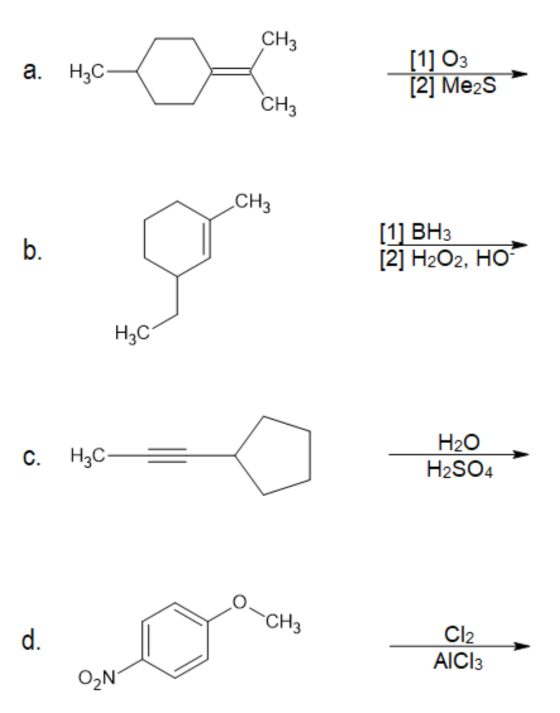
O3 ozone Me2S dimethyl sulfide DMS
BH3 borane H2O2 hydrogen peroxide HO- hydroxide
H2O water H2SO4 sulfuric acid
Cl2 chlorine AlCl3 aluminum chloride
Homework Answers
The 24 consonant sounds comprise six stops (plosives): p, b, t, d, k, g; the fricatives f, v, θ (as in thin), ð [eth] (as in then), s, z, ∫ [esh] (as in ship), Ʒ (as in pleasure), and h; two affricatives: t∫ (as in church) and dƷ (as the j in jam); the nasals m, n, ŋ (the sound that occurs at the end of words such as young); the lateral l; the postalveolar or retroflex r; and the semivowels j (often spelled y) and w. These remain fairly stable, but Inland Northern American differs from RP in two respects: (1) r following vowels is preserved in words such as door, flower, and harmony, whereas it is lost in RP; (2) t between vowels is voiced, so that metal and matter sound very much like British medal and madder, although the pronunciation of this t is softer and less aspirated, or breathy, than the d of British English.
write the structure of the major organic product formed in the reaction of 2-methyl-2-butene (a) hydrogen...
write the structure of the major organic product formed in the reaction of 2-methyl-2-butene (a) hydrogen chloride (b) dilute sulfuric acid (c) diborane in diglyme, followed by basic hydrogen peroxide (d) bromine in carbon tetrachloride (e) bromine in water (f) peroxyacetic acid (g) ozone (h) product of (g) treated with zinc and water (i) product of part (g) treated with dimethyl sulfide (CH3)2S
Write a balanced chemical equation for each of the following reactions: 1. Hydrogen + chlorine hydrogen...
 Write a balanced chemical equation for each of the following reactions: 1. Hydrogen + chlorine hydrogen chloride 2. Hydrogen + nitrogen — ammonia 3. Carbon + steam → carbon monoxide + hydrogen 4. Calcium oxide + water calcium hydroxide 5. Phosphorus + oxygen → diphosphorus pentoxide 6. Aluminum sulfate + calcium hydroxide → aluminum hydroxide + calcium sulfate 7. Aluminum + oxygen aluminum oxide 8. Sodium peroxide + water sodium hydroxide + oxygen 9. Copper + concentrated sulfuric acid →...
For each part below, draw the overall reaction which includes the skeletal structure of the starting...
 For each part below, draw the overall reaction which includes the skeletal structure of the starting material, reagents (over the arrow), and skeletal structure of the product(s). (2.5 pts each) a. Draw the reaction of 1-methylcyclohexene treated with potassium permanganate in aqueous acid. b. Draw the reaction of 3-methylbut-1-yne treated with 1) borane followed by 2) hydrogen peroxide. c. Draw the reaction of chlorobenzene with propanoyl chloride and aluminum trichloride. The product of this reaction is treated with hydrazine and...
Draw the structure of the one major product expected for each of the following reactions. Indicate...
 Draw the structure of the one major product expected for each
of the following reactions. Indicate stereochemistry where
applicable
Chemistry 2310 Ch 8 and 10 Test-Addition Reactions of Alkenes and Intro to Radicals 1.) BH3 Br. k) PhCO3H 1.) O 2.) DMS Ni H3C n) HO 1.) H2SO4 heat 2.) Br2 1.) Br2, light 2.) NaOEt 3.) Ch. H2O o) 1.) Cl2, light 2.) NaOEt 3.) Os followed by DMS p) 1.) BH3 THF followed by H202/HO 2.) TsCl, pyridine...
Draw the structure of the one major product expected for each
of the following reactions. Indicate stereochemistry where
applicable
Chemistry 2310 Ch 8 and 10 Test-Addition Reactions of Alkenes and Intro to Radicals 1.) BH3 Br. k) PhCO3H 1.) O 2.) DMS Ni H3C n) HO 1.) H2SO4 heat 2.) Br2 1.) Br2, light 2.) NaOEt 3.) Ch. H2O o) 1.) Cl2, light 2.) NaOEt 3.) Os followed by DMS p) 1.) BH3 THF followed by H202/HO 2.) TsCl, pyridine...
2. Draw the major product(s) from the reaction of the starting material below with the following...
 2. Draw the major product(s) from the reaction of the starting material below with the following reagents: (12 marks) (a) (b) (1) BH3, THF (2) H2O2, NaOH, H2O Cl in excess EtOH (0) I-CI (d) (1) O3. CH CI: (2) Zn, acetic acid (e) (1) (1) OsO4, THF (2) H2S (1) Hg(OOCCH3)2, H2O (2) NaBH4, NaOH, H2O
only the even numbered problems raw the reaction of 2,3-dimethylhex-2-ene with a. aqueous acid and heat raw the reaction of 1-chloro-2-methylbutane with a. potassium hydroxide b. borane and hydrog...
 only the even numbered problems
raw the reaction of 2,3-dimethylhex-2-ene with a. aqueous acid and heat raw the reaction of 1-chloro-2-methylbutane with a. potassium hydroxide b. borane and hydrogen peroxide b. sodium acetate then KOH 1.28 Draw the reaction of (R)-2-chloro-3-methylbuta a. potassium hydroxide b. sodium acetate then KOH 11.29 Draw the reaction of 4-bromopentan-2-one with lithium aluminum hydride b. a. sodium borohydride Draw the reaction of 5,5-dimethoxyhexanal with 11.30 lithium aluminum hydride b. a. sodium borohydride Draw the reaction...
only the even numbered problems
raw the reaction of 2,3-dimethylhex-2-ene with a. aqueous acid and heat raw the reaction of 1-chloro-2-methylbutane with a. potassium hydroxide b. borane and hydrogen peroxide b. sodium acetate then KOH 1.28 Draw the reaction of (R)-2-chloro-3-methylbuta a. potassium hydroxide b. sodium acetate then KOH 11.29 Draw the reaction of 4-bromopentan-2-one with lithium aluminum hydride b. a. sodium borohydride Draw the reaction of 5,5-dimethoxyhexanal with 11.30 lithium aluminum hydride b. a. sodium borohydride Draw the reaction...
Starting from 3-methylhex-1-ene as the substrate at the center of your page, draw a reaction map showing the regiochemical and stereochemical outcome or outcomes for each of the following series of reagents. Name each of your products, including stereoche
Starting from 3-methylhex-1-ene as the substrate at the center of your page, draw a reaction map showing the regiochemical and stereochemical outcome or outcomes for each of the following series of reagents. Name each of your products, including stereochemical designations for any chirality centers that are generated.**Pay attention to the possibility of rearrangement when your mechanism produces a carbocation. A. H2SO4, H2OB. 1. Hg(OAc)2, H2O; 2. NaBH4C. 1. BH3•THF; 2. H2O2, NaOHD. Br2, CCl4E. Br2, H2OF. HBrG. HBr, ROORH. 1. O3; 2. DMSI. H2, Pt
Write the structure of the major organic product isolated from the reaction of 3-hexyne with (a)...
 Write the structure of the major organic product isolated from the reaction of 3-hexyne with (a) Hydrogen (2 mol), platinum (f) Chlorine (2 mol) (b) Hydrogen (1 mol), Lindlar palladium (g) Aqueous sulfuric acid, mercury(II) sulfate (C) Hydrogen chloride (1 mol) (h) Ozone followed by hydrolysis (d) Hydrogen chloride (2 mol) (e) Chlorine (1 mol)
only D, E And F EM 211-Problem Set-08-A.pdf Download Info XClose ZOOM UNIT#-A 1. Draw the...
 only D, E And F
EM 211-Problem Set-08-A.pdf Download Info XClose ZOOM UNIT#-A 1. Draw the mechanism and predict the products (including all possible stereoisomers) for the reaction of the reactant below (whose name is: H3CH2C н Hас Нас CH3 (a) with hydrogen bromide. Also consider: after forming the product(s) what reagent(s) and conditions need to be used in order to reform the above reactant? (b) with hydrogen bromide with alkyl peroxide. would hydrogen chloride or hydrogen bromide work in...
only D, E And F
EM 211-Problem Set-08-A.pdf Download Info XClose ZOOM UNIT#-A 1. Draw the mechanism and predict the products (including all possible stereoisomers) for the reaction of the reactant below (whose name is: H3CH2C н Hас Нас CH3 (a) with hydrogen bromide. Also consider: after forming the product(s) what reagent(s) and conditions need to be used in order to reform the above reactant? (b) with hydrogen bromide with alkyl peroxide. would hydrogen chloride or hydrogen bromide work in...
help! Section 1: Balance each of the following reactions. Your instructor may discuss the different types...
 help!
Section 1: Balance each of the following reactions. Your instructor may discuss the different types of reactions present in these examples. Reaction Type Al + O2 +Al:03 Synthesis Synthesis N2 + H2 + NH3 MgCO3 → MgO + CO2 KCIO: → KCI + 02 Cu + AgNO3 → Ag + Cu(NO3)2 Cl2 + Nal → NaCl + 1; HCI + NaOH + H:0 + NaCI BiCl3 + H2S → Bi2S3 + HCI Section II: Balance each of the following...
help!
Section 1: Balance each of the following reactions. Your instructor may discuss the different types of reactions present in these examples. Reaction Type Al + O2 +Al:03 Synthesis Synthesis N2 + H2 + NH3 MgCO3 → MgO + CO2 KCIO: → KCI + 02 Cu + AgNO3 → Ag + Cu(NO3)2 Cl2 + Nal → NaCl + 1; HCI + NaOH + H:0 + NaCI BiCl3 + H2S → Bi2S3 + HCI Section II: Balance each of the following...
 Write a balanced chemical equation for each of the following reactions: 1. Hydrogen + chlorine hydrogen chloride 2. Hydrogen + nitrogen — ammonia 3. Carbon + steam → carbon monoxide + hydrogen 4. Calcium oxide + water calcium hydroxide 5. Phosphorus + oxygen → diphosphorus pentoxide 6. Aluminum sulfate + calcium hydroxide → aluminum hydroxide + calcium sulfate 7. Aluminum + oxygen aluminum oxide 8. Sodium peroxide + water sodium hydroxide + oxygen 9. Copper + concentrated sulfuric acid →...
 For each part below, draw the overall reaction which includes the skeletal structure of the starting material, reagents (over the arrow), and skeletal structure of the product(s). (2.5 pts each) a. Draw the reaction of 1-methylcyclohexene treated with potassium permanganate in aqueous acid. b. Draw the reaction of 3-methylbut-1-yne treated with 1) borane followed by 2) hydrogen peroxide. c. Draw the reaction of chlorobenzene with propanoyl chloride and aluminum trichloride. The product of this reaction is treated with hydrazine and...
 Draw the structure of the one major product expected for each
of the following reactions. Indicate stereochemistry where
applicable
Chemistry 2310 Ch 8 and 10 Test-Addition Reactions of Alkenes and Intro to Radicals 1.) BH3 Br. k) PhCO3H 1.) O 2.) DMS Ni H3C n) HO 1.) H2SO4 heat 2.) Br2 1.) Br2, light 2.) NaOEt 3.) Ch. H2O o) 1.) Cl2, light 2.) NaOEt 3.) Os followed by DMS p) 1.) BH3 THF followed by H202/HO 2.) TsCl, pyridine...
Draw the structure of the one major product expected for each
of the following reactions. Indicate stereochemistry where
applicable
Chemistry 2310 Ch 8 and 10 Test-Addition Reactions of Alkenes and Intro to Radicals 1.) BH3 Br. k) PhCO3H 1.) O 2.) DMS Ni H3C n) HO 1.) H2SO4 heat 2.) Br2 1.) Br2, light 2.) NaOEt 3.) Ch. H2O o) 1.) Cl2, light 2.) NaOEt 3.) Os followed by DMS p) 1.) BH3 THF followed by H202/HO 2.) TsCl, pyridine...
 2. Draw the major product(s) from the reaction of the starting material below with the following reagents: (12 marks) (a) (b) (1) BH3, THF (2) H2O2, NaOH, H2O Cl in excess EtOH (0) I-CI (d) (1) O3. CH CI: (2) Zn, acetic acid (e) (1) (1) OsO4, THF (2) H2S (1) Hg(OOCCH3)2, H2O (2) NaBH4, NaOH, H2O
 only the even numbered problems
raw the reaction of 2,3-dimethylhex-2-ene with a. aqueous acid and heat raw the reaction of 1-chloro-2-methylbutane with a. potassium hydroxide b. borane and hydrogen peroxide b. sodium acetate then KOH 1.28 Draw the reaction of (R)-2-chloro-3-methylbuta a. potassium hydroxide b. sodium acetate then KOH 11.29 Draw the reaction of 4-bromopentan-2-one with lithium aluminum hydride b. a. sodium borohydride Draw the reaction of 5,5-dimethoxyhexanal with 11.30 lithium aluminum hydride b. a. sodium borohydride Draw the reaction...
only the even numbered problems
raw the reaction of 2,3-dimethylhex-2-ene with a. aqueous acid and heat raw the reaction of 1-chloro-2-methylbutane with a. potassium hydroxide b. borane and hydrogen peroxide b. sodium acetate then KOH 1.28 Draw the reaction of (R)-2-chloro-3-methylbuta a. potassium hydroxide b. sodium acetate then KOH 11.29 Draw the reaction of 4-bromopentan-2-one with lithium aluminum hydride b. a. sodium borohydride Draw the reaction of 5,5-dimethoxyhexanal with 11.30 lithium aluminum hydride b. a. sodium borohydride Draw the reaction...
 Write the structure of the major organic product isolated from the reaction of 3-hexyne with (a) Hydrogen (2 mol), platinum (f) Chlorine (2 mol) (b) Hydrogen (1 mol), Lindlar palladium (g) Aqueous sulfuric acid, mercury(II) sulfate (C) Hydrogen chloride (1 mol) (h) Ozone followed by hydrolysis (d) Hydrogen chloride (2 mol) (e) Chlorine (1 mol)
 only D, E And F
EM 211-Problem Set-08-A.pdf Download Info XClose ZOOM UNIT#-A 1. Draw the mechanism and predict the products (including all possible stereoisomers) for the reaction of the reactant below (whose name is: H3CH2C н Hас Нас CH3 (a) with hydrogen bromide. Also consider: after forming the product(s) what reagent(s) and conditions need to be used in order to reform the above reactant? (b) with hydrogen bromide with alkyl peroxide. would hydrogen chloride or hydrogen bromide work in...
only D, E And F
EM 211-Problem Set-08-A.pdf Download Info XClose ZOOM UNIT#-A 1. Draw the mechanism and predict the products (including all possible stereoisomers) for the reaction of the reactant below (whose name is: H3CH2C н Hас Нас CH3 (a) with hydrogen bromide. Also consider: after forming the product(s) what reagent(s) and conditions need to be used in order to reform the above reactant? (b) with hydrogen bromide with alkyl peroxide. would hydrogen chloride or hydrogen bromide work in...
 help!
Section 1: Balance each of the following reactions. Your instructor may discuss the different types of reactions present in these examples. Reaction Type Al + O2 +Al:03 Synthesis Synthesis N2 + H2 + NH3 MgCO3 → MgO + CO2 KCIO: → KCI + 02 Cu + AgNO3 → Ag + Cu(NO3)2 Cl2 + Nal → NaCl + 1; HCI + NaOH + H:0 + NaCI BiCl3 + H2S → Bi2S3 + HCI Section II: Balance each of the following...
help!
Section 1: Balance each of the following reactions. Your instructor may discuss the different types of reactions present in these examples. Reaction Type Al + O2 +Al:03 Synthesis Synthesis N2 + H2 + NH3 MgCO3 → MgO + CO2 KCIO: → KCI + 02 Cu + AgNO3 → Ag + Cu(NO3)2 Cl2 + Nal → NaCl + 1; HCI + NaOH + H:0 + NaCI BiCl3 + H2S → Bi2S3 + HCI Section II: Balance each of the following...
Most questions answered within 3 hours.
-
Where is the error in this code sequence?
String s1 = "Hello";
String s2 = "ello";...
asked 11 months ago -
Financial data for Joel de Paris, Inc., for last year
follow:
Joel de Paris, Inc.
Balance...
asked 11 months ago -
Consider this reaction:
Al2(SO4)3 (aq)+ BaCl3
(aq) Al2Cl6 (aq)- +
3BaSO4(s) . What is the...
asked 11 months ago -
Suppose that Savneet is considering increasing her
recent random sample from 20 car rentals to 40...
asked 11 months ago -
Trucks arrive at an unloading terminal at an average rate of 120
per hour.
Trucks arrive...
asked 11 months ago -
Why are methanol and ethanol completely soluble in water while
octanol is not very little soluble....
asked 11 months ago -
A facilities manager at a university reads in a research report
that the mean amount of...
asked 11 months ago -
When the CuSO4 is rehydrated by adding water to the anhydrous
compound, is this an endothermic...
asked 11 months ago -
A ray of sunlight is passing from diamond into crown glass; the
angle of incidence is...
asked 11 months ago -
A block of mass 0.249 kg is placed on top of a light, vertical
spring of...
asked 11 months ago -
how do the kidneys compensate in the presences of acidosis
a) trigger hyperventilate
b) reserve acid...
asked 11 months ago -
Question 501 pts
The rental rate of capital to the firm increases. Which of the
following...
asked 11 months ago