A company faces a stream of obligations over the next 4 years as shown below, where...
A company faces a stream of obligations over the next 4 years as shown below, where the numbers denote thousands of dollars.
| Year | 1 | 2 | 3 | 4 | |||
| CF ('000) | 200 | 0 | 500 | 300 |
The spot rate curve is given below:
| Year | 1 | 2 | 3 | 4 | 5 | 6 | 7 | 8 | 9 | 10 |
| Spot Rate (%) | 6.68 | 7.27 | 7.81 | 8.31 | 8.75 | 9.16 | 9.52 | 9.85 | 10.15 | 10.42 |
The company decides to invest in two bonds (each with face value $1,000) described as follows:
Bond 1 is a 4-year 8% coupon bond, and
Bond 2 is a 3-year zero-coupon bond.
(a) Calculate the prices of the two bonds and the obligation. (Keep 2 decimal places, e.g xx.12)
Bond 1: _____________ Bond 2: ______________ Obligation: __________
(b) Calculate the quasi-modified durations for the two bonds and the obligation. (Keep 2 decimal places, e.g xx.12)
Bond 1: ____________ Bond 2: ______________ Obligation: _____________
(c) Find a portfolio P1x1 + P2x2, where x1 and x2 denote the number of units of bonds 1 and 2, that has the same present value as the obligation stream and is immunized against a parallel shift in the spot rate curve. (Keep 2 decimal places, e.g xx.12)
x1: _____________ x2: __________________
Homework Answers
(a) Bond 1 coupon, C = 8% = 8% x 1,000 = $ 80
Price of bond 1 = C / (1 + s1) + C / (1 + s2)2 + C / (1 + s3)3 + (C + Face value) / (1 + s4)4 = 80 / (1 + 6.68%) + 80 / (1 + 7.27%)2 + 80 / (1 + 7.81)3 + (80 + 1,000) / (1 + 8.31%)4 = $ 1,220.91
Price of bond 2 = Face value / (1 + s3)3 = 1,000 / (1 + 7.81%)3 = $ 798.04
Obligation = PV of the obligations = 200,000 / (1 + s1) + 500,000 / (1 + s3)3 + 300,000 / (1 + s4)4 = 200,000 / (1 + 6.68%) + 500,000 / (1 + 7.81%)3 + 300,000 / (1 + 8.31%)4 = $ 804,490
(b) Yield of bond 1 = RATE (Period, PMT, PV, FV) = RATE(4,80,-1220.91,1000) = 2.17%
Yield of the obligation = calculated using IRR function of excel
I have resorted to excel to calculate the quasi modified duration.
| Bond | Settlement | Maturity | Coupon | Yield | Quasi Modified Duration |
| A | B | C | D | F = MDURATION (A, B, C, D, 1) | |
| Bond 1 | 1/1/2019 | 1/1/2023 | 8.00% | 2.17% | 3.54 |
| Bond 2 | 1/1/2019 | 1/1/2022 | 0.00% | 7.81% | 2.78 |
Modified duration of the obligation:
Please see the table below. The figure of -804,490 is the PV of obligation calculated in part (a). Adjacent cells in blue contain the formula in excel I have used to get the final output.
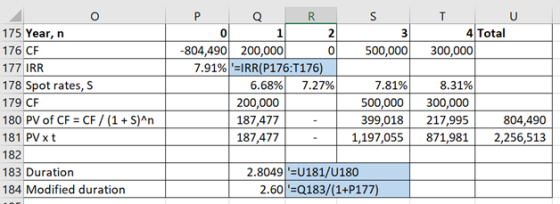
Part (c)
PV of obligation = 804,490 = PV of bonds = P1x1 + P2x2 = 1,220.91x1 + 798.04x2 --------------- equation (1)
PV of obligation x Modified duration of obligation = 804,490 x 2.60 = P1x1D1 + P2x2D2 = 1,220.91x1 x 3.54 + 798.04x2 x 2.78
Hence, 2,091,101.45 = 4,326.44x1 + 2,220.68x2 --------- equation (2)
Perform: 2.78 x equation (1) - equation (2) gives:
2.78 x 804,490 - 2,091,101.45 = (2.78 x 1,220.91 - 4,326.44)x1 + (2.78 x 798.04 - 2,220.68)x2
Hence, 147,531.79 = -929.038x1
hence, x1 = - 158.80
and x2 = [804,490 - 1,220.91 x (-18.80)] / 798.04 =
1,251.03
Add Answer to:
A company faces a stream of obligations over the next 4 years as
shown below, where...
Sunland Company is issuing eight-year bonds with a coupon rate of 6.5 percent and semiannual coupon...
Sunland Company is issuing eight-year bonds with a coupon rate of 6.5 percent and semiannual coupon payments. If the current market rate for similar bonds is 12 percent. What will the bond price be? (Round intermediate calculations to 5 decimal places, e.g. 1.25145 and bond price to 2 decimal places, e.g. 15.25.) Bond Price ? If company management wants to raise $1.25 million, how many bonds does the firm have to sell? (Round intermediate calculations to 5 decimal places, e.g....
1 2 3 Four years ago, Mary Stills bought six-year, 5.0 percent coupon bonds issued by...
 1
2
3
Four years ago, Mary Stills bought six-year, 5.0 percent coupon bonds issued by the Blossom Corp. for $947.64. If she sells these bonds at the current price of $890.50, what will be her realized yield on the bonds? Assume similar coupon- paying bonds make annual coupon payments. (Round intermediate calculations to 5 decimal places, e.g. 1.25145 and final answer to 2 decimal places, e.g. 15.25%) Realised rate of return Sandhill, Inc., has four-year bonds outstanding that pay...
1
2
3
Four years ago, Mary Stills bought six-year, 5.0 percent coupon bonds issued by the Blossom Corp. for $947.64. If she sells these bonds at the current price of $890.50, what will be her realized yield on the bonds? Assume similar coupon- paying bonds make annual coupon payments. (Round intermediate calculations to 5 decimal places, e.g. 1.25145 and final answer to 2 decimal places, e.g. 15.25%) Realised rate of return Sandhill, Inc., has four-year bonds outstanding that pay...
An insurance company must make payments to a customer of $14 million in one year and...
 An insurance company must make payments to a customer of $14 million in one year and $8 million in six years. The yield curve is flat at 12%. a. If it wants to fully fund and immunize its obligation to this customer with a single issue of a zero-coupon bond, what maturity bond must it purchase? (Do not round intermediate calculations. Round your answer to 4 decimal places.) Maturity of zero coupon bond years b. What must be the face...
An insurance company must make payments to a customer of $12 million in one year and...
 An insurance company must make payments to a customer of $12 million in one year and $6 million in three years. The yield curve is flat at 8%. a. If it wants to fully fund and immunize its obligation to this customer with a single issue of a zero-coupon bond, what maturity bond must it purchase? (Do not round intermediate calculations. Round your answer to 4 decimal places.) Maturity of zero coupon bond years b. What must be the face...
15.7 Prices of zero-coupon bonds reveal the following pattern of forward rates: Forward Rate For years...
15.7 Prices of zero-coupon bonds reveal the following pattern of forward rates: Forward Rate For years 1-3, respectively. 5,6, and 7%. In addition to the zero-coupon bond, investors also may purchase a 3-year bond making annual payments of $50 with par value $1,000. a. What is the price of the coupon bond? (Do not round intermediate calculations. Round your answer to 2 decimal places.) b. What is the yield to maturity of the coupon bond? (Do not round intermediate calculations. Round...
Below is a list of prices for zero-coupon bonds of various maturities. Price of $1,000 Par...
 Below is a list of prices for zero-coupon bonds of various maturities. Price of $1,000 Par Maturity (Years) Bond (Zero-Coupon) $966.78 894.28 803.54 WN a. A 6.4% coupon $1,000 par bond pays an annual coupon and will mature in 3 years. What should the yield to maturity on the bond be? (Round your answer to 2 decimal places.) Yield to maturity % b. If at the end of the first year the yield curve flattens out at 8.1%, what will...
B. A Japanese company has a bond outstanding that sells for 91 percent of its ¥100,000...
B. A Japanese company has a bond outstanding that sells for 91 percent of its ¥100,000 par value. The bond has a coupon rate of 5 percent paid annually and matures in 12 years. What is the yield to maturity of this bond (Do not round intermediate calculations and enter your answer as a percent rounded to 2 decimal places, e.g., 32.16.) C. Say you own an asset that had a total return last year of 11.6 percent. If the...
The current yield curve for default-free zero-coupon bonds is as follows: Maturity (years) YTM 1 9.5...
The current yield curve for default-free zero-coupon bonds is as follows: Maturity (years) YTM 1 9.5 % 2 10.5 3 11.5 a. What are the implied one-year forward rates? (Do not round intermediate calculations. Round your answers to 2 decimal places.) Maturity (years) YTM Forward Rate 1 9.5 % 2 10.5 % % 3 11.5 % % b. Assume that the pure expectations hypothesis of the term structure is correct. If market expectations are accurate, what will the pure yield...
An insurance company is analyzing the following three bonds, each with five years to maturity, annual...
 An insurance company is analyzing the following three bonds, each with five years to maturity, annual coupon payments, and duration as the measure of interest rate risk. What is the duration of each of the three bonds? (Do not round intermediate calculations. Round your answers to 2 decimal places. (e.g., 32.16)) Duration of the bond a. $10,000 par value, coupon rate-8%, 6-0.10 b. $10,000 par value, coupon rate-10%, rb-0.10 c, $10,000 par value, coupon rate-12%, rb-0.10 years
The current yield curve for default-free zero-coupon bonds is as follows: Maturity (years) YTM 10.1% 11.1 12.1 a. What are the implied one-year forward rates? (Do not round intermediate calculations....
 The current yield curve for default-free zero-coupon bonds is as follows: Maturity (years) YTM 10.1% 11.1 12.1 a. What are the implied one-year forward rates? (Do not round intermediate calculations. Round your answers to 2 decimal places.) Maturity (yers) YTM 10.1% Forward Rate 12.1% b. Assume that the pure expectations hypothesis of the term structure is correct. If market expectations are accurate, what will the pure yield curve (that is, the yields to maturity on one- and two-year zero-coupon bonds)...
 1
2
3
Four years ago, Mary Stills bought six-year, 5.0 percent coupon bonds issued by the Blossom Corp. for $947.64. If she sells these bonds at the current price of $890.50, what will be her realized yield on the bonds? Assume similar coupon- paying bonds make annual coupon payments. (Round intermediate calculations to 5 decimal places, e.g. 1.25145 and final answer to 2 decimal places, e.g. 15.25%) Realised rate of return Sandhill, Inc., has four-year bonds outstanding that pay...
1
2
3
Four years ago, Mary Stills bought six-year, 5.0 percent coupon bonds issued by the Blossom Corp. for $947.64. If she sells these bonds at the current price of $890.50, what will be her realized yield on the bonds? Assume similar coupon- paying bonds make annual coupon payments. (Round intermediate calculations to 5 decimal places, e.g. 1.25145 and final answer to 2 decimal places, e.g. 15.25%) Realised rate of return Sandhill, Inc., has four-year bonds outstanding that pay...
 An insurance company must make payments to a customer of $14 million in one year and $8 million in six years. The yield curve is flat at 12%. a. If it wants to fully fund and immunize its obligation to this customer with a single issue of a zero-coupon bond, what maturity bond must it purchase? (Do not round intermediate calculations. Round your answer to 4 decimal places.) Maturity of zero coupon bond years b. What must be the face...
 An insurance company must make payments to a customer of $12 million in one year and $6 million in three years. The yield curve is flat at 8%. a. If it wants to fully fund and immunize its obligation to this customer with a single issue of a zero-coupon bond, what maturity bond must it purchase? (Do not round intermediate calculations. Round your answer to 4 decimal places.) Maturity of zero coupon bond years b. What must be the face...
 Below is a list of prices for zero-coupon bonds of various maturities. Price of $1,000 Par Maturity (Years) Bond (Zero-Coupon) $966.78 894.28 803.54 WN a. A 6.4% coupon $1,000 par bond pays an annual coupon and will mature in 3 years. What should the yield to maturity on the bond be? (Round your answer to 2 decimal places.) Yield to maturity % b. If at the end of the first year the yield curve flattens out at 8.1%, what will...
 An insurance company is analyzing the following three bonds, each with five years to maturity, annual coupon payments, and duration as the measure of interest rate risk. What is the duration of each of the three bonds? (Do not round intermediate calculations. Round your answers to 2 decimal places. (e.g., 32.16)) Duration of the bond a. $10,000 par value, coupon rate-8%, 6-0.10 b. $10,000 par value, coupon rate-10%, rb-0.10 c, $10,000 par value, coupon rate-12%, rb-0.10 years
 The current yield curve for default-free zero-coupon bonds is as follows: Maturity (years) YTM 10.1% 11.1 12.1 a. What are the implied one-year forward rates? (Do not round intermediate calculations. Round your answers to 2 decimal places.) Maturity (yers) YTM 10.1% Forward Rate 12.1% b. Assume that the pure expectations hypothesis of the term structure is correct. If market expectations are accurate, what will the pure yield curve (that is, the yields to maturity on one- and two-year zero-coupon bonds)...
Most questions answered within 3 hours.
-
Where is the error in this code sequence?
String s1 = "Hello";
String s2 = "ello";...
asked 11 months ago -
Financial data for Joel de Paris, Inc., for last year
follow:
Joel de Paris, Inc.
Balance...
asked 11 months ago -
Consider this reaction:
Al2(SO4)3 (aq)+ BaCl3
(aq) Al2Cl6 (aq)- +
3BaSO4(s) . What is the...
asked 11 months ago -
Suppose that Savneet is considering increasing her
recent random sample from 20 car rentals to 40...
asked 11 months ago -
Trucks arrive at an unloading terminal at an average rate of 120
per hour.
Trucks arrive...
asked 11 months ago -
Why are methanol and ethanol completely soluble in water while
octanol is not very little soluble....
asked 11 months ago -
A facilities manager at a university reads in a research report
that the mean amount of...
asked 11 months ago -
When the CuSO4 is rehydrated by adding water to the anhydrous
compound, is this an endothermic...
asked 11 months ago -
A ray of sunlight is passing from diamond into crown glass; the
angle of incidence is...
asked 11 months ago -
A block of mass 0.249 kg is placed on top of a light, vertical
spring of...
asked 11 months ago -
how do the kidneys compensate in the presences of acidosis
a) trigger hyperventilate
b) reserve acid...
asked 11 months ago -
Question 501 pts
The rental rate of capital to the firm increases. Which of the
following...
asked 11 months ago