b) Consider the I(1) process DeltaYt : m + et, where et ~ WN(0, sigma^2). Take...
b) Consider the I(1) process DeltaYt : m + et, where
et ~ WN(0, sigma^2).
Take now the first difference of DeltaYt. What, kind of process do
you obtain? Is it stationary? Is it invertible? Discuss.
Homework Answers

Add Answer to:
b) Consider the I(1) process DeltaYt : m + et, where
et ~ WN(0, sigma^2).
Take...
Consider y, = у,-1-0.25%-2 + et-1.54-1 + 0.54-2, et ~ WN(0, σ2). a) Determine the order of this A...
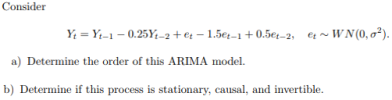 Consider y, = у,-1-0.25%-2 + et-1.54-1 + 0.54-2, et ~ WN(0, σ2). a) Determine the order of this ARIMA model b) Determine if this process is stationary, causal, and invertible.
Consider y, = у,-1-0.25%-2 + et-1.54-1 + 0.54-2, et ~ WN(0, σ2). a) Determine the order of this ARIMA model b) Determine if this process is stationary, causal, and invertible.
Consider y, = у,-1-0.25%-2 + et-1.54-1 + 0.54-2, et ~ WN(0, σ2). a) Determine the order of this ARIMA model b) Determine if this process is stationary, causal, and invertible.
Consider the process where B is a backwards shift operator so that BXt-Xt-i and the {Zt) are assu...
 Consider the process where B is a backwards shift operator so that BXt-Xt-i and the {Zt) are assumed to be independent random errors. (a) [2 marks] Identify what kind of nonseasonal ARIMA(p,d,q) process this is; that is give the parameters (p,d,q) and give the abbreviated name for this particular process. (b) [3 marks] (i) Is this particular process stationary? Explain. (ii) Is this process invertible? Why?
Consider the process where B is a backwards shift operator so that BXt-Xt-i and...
Consider the process where B is a backwards shift operator so that BXt-Xt-i and the {Zt) are assumed to be independent random errors. (a) [2 marks] Identify what kind of nonseasonal ARIMA(p,d,q) process this is; that is give the parameters (p,d,q) and give the abbreviated name for this particular process. (b) [3 marks] (i) Is this particular process stationary? Explain. (ii) Is this process invertible? Why?
Consider the process where B is a backwards shift operator so that BXt-Xt-i and...
2. Consider an ARMA(1,1) process, X4 = 0.5X:-1 +0+ - 0.25a4-1, where az is white noise...
 2. Consider an ARMA(1,1) process, X4 = 0.5X:-1 +0+ - 0.25a4-1, where az is white noise with zero mean and unit variance. (a) Is the model stationary? Explain your answer briefly. (b) Is the model invertible? Explain your answer briefly. (c) Find the infinite moving-average representation of Xt. Namely, find b; such that X =< 0;&–; j=0 (d) Evaluate the first three lags of the ACF and PACF.
2. Consider a following time series process Yt = 1.5Yt−1 −0.5Yt−2 +εt a) Rewrite this process...
2. Consider a following time series process Yt = 1.5Yt−1 −0.5Yt−2 +εt a) Rewrite this process in lag polynomial form. b) Is this process invertible? Is this process covariance stationary? c) Difference this process once and show that ΔYt = Yt −Yt−1 is covariance stationary.
Consider the process Y.-μ + et-o, et-1-912 et-12, where {ed denotes a white-noise process with mean...
 Consider the process Y.-μ + et-o, et-1-912 et-12, where {ed denotes a white-noise process with mean 0 and variance σ? > 0. Assume that et ls independent of Yt-1, Yt-2, Find the autocorrelation function for (Yt).
b) In what follows, we assume cc return r_t is a covariance stationary process. Prove the...
b) In what follows, we assume cc return r_t is a covariance stationary process. Prove the following statements: i. If r_t iid(0; sigma^2) (or independent white noise); then r_t mds(0; sigma^2). ii. If r_t mds(0; sigma^2); then r_t WN(0; sigma^2) (or weak white noise).
please solve this problems Consider the following autoregressive processes: W 2W-1X Wo 0 Zn = 3/4 Zq-1 + Xn Zo = 0. (a)...
 please solve this problems
Consider the following autoregressive processes: W 2W-1X Wo 0 Zn = 3/4 Zq-1 + Xn Zo = 0. (a) Suppose that Xn is a Bernoulli process. What trends do the processes exhibit? (b) Express Wn and Zn in terms of Xn, Xn-1, ..., X1 and then find E[Wn] and E[Zn]. Do these results agree with the trends you expect? (c) Do Wn or Zn have independent increments? stationary increments? (d) Generate 100 outcomes of a Bernoulli...
please solve this problems
Consider the following autoregressive processes: W 2W-1X Wo 0 Zn = 3/4 Zq-1 + Xn Zo = 0. (a) Suppose that Xn is a Bernoulli process. What trends do the processes exhibit? (b) Express Wn and Zn in terms of Xn, Xn-1, ..., X1 and then find E[Wn] and E[Zn]. Do these results agree with the trends you expect? (c) Do Wn or Zn have independent increments? stationary increments? (d) Generate 100 outcomes of a Bernoulli...
Suppose that (Wn: n 2 0) is an autoregressive sequence of order 1, so that for n 2 0, where the Z...
 Suppose that (Wn: n 2 0) is an autoregressive sequence of order 1, so that for n 2 0, where the Z's are i.i.d. and independent of Wo. a) Express Wn as a function of Wo, Z1, , Zn Suppose that |ρ| 〈 1 and var(WD+var(ZI) 〈 OO b) Compute cov(Wm, Wn) for m, n 2 0 c) Prove that there exists a deterministic constant a for which as n -oo and compute a. (Hint: Compute var(Wn)) Suppose, in addition,...
6. (13 marks) where {U, } ~ WN(0,00) is Consider two independent AR(1) series< independent of {K} ~ WN(0,OF). Does their sum Z,-X,-X necessarily follow an AR(1) series? Prove or disprove. (Hint: C...
 6. (13 marks) where {U, } ~ WN(0,00) is Consider two independent AR(1) series< independent of {K} ~ WN(0,OF). Does their sum Z,-X,-X necessarily follow an AR(1) series? Prove or disprove. (Hint: Compare the causal representation of the sum to that of an AR(1) process)
6. (13 marks) where {U, } ~ WN(0,00) is Consider two independent AR(1) series
6. (13 marks) where {U, } ~ WN(0,00) is Consider two independent AR(1) series< independent of {K} ~ WN(0,OF). Does their sum Z,-X,-X necessarily follow an AR(1) series? Prove or disprove. (Hint: Compare the causal representation of the sum to that of an AR(1) process)
6. (13 marks) where {U, } ~ WN(0,00) is Consider two independent AR(1) series
QUESTION 3 (a) Consider the ARMA (1, 1) process -Bat-1-where o and θ are model parame-...
 QUESTION 3 (a) Consider the ARMA (1, 1) process -Bat-1-where o and θ are model parame- are independent and identically distributed random variables with mean 0 z, oz,-1 ters, and a1, a2, and variance σ (i) Show that the variance of the process is γ,- (ii) Using (i) or otherwise, show that the autocorrelation function (ACF) of the process is: ifk=0. (b) Let Y be an AR(2) process of the special form Y-2Y-2e (i) Find the range of values of...
 Consider y, = у,-1-0.25%-2 + et-1.54-1 + 0.54-2, et ~ WN(0, σ2). a) Determine the order of this ARIMA model b) Determine if this process is stationary, causal, and invertible.
Consider y, = у,-1-0.25%-2 + et-1.54-1 + 0.54-2, et ~ WN(0, σ2). a) Determine the order of this ARIMA model b) Determine if this process is stationary, causal, and invertible.
Consider y, = у,-1-0.25%-2 + et-1.54-1 + 0.54-2, et ~ WN(0, σ2). a) Determine the order of this ARIMA model b) Determine if this process is stationary, causal, and invertible.
 Consider the process where B is a backwards shift operator so that BXt-Xt-i and the {Zt) are assumed to be independent random errors. (a) [2 marks] Identify what kind of nonseasonal ARIMA(p,d,q) process this is; that is give the parameters (p,d,q) and give the abbreviated name for this particular process. (b) [3 marks] (i) Is this particular process stationary? Explain. (ii) Is this process invertible? Why?
Consider the process where B is a backwards shift operator so that BXt-Xt-i and...
Consider the process where B is a backwards shift operator so that BXt-Xt-i and the {Zt) are assumed to be independent random errors. (a) [2 marks] Identify what kind of nonseasonal ARIMA(p,d,q) process this is; that is give the parameters (p,d,q) and give the abbreviated name for this particular process. (b) [3 marks] (i) Is this particular process stationary? Explain. (ii) Is this process invertible? Why?
Consider the process where B is a backwards shift operator so that BXt-Xt-i and...
 2. Consider an ARMA(1,1) process, X4 = 0.5X:-1 +0+ - 0.25a4-1, where az is white noise with zero mean and unit variance. (a) Is the model stationary? Explain your answer briefly. (b) Is the model invertible? Explain your answer briefly. (c) Find the infinite moving-average representation of Xt. Namely, find b; such that X =< 0;&–; j=0 (d) Evaluate the first three lags of the ACF and PACF.
 Consider the process Y.-μ + et-o, et-1-912 et-12, where {ed denotes a white-noise process with mean 0 and variance σ? > 0. Assume that et ls independent of Yt-1, Yt-2, Find the autocorrelation function for (Yt).
 please solve this problems
Consider the following autoregressive processes: W 2W-1X Wo 0 Zn = 3/4 Zq-1 + Xn Zo = 0. (a) Suppose that Xn is a Bernoulli process. What trends do the processes exhibit? (b) Express Wn and Zn in terms of Xn, Xn-1, ..., X1 and then find E[Wn] and E[Zn]. Do these results agree with the trends you expect? (c) Do Wn or Zn have independent increments? stationary increments? (d) Generate 100 outcomes of a Bernoulli...
please solve this problems
Consider the following autoregressive processes: W 2W-1X Wo 0 Zn = 3/4 Zq-1 + Xn Zo = 0. (a) Suppose that Xn is a Bernoulli process. What trends do the processes exhibit? (b) Express Wn and Zn in terms of Xn, Xn-1, ..., X1 and then find E[Wn] and E[Zn]. Do these results agree with the trends you expect? (c) Do Wn or Zn have independent increments? stationary increments? (d) Generate 100 outcomes of a Bernoulli...
 Suppose that (Wn: n 2 0) is an autoregressive sequence of order 1, so that for n 2 0, where the Z's are i.i.d. and independent of Wo. a) Express Wn as a function of Wo, Z1, , Zn Suppose that |ρ| 〈 1 and var(WD+var(ZI) 〈 OO b) Compute cov(Wm, Wn) for m, n 2 0 c) Prove that there exists a deterministic constant a for which as n -oo and compute a. (Hint: Compute var(Wn)) Suppose, in addition,...
 6. (13 marks) where {U, } ~ WN(0,00) is Consider two independent AR(1) series< independent of {K} ~ WN(0,OF). Does their sum Z,-X,-X necessarily follow an AR(1) series? Prove or disprove. (Hint: Compare the causal representation of the sum to that of an AR(1) process)
6. (13 marks) where {U, } ~ WN(0,00) is Consider two independent AR(1) series
6. (13 marks) where {U, } ~ WN(0,00) is Consider two independent AR(1) series< independent of {K} ~ WN(0,OF). Does their sum Z,-X,-X necessarily follow an AR(1) series? Prove or disprove. (Hint: Compare the causal representation of the sum to that of an AR(1) process)
6. (13 marks) where {U, } ~ WN(0,00) is Consider two independent AR(1) series
 QUESTION 3 (a) Consider the ARMA (1, 1) process -Bat-1-where o and θ are model parame- are independent and identically distributed random variables with mean 0 z, oz,-1 ters, and a1, a2, and variance σ (i) Show that the variance of the process is γ,- (ii) Using (i) or otherwise, show that the autocorrelation function (ACF) of the process is: ifk=0. (b) Let Y be an AR(2) process of the special form Y-2Y-2e (i) Find the range of values of...
Most questions answered within 3 hours.
-
Where is the error in this code sequence?
String s1 = "Hello";
String s2 = "ello";...
asked 10 months ago -
Financial data for Joel de Paris, Inc., for last year
follow:
Joel de Paris, Inc.
Balance...
asked 10 months ago -
Consider this reaction:
Al2(SO4)3 (aq)+ BaCl3
(aq) Al2Cl6 (aq)- +
3BaSO4(s) . What is the...
asked 10 months ago -
Suppose that Savneet is considering increasing her
recent random sample from 20 car rentals to 40...
asked 10 months ago -
Trucks arrive at an unloading terminal at an average rate of 120
per hour.
Trucks arrive...
asked 10 months ago -
Why are methanol and ethanol completely soluble in water while
octanol is not very little soluble....
asked 10 months ago -
A facilities manager at a university reads in a research report
that the mean amount of...
asked 10 months ago -
When the CuSO4 is rehydrated by adding water to the anhydrous
compound, is this an endothermic...
asked 10 months ago -
A ray of sunlight is passing from diamond into crown glass; the
angle of incidence is...
asked 10 months ago -
A block of mass 0.249 kg is placed on top of a light, vertical
spring of...
asked 10 months ago -
how do the kidneys compensate in the presences of acidosis
a) trigger hyperventilate
b) reserve acid...
asked 10 months ago -
Question 501 pts
The rental rate of capital to the firm increases. Which of the
following...
asked 10 months ago