Nuclear fusion occurs typically in a. the upper atmosphere. b. uranium mines. c. the sun. d....
Nuclear fusion occurs typically in
a. the upper atmosphere.
b. uranium mines.
c. the sun.
d. all of the above.
Homework Answers
we receive energy from sun and this happens because of common process taking place inside the sun i.e nuclear fusion.
Sun produces energy by nuclear fusion of hydrogen nuclei into Helium.
so option C is correct.
Add Answer to:
Nuclear fusion occurs typically in
a. the upper atmosphere.
b. uranium mines.
c. the sun.
d....
Estimate the lifetime of sun whether your source was: a) Potential gravitational b)Energy of nuclear fusion...
Estimate the lifetime of sun whether your source was: a) Potential gravitational b)Energy of nuclear fusion of hidrogen and helium on PP cicle c)Calculate the minimal mass of a star with lifetime equal to universe's age, or 13.7 billions of years
Nuclear fusion in the stars occurs by a series of reactions. Identify X, Y, and Z...
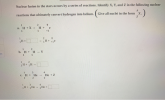 Nuclear fusion in the stars occurs by a series of reactions. Identify X, Y, and Z in the following nuclear reactions that ultimately convert hydrogen into helium. Give all nuclei in the form X. 12 b. H + H - Y
The source of the sun's energy is: A. nuclear fusion B. nuclear fission C. crude oil
The source of the sun's energy is: A. nuclear fusion B. nuclear fission C. crude oil
Activity 27-5. Nuclear fusion [Accompanies Section 27-5] In one fusion reaction that occurs in the cores...
 Activity 27-5. Nuclear fusion [Accompanies Section 27-5] In one fusion reaction that occurs in the cores of certain stars, a nucleus of helium-4 (-He, with two protons and two neutrons) fuses with a nucleus of neon-20 (2°Ne, with 10 protons and 10 neutron) to form a nucleus of magnesium-24 (24Mg, with 12 protons and 12 neutrons). A gamma-ray photon (y) is also produced: He + 20Ne + 24 Mg + y (a) Rank the following nuclei in order of their...
(65 pts) Nuclear Fusiorn (a) What is nuclear fusion ? (b) Give an example (different than...
 (65 pts) Nuclear Fusiorn (a) What is nuclear fusion ? (b) Give an example (different than those in this problem below) of a nuclear fusion reaction (c) When a tritium nucleon and a deuterium nucleon under a fusion reaction they produce a helium aucleus and a neutron. If the masses of the species are the following tritium: 3.01605 amu deuterium: 20140 amu helium: 4.00260 amu neutron: 1.0089665 amu How much energy (in kJ) will be produced per mole of reaction...
In its core the Sun changed, hydrogen into helium and produces energy by this nuclear fusion...
 In its core the Sun changed, hydrogen into helium and produces energy by this nuclear fusion process. Each hydrogen atom has a positively charged center (a proton) and a negatively charged electron that exists around the periphery of the atom. The heat of the Sun pulls the electrons off the hydrogen atoms, leaving positively charged protons behind. To make energy the sun has to force these positively charged particles very close together so that a very strong but short range...
Problem 5. [Einstein's E = mc²] Sun is producing energy by nuclear fusion reactions converting four...
 Problem 5. [Einstein's E = mc²] Sun is producing energy by nuclear fusion reactions converting four hydrogen nuclei to form one nucleus of He, i.e. 4H + He. However, mass of helium nucleus is smaller than that of four hydrogens and this difference is called mass defect. If mass of the hydrogen nucleus is my and mass of the helium nucleus Mhe mass defect of one nuclear reaction Am is equal to Am = 4 *my - Me (1) Using...
Nuclear fusion reactions at the center of the sun produce gamma-ray photons with energies of order...
Nuclear fusion reactions at the center of the sun produce gamma-ray photons with energies of order 1 MeV (106 eV). By contrast, what we see emanating from the sun's surface are visible-light photons with wavelengths of order 500 nm. A simple model that explains this difference in wavelength is that a photon undergoes Compton scattering many times - in fact, about 1026 times, as suggested by models of the solar interior - as it travels from the center of the...
Il Review | Constants Periodic Table Unlike chemical reactions, for which mass is conserved, nuclear reactions...
 Il Review | Constants Periodic Table Unlike chemical reactions, for which mass is conserved, nuclear reactions result in slight changes in mass. When mass is lost, it becomes energy according to the equation Natural gas (mainly CH4) is used in many power plants to generate electrical power utilizing combustion reactions. Uranium-235 is used to generate power utilizing nuclear fission. Fusion reactions involving hydrogen-1 are under investigation as a future source of electrical power. AE=Amục where AE is the energy in...
SHOW LAB WORK QUESTION 9 OF 15.> In the enrichment of uranium for nuclear reactors, a...
 SHOW LAB WORK QUESTION 9 OF 15.> In the enrichment of uranium for nuclear reactors, a gas called uranium hexafluoride (UF6) is generated and then placed in large gas centrifuges to separate different isotopes of uranium. Suppose you were to perform the same experiment with uranium hexafluoride.Given that uranium hexafluoride is much heavier than either of the gasses used in this experiment, how would you expect the value of absolute zero measured from the experiment to compare to the one...
 Nuclear fusion in the stars occurs by a series of reactions. Identify X, Y, and Z in the following nuclear reactions that ultimately convert hydrogen into helium. Give all nuclei in the form X. 12 b. H + H - Y
 Activity 27-5. Nuclear fusion [Accompanies Section 27-5] In one fusion reaction that occurs in the cores of certain stars, a nucleus of helium-4 (-He, with two protons and two neutrons) fuses with a nucleus of neon-20 (2°Ne, with 10 protons and 10 neutron) to form a nucleus of magnesium-24 (24Mg, with 12 protons and 12 neutrons). A gamma-ray photon (y) is also produced: He + 20Ne + 24 Mg + y (a) Rank the following nuclei in order of their...
 (65 pts) Nuclear Fusiorn (a) What is nuclear fusion ? (b) Give an example (different than those in this problem below) of a nuclear fusion reaction (c) When a tritium nucleon and a deuterium nucleon under a fusion reaction they produce a helium aucleus and a neutron. If the masses of the species are the following tritium: 3.01605 amu deuterium: 20140 amu helium: 4.00260 amu neutron: 1.0089665 amu How much energy (in kJ) will be produced per mole of reaction...
 In its core the Sun changed, hydrogen into helium and produces energy by this nuclear fusion process. Each hydrogen atom has a positively charged center (a proton) and a negatively charged electron that exists around the periphery of the atom. The heat of the Sun pulls the electrons off the hydrogen atoms, leaving positively charged protons behind. To make energy the sun has to force these positively charged particles very close together so that a very strong but short range...
 Problem 5. [Einstein's E = mc²] Sun is producing energy by nuclear fusion reactions converting four hydrogen nuclei to form one nucleus of He, i.e. 4H + He. However, mass of helium nucleus is smaller than that of four hydrogens and this difference is called mass defect. If mass of the hydrogen nucleus is my and mass of the helium nucleus Mhe mass defect of one nuclear reaction Am is equal to Am = 4 *my - Me (1) Using...
 Il Review | Constants Periodic Table Unlike chemical reactions, for which mass is conserved, nuclear reactions result in slight changes in mass. When mass is lost, it becomes energy according to the equation Natural gas (mainly CH4) is used in many power plants to generate electrical power utilizing combustion reactions. Uranium-235 is used to generate power utilizing nuclear fission. Fusion reactions involving hydrogen-1 are under investigation as a future source of electrical power. AE=Amục where AE is the energy in...
 SHOW LAB WORK QUESTION 9 OF 15.> In the enrichment of uranium for nuclear reactors, a gas called uranium hexafluoride (UF6) is generated and then placed in large gas centrifuges to separate different isotopes of uranium. Suppose you were to perform the same experiment with uranium hexafluoride.Given that uranium hexafluoride is much heavier than either of the gasses used in this experiment, how would you expect the value of absolute zero measured from the experiment to compare to the one...
Most questions answered within 3 hours.
-
Where is the error in this code sequence?
String s1 = "Hello";
String s2 = "ello";...
asked 10 months ago -
Financial data for Joel de Paris, Inc., for last year
follow:
Joel de Paris, Inc.
Balance...
asked 10 months ago -
Consider this reaction:
Al2(SO4)3 (aq)+ BaCl3
(aq) Al2Cl6 (aq)- +
3BaSO4(s) . What is the...
asked 10 months ago -
Suppose that Savneet is considering increasing her
recent random sample from 20 car rentals to 40...
asked 10 months ago -
Trucks arrive at an unloading terminal at an average rate of 120
per hour.
Trucks arrive...
asked 10 months ago -
Why are methanol and ethanol completely soluble in water while
octanol is not very little soluble....
asked 10 months ago -
A facilities manager at a university reads in a research report
that the mean amount of...
asked 10 months ago -
When the CuSO4 is rehydrated by adding water to the anhydrous
compound, is this an endothermic...
asked 10 months ago -
A ray of sunlight is passing from diamond into crown glass; the
angle of incidence is...
asked 10 months ago -
A block of mass 0.249 kg is placed on top of a light, vertical
spring of...
asked 10 months ago -
how do the kidneys compensate in the presences of acidosis
a) trigger hyperventilate
b) reserve acid...
asked 10 months ago -
Question 501 pts
The rental rate of capital to the firm increases. Which of the
following...
asked 10 months ago